
Chest Pain
Chest pain with pressure, squeezing, or tightness that spreads to the arm, jaw, neck, or back, especially with shortness of breath, sweating, or nausea, needs to be evaluated now, not waited out. Bellaire ER is open 24/7 at 5302 Bellaire Blvd with on-site EKG, troponin labs, CT and X-ray. These can signal a heart attack. If you have unexplained chest pain and are unsure of the cause, go to an emergency room. Bellaire ER is open 24/7 with on-site EKG, troponin blood testing, and imaging to quickly determine whether your chest pain is cardiac.
- Open now, 24/7/365
- Walk in, no appointment
- 5302 Bellaire Blvd, free parking
Unsure if Your Symptoms Require Emergency Care?
Call our clinical triage desk at (713) 660-0001. An on-duty board-certified emergency physician will evaluate your symptoms before you leave home.
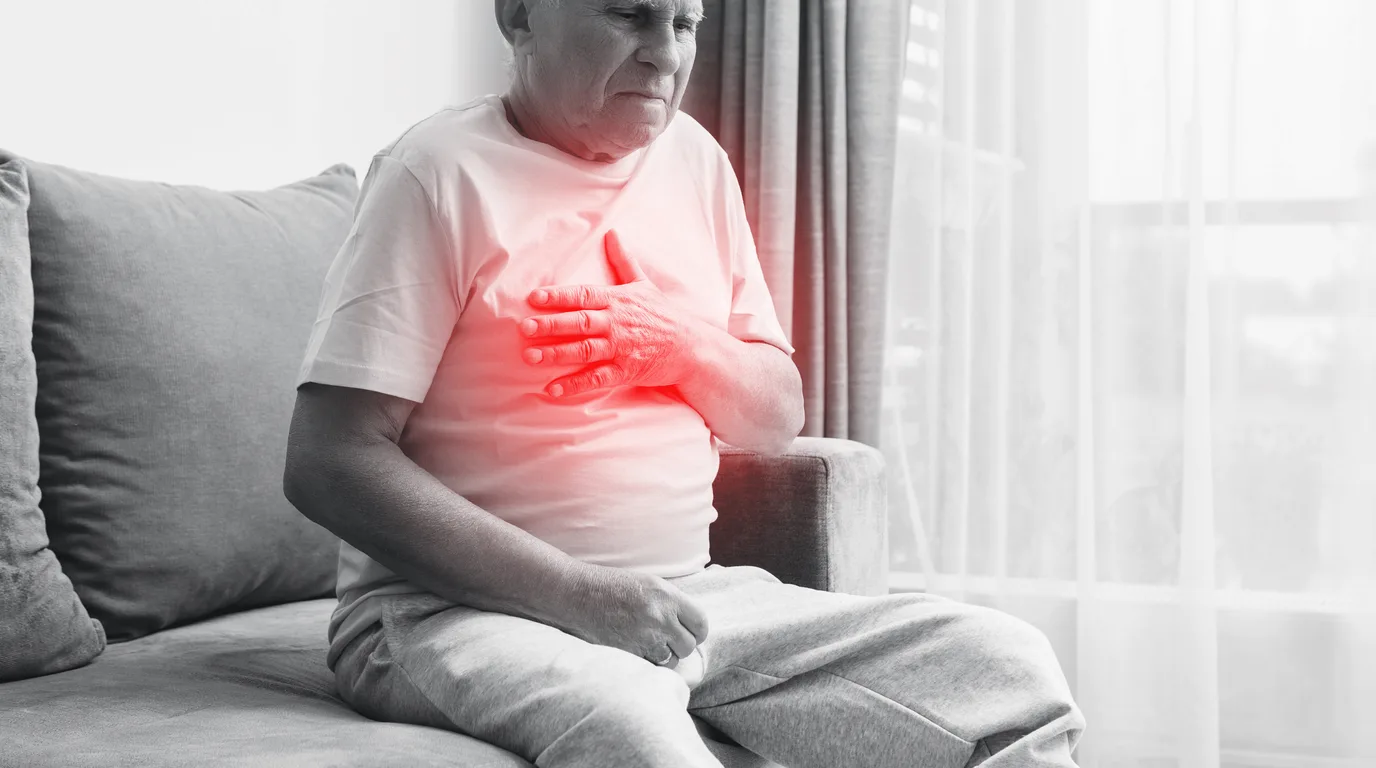
Symptoms
- Pressure or tightness: A squeezing, heavy, or crushing feeling in the center or left side of the chest, often lasting more than a few minutes.
- Radiating pain: Discomfort that spreads to one or both arms, the jaw, neck, shoulder, or back, a common sign of a cardiac cause.
- Shortness of breath: Difficulty breathing that occurs with the chest pain or on its own, sometimes even at rest.
- Sweating, nausea, or lightheadedness: Cold, clammy sweat, nausea or vomiting, dizziness, or fainting occurring alongside chest discomfort.
- Sharp or burning pain: Stabbing pain that worsens with breathing or movement, or a burning sensation behind the breastbone that may point to non-cardiac causes such as reflux or muscle strain.
When it's an emergency
Emergency care for chest pain
Call 911 immediately for life-threatening symptoms or if you cannot travel safely. Do not drive yourself or delay for online booking.
For other urgent symptoms, seek prompt emergency evaluation. Bellaire ER accepts walk-ins 24/7. For facility questions, call (713) 660-0001.
Call 911 immediately if you have chest pressure, tightness, or squeezing that lasts more than a few minutes or comes and goes: especially if it spreads to your arm, jaw, neck, shoulder, or back. These are classic warning signs of a heart attack, and calling 911 is safer than driving yourself because paramedics can begin treatment on the way.
Also call 911 immediately if chest pain comes with shortness of breath, breaking out in a cold sweat, nausea or vomiting, lightheadedness, or fainting. Women, older adults, and people with diabetes may have less obvious symptoms, such as unusual fatigue, back or jaw discomfort, or shortness of breath without severe chest pain.
Seek emergency care for sudden, severe, or tearing chest pain, chest pain with coughing up blood, or pain with a rapid or irregular heartbeat. These can signal serious conditions such as a pulmonary embolism (blood clot in the lung) or aortic problem that need immediate evaluation.
When in doubt, treat chest pain as an emergency. It is not possible to reliably rule out a heart attack at home, and early treatment saves heart muscle and lives. Bellaire ER is open 24/7 with on-site EKG and troponin testing to evaluate chest pain immediately, and if it is a heart attack we stabilize you and arrange rapid transfer for hospital cardiac care.
When it's not an emergency
Some chest discomfort has clearly non-cardiac causes. A brief, sharp pain that worsens when you press on the chest wall or take a deep breath often comes from a strained muscle or the rib joints. A burning sensation behind the breastbone after meals or when lying down is frequently acid reflux (heartburn).
If your symptoms are mild, brief, and clearly tied to a known cause, and you have no heart disease risk factors or warning signs above. It is reasonable to contact your primary care physician or use telemedicine for guidance. Bellaire ER also offers online urgent care visits for lower-risk symptoms.
If you are ever unsure whether chest pain is serious, do not wait it out. It is always safer to be evaluated in person.
What else could be causing this
- Heart attack (myocardial infarction)
- A blocked coronary artery starves heart muscle of blood. Classically a pressure or squeezing across the chest that may spread to an arm, the jaw, neck or back, often with sweating, nausea or breathlessness. This is the cause every chest-pain evaluation is built to find or exclude first.
- Angina
- Narrowed coronary arteries that cannot meet demand. The discomfort is similar to a heart attack but typically comes on with exertion or stress and eases within minutes of rest. New angina, or angina that is changing, is evaluated as an emergency.
- Pulmonary embolism
- A blood clot in the lung. Often sharp pain that worsens on breathing in, with sudden breathlessness, a fast heartbeat, and sometimes coughing up blood. Risk rises after surgery, long immobility, pregnancy or a previous clot.
- Aortic dissection
- A tear in the wall of the body's main artery. Usually sudden, severe, tearing or ripping pain that may move to the back between the shoulder blades. Uncommon, but time-critical.
- Pericarditis or myocarditis
- Inflammation of the sac around the heart, or of heart muscle itself. Often sharp pain that is worse lying flat and better sitting forward, sometimes after a viral illness.
- Pneumonia or pleurisy
- Infection or inflammation of the lung and its lining. Pain is usually one-sided and worse on deep breaths or coughing, with fever, cough or breathlessness.
- Acid reflux (GERD)
- Stomach acid in the esophagus. A burning behind the breastbone, often after meals or lying down, sometimes with a sour taste. Reflux and cardiac pain are confused in both directions, which is why burning pain is not by itself reassuring.
- Chest wall and muscle strain
- Costochondritis or a pulled muscle. The pain is usually reproducible, pressing on the spot recreates it, and changes with position or movement. Reassuring, but only once the dangerous causes have been considered.
- Panic or anxiety
- Chest tightness with a racing heart, breathlessness and tingling. Real and distressing, and a diagnosis reached after cardiac and lung causes have been excluded, never before.
What happens when you arrive
When you arrive at Bellaire ER with chest pain, you are evaluated by a board-certified emergency physician and connected to a heart monitor. An EKG (electrocardiogram) is used to check your heart's electrical activity for signs of a heart attack or abnormal rhythm.
We draw blood on site, including troponin, a protein that rises when heart muscle is injured, and other labs. Our on-site X-ray, CT, and ultrasound let us look for lung, blood vessel, and other causes without sending you elsewhere.
Because the lab and imaging are on site, the workup happens here rather than being referred out. If your evaluation points to a heart attack or another condition that needs hospital-based cardiac care, we stabilize you and arrange rapid transfer. Before you leave, your physician explains your results and gives you a clear follow-up plan.
Tests we can run on site
- EKG (electrocardiogram)
- A recording of the heart's electrical activity. It can show an active heart attack, a previous one, a dangerous rhythm, or strain on the heart. It is painless, takes a few minutes, and is usually the first test done.
- Troponin blood test
- Troponin is a protein released when heart muscle is injured. It is the single most useful blood test for a heart attack. Levels rise over hours, so more than one sample may be needed before the result is meaningful.
- Chest X-ray
- Looks at the lungs, the outline of the heart and the major vessels. It can show pneumonia, fluid, a collapsed lung, or an enlarged heart.
- CT scan
- Cross-sectional imaging, used when a clot in the lung or a problem with the aorta is a possibility. It answers questions a plain X-ray cannot.
- Ultrasound
- Sound-wave imaging used at the bedside to look at the heart, the sac around it, and the lungs, without radiation.
- Additional blood work
- A blood count, metabolic panel, and where appropriate a D-dimer for clotting. These look for anemia, infection, electrolyte problems and other conditions that cause or worsen chest pain.
- Continuous cardiac monitoring and pulse oximetry
- Tracks heart rhythm and blood oxygen throughout your visit, so a change is caught while you are being evaluated rather than after you go home.
Treated here, or transferred
Bellaire ER is a licensed freestanding emergency room. That means it is equipped and staffed for emergency evaluation, stabilization and treatment: board-certified emergency physicians, nurse practitioners, on-site CT, X-ray, ultrasound and laboratory, and it is not a hospital. Knowing which half of that applies to you is a fair thing to ask before you come in.
Many causes of chest pain are identified and treated here. Reflux, chest wall pain, pericarditis, pneumonia and a panic attack can be diagnosed and managed in the emergency room, with treatment started here and a plan for follow-up.
Some causes need a hospital. A heart attack requiring cardiac catheterization, a large pulmonary embolism, an aortic dissection, or a patient who needs admission or a cardiology service will be stabilized here and transferred. Treatment starts at Bellaire ER: monitoring, oxygen, medication, imaging, and continues without interruption on the way. Transfer is not a failure of the visit; it is what the visit is for when that is the answer.
If the evaluation is reassuring, your physician explains what was ruled out and why, and what to do if symptoms return.
Children
Chest pain in children is common and is far less often cardiac than in adults. The usual causes are chest wall and muscle pain, asthma or a respiratory infection, reflux, or anxiety. That is reassuring context, not a reason to dismiss it.
Call 911 for a child with severe breathing difficulty or loss of consciousness. Other chest-pain warning signs need prompt emergency evaluation, including when pain comes with fainting or near-fainting: particularly during exercise, with a racing or irregular heartbeat, with real difficulty breathing, or if there is a family history of sudden cardiac death or an inherited heart condition. Pain that wakes a child from sleep, or comes with fever and breathlessness, also needs to be seen.
Bellaire ER treats adults and children, and the same on-site imaging and laboratory are used to work out which cause is in front of us.
After you leave
A normal EKG and a normal troponin are meaningful, but they describe the moment they were taken. Chest pain that comes back is a new event and deserves a new evaluation, being seen once does not mean the next episode is safe to wait out.
Call 911 immediately if the pain returns and lasts more than a few minutes, spreads to your arm, jaw, neck or back, or arrives with breathlessness, sweating, nausea, fainting or a racing heart. Return sooner rather than later if you develop a fever, cough up blood, or find that you are breathless doing things that were easy the week before.
Take any medication you were given as directed and finish the course. Book the follow-up you were advised to book, including with a cardiologist if that was recommended, a same-day reassuring result is not a substitute for the longer look a cardiologist can take.
Bring your discharge paperwork and your test results to that appointment. It saves repeating tests you have already had.
What this visit costs
We accept most major insurance and bill your insurer directly. For emergency care, federal law caps what you pay at in-network rates and bars surprise bills, your deductible and copay still apply. Never delay emergency care over cost.
See how ER billing worksInsurance and coverage questionsRead the facility notice
Questions about a specific plan? Call (713) 660-0001. Only your plan can tell you how a claim will be processed.
Lowering your risk
You can lower your risk of the most serious cause of chest pain: heart disease, by not smoking, staying physically active, and eating a diet lower in saturated fat, salt, and added sugar. Managing high blood pressure, high cholesterol, and diabetes with your doctor's guidance is especially important.
If you have known risk factors or a family history of heart disease, talk with your physician about regular checkups and whether you should carry aspirin or other medications. Knowing your personal risk and the warning signs of a heart attack helps you act quickly if symptoms occur.
Common questions
When should I go to the ER for chest pain?
Call 911 immediately for chest pressure or chest pain with breathlessness, sweating or fainting. Seek emergency evaluation for chest pressure, tightness, or squeezing that lasts more than a few minutes, spreads to your arm, jaw, neck, or back, or comes with shortness of breath, sweating, nausea, or lightheadedness. These can be signs of a heart attack. When you cannot clearly explain your chest pain, it is safest to be evaluated right away.
How do you know if chest pain is a heart attack or something else?
You cannot reliably tell at home, which is why testing matters. Cardiac chest pain is often a pressure or squeezing sensation that may radiate to the arm or jaw and comes with sweating or shortness of breath, while non-cardiac causes like acid reflux or muscle strain may burn or worsen with movement or pressing on the chest. At Bellaire ER, an EKG and a troponin blood test help determine whether your heart is the source.
What tests will Bellaire ER do for chest pain?
Evaluation usually starts with an EKG and continuous heart monitoring, plus blood tests including troponin to check for heart muscle injury. Depending on your symptoms, we may also use on-site X-ray, CT, or ultrasound to look for lung or blood vessel causes. Because the lab and imaging are on site, the testing is done here rather than referred out to an outside facility.
Should I drive myself to the ER for chest pain?
Call 911 immediately for chest pressure or chest pain with breathlessness, sweating or fainting. For other urgent symptoms, seek emergency evaluation. If you have signs of a heart attack, an ambulance is safer than driving. Paramedics can start monitoring and treatment on the way and get you to care faster, and it is dangerous to drive if you lose consciousness. Have someone else drive only if symptoms are mild and you have no warning signs, but when in doubt, call 911.
What are the most common causes of chest pain?
Most chest pain is not a heart attack. The common causes are acid reflux, chest wall or muscle strain, anxiety, and respiratory infections. The serious ones: heart attack, angina, a blood clot in the lung, aortic dissection, pericarditis and pneumonia, are less common but are what an emergency evaluation is designed to find or rule out first, because they are the ones where waiting costs you.
Can chest pain on the left side be something other than my heart?
Yes, often. The heart sits slightly left of center, so left-sided pain gets attention, but the same area covers lung, rib, muscle, nerve and stomach. Left-sided pain that is sharp, reproducible when you press on it, or clearly tied to movement is frequently musculoskeletal. Location alone does not settle it, which is why an EKG and blood test are used rather than a description of where it hurts.
How do I tell heartburn from a heart attack?
You often cannot, and doctors do not try to at the bedside without testing. Reflux tends to burn, follow meals, and ease with antacids; cardiac pain tends to press or squeeze, come with exertion, sweating or breathlessness, and spread to the arm or jaw. But heart attacks present as indigestion often enough that the overlap is the whole problem. Antacids helping does not rule out your heart.
Can anxiety cause real chest pain?
Yes. A panic attack can produce genuine chest tightness, a racing heart, breathlessness and tingling, the symptoms are real, not imagined. It is a diagnosis made after cardiac and lung causes have been excluded, though, not instead of checking. If this is your first episode, get it evaluated.
What if my chest pain went away on its own?
Pain that has stopped is still worth evaluating, particularly if it lasted more than a few minutes, came on with exertion, or arrived with sweating or breathlessness. Angina eases with rest and can be the warning that precedes a heart attack by days or weeks. A heart attack can also come and go before it settles in.
Do I need a referral or an appointment to be seen?
No. Bellaire ER is open 24 hours a day, 365 days a year, and no appointment or referral is needed. Walk in any time. You can save your spot online first if you prefer, but for chest pain you should not delay in order to do so.
What should I bring with me?
A list of your medications and doses, any known heart conditions or previous cardiac tests, allergies, and your insurance card and photo ID. If you have had an EKG before, bringing a copy helps, comparing today's tracing to an old one can answer a question quickly. None of this is required to be seen.
Chest pain is the symptom people are right to worry about, and the one that is hardest to judge from home. A heart attack, a blood clot in the lung, and a strained chest muscle can all begin the same way, and no combination of symptoms reliably rules out the dangerous causes without testing.
What Bellaire ER can determine on site
Bellaire ER is a licensed freestanding emergency room staffed by board-certified emergency physicians and open 24/7. Chest pain evaluation begins with an EKG and continuous cardiac monitoring, followed by blood work including troponin, the protein that rises when heart muscle is injured. Our on-site imaging: X-ray, CT, and ultrasound, helps identify lung and blood-vessel causes during the same visit. Our full range of emergency services covers what we can diagnose and treat before any transfer decision is made.
If your evaluation points to a heart attack or another condition that needs hospital-based cardiac care, we stabilize you and arrange transfer to the appropriate cardiac service.
If you think you are having a heart attack
Come in now. Paramedics can begin monitoring and treatment on the way, and it is not safe to drive yourself if you may lose consciousness.
Walk in, or save your spot first
For chest pain you cannot explain, without those classic heart attack warning signs, Bellaire ER is open 24 hours a day, 365 days a year at 5302 Bellaire Blvd, Bellaire, TX 77401. Get directions or call 713-660-0001.
No appointment is required to be seen. Walk in any time. If you would rather not wait at the facility, you can save your spot online before you arrive. For mild symptoms you are confident are not cardiac, such as reflux or a strained chest muscle, a telehealth visit is also available.
Sources & further reading
Medical information on this page is consistent with guidance from these trusted organizations:
- MedlinePlus, Recognizing medical emergencies
- MedlinePlus, Chest Pain
- MedlinePlus, Heart Attack
- MedlinePlus Medical Encyclopedia, Chest Pain
- MedlinePlus, Pulmonary Embolism
- NHLBI (National Heart, Lung, and Blood Institute), Angina
- American Heart Association, Warning Signs of a Heart Attack
- American College of Emergency Physicians, Chest Pain: Know When to Go
People also ask
When should I go to the ER for chest pain?
Go to the ER right away for any chest pain that is severe, lasts more than a few minutes, or comes with shortness of breath, sweating, nausea, or pain spreading to the arm or jaw, and call 911 rather than driving. Brief, positional, or clearly muscle-related pain in a low-risk person can often start with Bellaire ER's virtual urgent care or your own doctor.
Read full answer →Is chest pain an emergency?
Chest pain can be a medical emergency and should be treated as one until proven otherwise. Call 911 immediately if chest pain is severe, lasts more than a few minutes, or comes with shortness of breath, sweating, nausea, or pain spreading to the arm, jaw, or back.
Read full answer →What are the symptoms of chest pain?
Chest pain can feel like pressure, tightness, squeezing, burning, or a sharp stab, and it may spread to the arm, jaw, neck, or back. Warning symptoms that point to a heart problem include chest pressure with shortness of breath, sweating, nausea, or lightheadedness.
Read full answer →