
Abdominal Pain
Go to the ER immediately for abdominal pain that is sudden, severe, or worsening, or accompanied by a rigid belly, persistent vomiting, high fever, or blood in stool or vomit. These symptoms can signal life-threatening conditions like appendicitis, a gallbladder attack, bowel obstruction, or ectopic pregnancy. Bellaire ER provides 24/7 evaluation with on-site CT, ultrasound, and lab testing.
- Open now, 24/7/365
- Walk in, no appointment
- 5302 Bellaire Blvd, free parking
Unsure if Your Symptoms Require Emergency Care?
Call our clinical triage desk at (713) 660-0001. An on-duty board-certified emergency physician will evaluate your symptoms before you leave home.
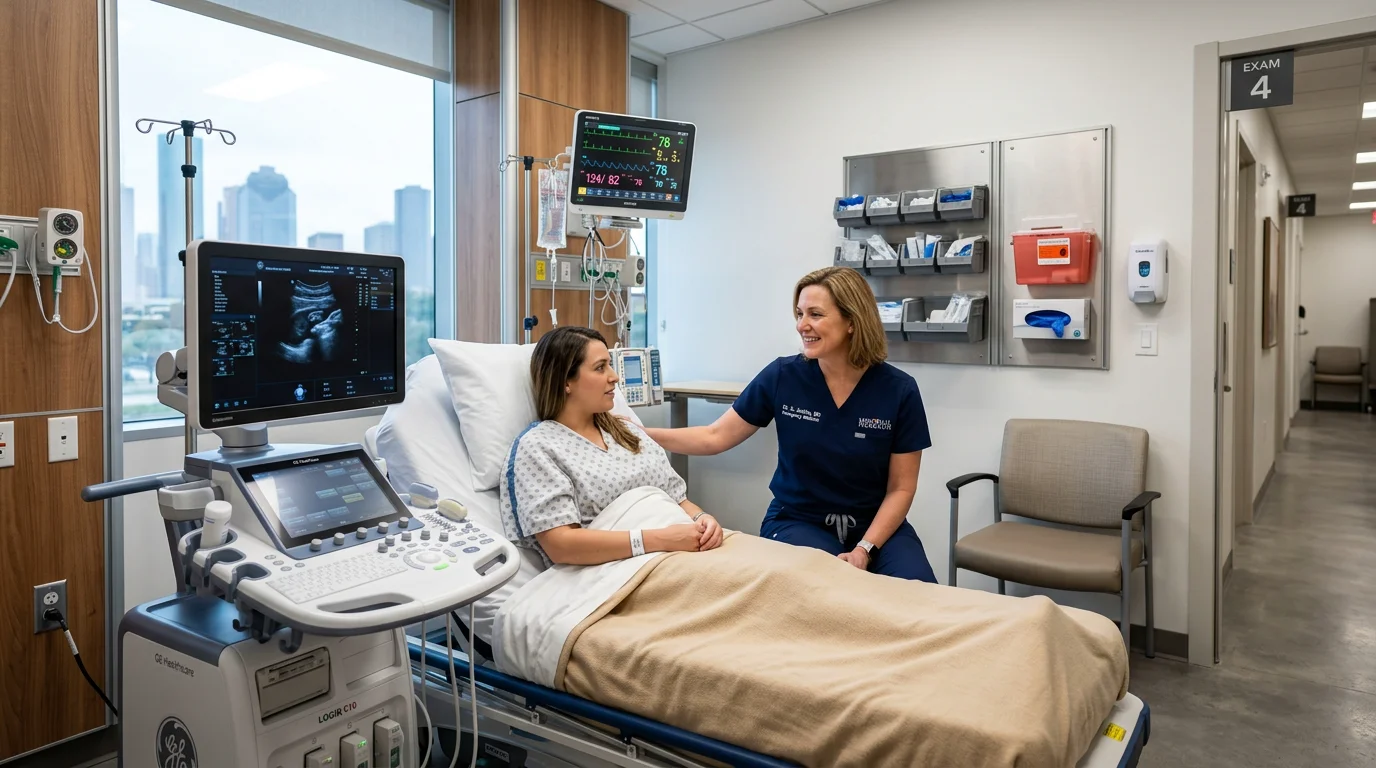
Symptoms
- Localized quadrant pain: Intense pain localized in the lower right abdomen (classic appendicitis) or upper right abdomen after eating (gallbladder or pancreatitis).
- Abdominal rigidity or guarding: A stomach that feels hard, board-like, or excruciatingly tender to touch, signaling peritonitis or organ perforation.
- Severe or sudden cramping: Rapid-onset, gripping abdominal spasms that intensify steadily rather than subsiding.
- Intractable vomiting or nausea: Repeated vomiting that prevents keeping oral fluids down, risking rapid dehydration and metabolic imbalance.
- Inability to pass gas or stool: Abdominal distension accompanied by obstipation, which strongly indicates a mechanical bowel obstruction.
- Blood in vomit or bowel movements: Bright red blood or dark coffee-ground vomit, or black, tarry stools, indicating acute gastrointestinal hemorrhage.
- High fever or chills: Elevated temperature paired with acute abdominal pain, pointing toward serious intra-abdominal infection or abscess.
- Jaundice: Yellowing of the skin or eyes paired with upper abdominal pain, signaling biliary obstruction or acute liver dysfunction.
- Dizziness, fainting, or clammy skin: Hemodynamic instability that can indicate acute internal bleeding, ruptured ectopic pregnancy, or sepsis.
When it's an emergency
Emergency care for abdominal pain
Call 911 immediately for life-threatening symptoms or if you cannot travel safely. Do not drive yourself or delay for online booking.
For other urgent symptoms, seek prompt emergency evaluation. Bellaire ER accepts walk-ins 24/7. For facility questions, call (713) 660-0001.
Seek emergency medical evaluation at Bellaire ER immediately if your abdominal pain is sudden, severe, or steadily intensifying; an ambulance is the faster route if safe travel is not possible. Pain beginning near the navel and migrating to the right lower quadrant is a hallmark of appendicitis, while severe right upper quadrant pain radiating to the back or shoulder blade often signals acute cholecystitis (gallbladder attack).
Immediate emergency care is required if pain is accompanied by a rigid or board-like abdomen; intractable vomiting; vomiting blood; black, tarry, or bloody stools; high fever; or significant abdominal swelling with an inability to pass gas or stool (bowel obstruction).
Emergency evaluation is urgent for females of childbearing age experiencing sudden lower pelvic pain. Especially with unexpected vaginal bleeding, lightheadedness, or fainting. As this may represent a ruptured ectopic pregnancy.
Bellaire ER operates 24/7 with on-site CT, ultrasound, and laboratory testing to diagnose, stabilize, and treat abdominal emergencies in a single visit, arranging direct hospital transfer when emergency surgery is required.
When it's not an emergency
Mild, transient abdominal discomfort that resolves within a few hours is usually not an emergency. Brief episodes of mild indigestion, gas, heartburn after a heavy meal, or mild cramping associated with a minor viral bug without red flags can typically be managed with rest, hydration, and primary care follow-up.
Stable, low-acuity gastrointestinal issues such as mild chronic constipation, occasional acid reflux, or minor dietary upset without fever, vomiting, or severe pain can also be evaluated through a primary care visit or via Bellaire ER's telemedicine service.
When in doubt, never wait. Abdominal pain that is progressively worsening, localized to one quadrant, or accompanied by any warning sign requires prompt in-person emergency evaluation.
What else could be causing this
- Appendicitis
- Inflammation of the appendix. Classically a dull pain near the navel that migrates to the lower right abdomen over hours, becomes sharper, and hurts more with coughing, walking or any jolt. Appetite goes first, then nausea. It is the diagnosis an evaluation of lower right pain is built to find, because a delayed appendix can perforate.
- Gallbladder disease and pancreatitis
- Gallstones are the common thread. A stone blocking the gallbladder outlet causes severe right upper abdominal pain, often after a fatty meal, sometimes radiating to the right shoulder blade; fever and pain persisting beyond a few hours suggest the gallbladder wall is infected. A stone obstructing the pancreatic duct instead causes pancreatitis: constant pain high in the abdomen boring through to the back, with persistent vomiting, often eased slightly by leaning forward. Alcohol is the other main cause of pancreatitis.
- Kidney stones
- A stone passing down the ureter. Severe pain in the flank and side that comes in waves, often radiating down toward the groin, with blood in the urine and nausea. The restlessness is characteristic: people with stone pain cannot find a position that helps, unlike peritoneal pain, where any movement makes things worse.
- Bowel obstruction
- A mechanical blockage of the intestine, most often from adhesions after previous abdominal surgery, or a hernia. Cramping pain in waves, a distending abdomen, vomiting that may turn bilious, and the decisive feature: gas and stool stop passing. It is a surgical problem and the reason imaging goes early in the workup.
- Diverticulitis
- Inflammation or infection of small outpouchings in the wall of the colon, usually producing steady pain in the lower left abdomen with fever and a change in bowel habit. It is more common with age. Most cases settle with antibiotics, but an abscess or a perforation changes the plan entirely, which is why imaging matters.
- Perforated peptic ulcer
- An ulcer in the stomach or duodenum that erodes all the way through. The onset is abrupt and the pain is immediately severe and generalized, the abdomen becomes rigid and board-like, and people lie very still because any movement hurts. Risk is higher with long-term anti-inflammatory use. This is time-critical.
- Gynecologic and pregnancy-related causes
- An ectopic pregnancy, a ruptured or bleeding ovarian cyst, ovarian torsion, or pelvic inflammatory disease. Sudden one-sided lower pelvic pain in anyone of childbearing age is treated as a possible ectopic pregnancy until a pregnancy test and imaging say otherwise, because a rupture causes internal bleeding. Torsion is equally time-sensitive, because the ovary loses its blood supply.
- Abdominal aortic aneurysm
- A weakened, bulging segment of the body's main artery. A leak or rupture produces sudden severe abdominal or back pain, sometimes with faintness or collapse, and is most likely in older adults, smokers and people with high blood pressure. Uncommon, frequently mistaken for a kidney stone, and the reason sudden severe pain in an older patient is imaged rather than observed.
- Gastroenteritis, constipation and functional pain
- The common and benign end of the range. Viral gastroenteritis brings cramping with vomiting and diarrhea; constipation and trapped gas produce cramping that eases after passing stool or gas; irritable bowel syndrome causes recurrent pain with a long and familiar pattern. These are reasonable conclusions once the dangerous causes have been considered, not first assumptions.
What happens when you arrive
Upon arrival at Bellaire ER, patients with acute abdominal pain are evaluated by a board-certified emergency physician. No appointment is needed and the facility is open 24/7/365.
Your physician conducts a focused clinical exam to check for peritoneal signs, guarding, and localized tenderness, followed immediately by targeted on-site diagnostics. Our facility has on-site CT imaging, diagnostic ultrasound, and an on-site laboratory for the blood work that guides an abdominal workup (CBC, CMP, Lipase, Amylase, Urinalysis, Serum hCG, and Lactate).
We provide rapid symptom relief through IV fluid resuscitation, targeted antiemetics, and physician-monitored IV pain management. Once diagnostic results confirm the cause, our team stabilizes you and coordinates direct surgical or hospital transfer if an appendectomy, cholecystectomy, or inpatient admission is needed.
Tests we can run on site
- Complete blood count
- A raised white cell count supports an infectious or inflammatory process such as appendicitis, cholecystitis or diverticulitis. The red cell values matter independently: a falling hemoglobin is how internal bleeding announces itself.
- Comprehensive metabolic panel and liver function tests
- Kidney function, electrolytes and hydration, plus liver and bile-duct enzymes. Raised bilirubin and bile-duct enzymes point to a blocked bile duct rather than a simply inflamed gallbladder, which is a different problem with a different plan.
- Lipase
- A pancreatic enzyme that rises sharply in pancreatitis. It is the single test that confirms or excludes pancreatitis in someone with severe upper abdominal pain, and it is run on essentially every central or upper abdominal presentation.
- Urinalysis
- Blood in the urine supports a kidney stone; white cells and bacteria point to a urinary or kidney infection. It is a small test, and it redirects the diagnosis often enough that it is part of almost every abdominal workup.
- Pregnancy test
- Run for every patient of childbearing age with abdominal or pelvic pain, regardless of what they expect the result to be. A positive test puts ectopic pregnancy at the front of the list and changes which imaging is used.
- CT scan
- Cross-sectional imaging of the whole abdomen and pelvis, and the test that most often settles an acute abdomen. It shows appendicitis, obstruction, diverticulitis, an abscess, a perforation, stones and aortic disease, the diagnoses where the answer changes what happens in the next hour.
- Ultrasound and plain abdominal X-ray
- Ultrasound uses sound waves with no radiation and is the first-line test for the gallbladder and bile ducts, for the ovaries and early pregnancy, and for the appendix in children and pregnancy; at the bedside it also shows free fluid in the abdomen. A plain abdominal X-ray is used for specific questions rather than routinely: the gas pattern of an obstruction, free air from a perforation, swallowed objects, and it cannot rule out most of the diagnoses above, which is why it is not the main imaging test.
Treated here, or transferred
Bellaire ER is a licensed freestanding emergency room. It has board-certified emergency physicians and nurse practitioners, on-site CT, X-ray, ultrasound and a full laboratory, medication administered during your visit, and it is open 24 hours a day, 365 days a year, for adults and children. It is equipped and staffed to evaluate, stabilize and treat emergencies, and it is not a hospital. With abdominal pain, that distinction is worth understanding before you come in, because the two halves of it both apply.
A great deal is finished here. The diagnosis itself is the main work: on-site CT, ultrasound and laboratory testing mean the question of what is causing the pain is answered in this building rather than referred out. Pain and nausea are treated while that happens, with intravenous medication, and dehydration is corrected with fluids. Diverticulitis, a urinary tract or kidney infection, gastritis, constipation, a passing kidney stone and gastroenteritis are commonly diagnosed and treated here, with treatment started on site and a prescription and follow-up plan before you leave.
Some causes need an operating room or an inpatient bed, and a freestanding emergency room has neither. Appendicitis, a perforated ulcer, a strangulated hernia, a bowel obstruction that will not resolve, an ectopic pregnancy, ovarian torsion, gallbladder surgery, severe pancreatitis and an aortic aneurysm all need hospital services. For those, the role of this visit is to identify the problem, start treatment and keep you stable: intravenous fluids, antibiotics, pain control, monitoring, and the imaging the receiving surgeon will want to see. Care continues without a gap during transfer to a hospital with the service you need. Transfer is how a freestanding emergency room is designed to work when the answer is surgical; it is not a sign the visit was wasted.
If the evaluation is reassuring, your physician will tell you specifically what was excluded and on what basis, which is the part worth listening to. Abdominal pain without a clear diagnosis after a thorough evaluation is a common and legitimate outcome, and it comes with instructions rather than a dismissal.
Children
Bellaire ER treats adults and children. Abdominal pain in children is extremely common and most of it is not serious, but the distribution of causes is different and the examination is harder, so the threshold for being seen is lower rather than higher.
The usual causes in children are constipation, viral gastroenteritis, mesenteric adenitis: inflamed lymph nodes in the abdomen after a viral illness, which mimics appendicitis closely, a urinary tract infection, and strep throat, which produces abdominal pain in children often enough to catch people out. Appendicitis is the most important diagnosis and it is harder to recognize in a young child, who may not localize the pain and whose appendix perforates sooner. A child who is lying still, refusing to jump, walking bent over, or who cries when the car goes over a bump is describing peritoneal irritation whether or not they can say where it hurts.
Bring a child in urgently for pain that is getting worse over hours, pain in the lower right abdomen, vomit that is green or bile-stained, blood in the stool or stool that looks like red currant jelly, a swollen or rigid abdomen, pain with a limp or a refusal to walk, or episodes of inconsolable screaming where the child draws the knees up and then goes limp between episodes. Any infant under three months with a rectal temperature of 100.4 degrees Fahrenheit or higher needs emergency evaluation. In an adolescent boy, sudden lower abdominal or groin pain is treated as possible testicular torsion, which has a narrow window.
When imaging is needed in a child, ultrasound and laboratory testing are used first; CT is reserved for when the question cannot be answered another way, so that radiation is kept to what is genuinely necessary.
After you leave
Abdominal pain that has been evaluated once and found benign can still change, and the evaluation describes the moment it was done. An appendix that looked normal on imaging four hours into the illness can be unmistakable twelve hours later. Being seen and cleared is not a reason to wait out a second, worse episode. It is a reason to come back sooner, because a comparison to the first visit is useful information.
Come back, or call 911 if you cannot travel safely, if the pain becomes severe or constant, settles into one area, particularly the lower right, or wakes you from sleep. Return for a fever or shaking chills, repeated vomiting that stops you keeping fluids down, a swollen or rigid abdomen, or an inability to pass gas or stool. Blood in the vomit, black tarry stool, blood in the stool, fainting, or a racing heart with lightheadedness are reasons to come back without waiting until the morning. For anyone pregnant or possibly pregnant, new or worsening pelvic pain and vaginal bleeding both need re-evaluation.
Expect some soreness for a day or two after an episode, and expect your appetite to lag behind feeling better. Eat simply at first and build back up, keep your fluid intake up, and if constipation was part of the picture, follow the regimen you were given rather than stopping the moment things move. Avoid anti-inflammatory medication such as ibuprofen if you were told to, which is usual after gastritis or an ulcer, and avoid alcohol until you have been cleared.
Finish any antibiotic course completely, even once you feel well. Keep the follow-up appointment you were given, including with a surgeon or a gastroenterologist if that was recommended, and bring your discharge paperwork and imaging results with you, it saves repeating tests you have already had.
What this visit costs
We accept most major insurance and bill your insurer directly. For emergency care, federal law caps what you pay at in-network rates and bars surprise bills, your deductible and copay still apply. Never delay emergency care over cost.
See how ER billing worksInsurance and coverage questionsRead the facility notice
Questions about a specific plan? Call (713) 660-0001. Only your plan can tell you how a claim will be processed.
Lowering your risk
While acute surgical conditions like appendicitis cannot be prevented, everyday digestive health measures can reduce the risk of common abdominal complications. Staying hydrated and maintaining a high-fiber diet support regular bowel motility and help prevent painful constipation or diverticular flare-ups.
Limiting heavy, high-fat meals and moderating alcohol consumption lowers the incidence of gallbladder inflammation and pancreatitis. Practicing safe food handling and hand hygiene reduces the risk of viral and bacterial foodborne gastroenteritis. If you have chronic conditions such as peptic ulcer disease, Crohn's, or gallstones, follow your maintenance medical regimen closely and seek early evaluation if symptoms change.
Common questions
When should I go to the ER for abdominal pain?
Go to the ER immediately if your abdominal pain is sudden, severe, or steadily worsening, or if it is paired with a rigid belly, persistent vomiting, high fever, blood in stool or vomit, or dizziness. Pain localized to the lower right abdomen or severe pelvic pain during pregnancy requires urgent emergency evaluation.
What serious medical conditions cause acute abdominal pain?
Serious causes include acute appendicitis, cholecystitis (gallbladder attack), kidney stones, bowel obstruction, pancreatitis, diverticulitis, perforated peptic ulcer, and ectopic pregnancy. Because symptoms can initially appear vague, on-site CT imaging and stat labs are vital for rapid, accurate diagnosis.
How does Bellaire ER diagnose the cause of abdominal pain?
A board-certified emergency physician evaluates you and uses on-site CT scanning, diagnostic ultrasound, and on-site laboratory testing. We analyze blood counts, organ function, pancreatitis enzymes, and pregnancy markers in a single visit without sending you to outside facilities.
Is lower right abdominal pain always appendicitis?
Not always, but it is the most critical condition to rule out. Lower right pain can also stem from kidney stones, ovarian cysts, ectopic pregnancy, mesenteric adenitis, or Crohn's flare-ups. Because an inflamed appendix can perforate within 24 to 72 hours, new or worsening lower right pain must be evaluated promptly.
Can I use telemedicine instead of visiting the ER for stomach pain?
Telemedicine is appropriate for mild, non-emergency concerns like mild heartburn, minor stomach upset, or questions about chronic symptoms. However, severe, sharp, or worsening abdominal pain requires an in-person physical exam, imaging, and blood work that cannot be performed virtually.
Abdominal pain can stem from common digestive issues or indicate an acute surgical emergency requiring prompt intervention. If you or a loved one experience severe, sudden, or worsening abdominal symptoms, timely medical evaluation is critical to ensure accurate diagnosis and rapid relief.
Comprehensive 24/7 Emergency Care at Bellaire ER
At Bellaire ER, our board-certified emergency physicians and clinical nursing team provide compassionate care around the clock. Our on-site imaging: CT, X-ray, and ultrasound, and on-site laboratory let us evaluate and stabilize acute abdominal conditions without sending you to an outside facility. See the full scope of our emergency services for what we diagnose and treat in a single visit.
Walk in, or save your spot first
If you are experiencing red-flag symptoms or are unsure whether your pain warrants emergency attention, visit us at 5302 Bellaire Blvd, Bellaire, TX 77401. Get directions or call 713-660-0001. We are open 24 hours a day, 365 days a year.
No appointment is required to be seen. Walk in any time. If you would rather not wait at the facility, you can save your spot online before you arrive. For mild, non-emergency digestive concerns, a telehealth visit is also available.
Sources & further reading
Medical information on this page is consistent with guidance from these trusted organizations:
People also ask
When should I go to the ER for abdominal pain?
Go to the ER for abdominal pain that is severe, sudden, or steadily worsening, or that comes with fever, persistent vomiting, blood in vomit or stool, a rigid belly, chest pain, or fainting. Mild, brief pain with a clear cause can usually wait for Bellaire ER's virtual urgent care or your primary doctor.
Read full answer →Is abdominal pain an emergency?
Abdominal pain can be a medical emergency. It is an emergency when the pain is severe, sudden, or unrelenting, or comes with fever, persistent vomiting, blood in vomit or stool, a rigid or very tender belly, chest pain, or signs of shock. Those need immediate ER care.
Read full answer →What are the symptoms of abdominal pain?
Abdominal pain ranges from dull cramping, bloating, and gas to sharp, localized, or burning pain, often with nausea, vomiting, or changes in bowel habits. The location, timing, and accompanying symptoms: especially fever, blood, or a rigid belly, point to the cause and how serious it is.
Read full answer →