
CT Scan
A CT (computed tomography) scan uses X-rays to create detailed cross-sectional images of the brain, chest, abdomen, and other structures, helping doctors quickly find internal bleeding, blood clots, fractures, infections, and other problems that a standard X-ray can miss. At Bellaire ER, CT scans are performed on-site 24/7 and reviewed by the board-certified emergency physician caring for you. Both self-pay and insured patients are welcome.
- Open now, 24/7/365
- Walk in, no appointment
- 5302 Bellaire Blvd, free parking
Unsure if Your Symptoms Require Emergency Care?
Call our clinical triage desk at (713) 660-0001. An on-duty board-certified emergency physician will evaluate your symptoms before you leave home.
Symptoms
- Severe or sudden headache: The worst headache of your life or a sudden severe headache can signal bleeding in or around the brain and may need a head CT.
- Head injury: A significant blow to the head, especially with confusion, vomiting, or loss of consciousness, often warrants a CT to rule out bleeding or skull fracture.
- Severe abdominal pain: Intense, persistent, or worsening belly pain may point to appendicitis, kidney stones, a blocked or ruptured organ, or internal bleeding that CT can identify.
- Stroke warning signs: Sudden weakness, facial drooping, slurred speech, or vision loss require an urgent CT to distinguish a bleeding stroke from a clot.
- Chest or torso trauma: A hard fall, car crash, or blunt injury to the chest can cause internal bleeding or organ damage that CT can detect quickly.
When it's an emergency
Emergency care for ct scan
Call 911 immediately for life-threatening symptoms or if you cannot travel safely. Do not drive yourself or delay for online booking.
For other urgent symptoms, seek prompt emergency evaluation. Bellaire ER accepts walk-ins 24/7. For facility questions, call (713) 660-0001.
Call 911 immediately if you have sudden signs of a stroke: facial drooping, arm weakness, slurred speech, sudden confusion, or sudden vision loss. These require an urgent head CT to decide on treatment, and every minute matters.
Seek emergency care for a serious head injury, particularly if it is followed by loss of consciousness, repeated vomiting, worsening confusion, a seizure, or clear fluid draining from the nose or ears. These can signal bleeding inside the skull.
Come straight to Bellaire ER for severe, sudden, or worsening abdominal pain, or for major trauma to the chest or abdomen from a fall or collision. A CT scan can quickly reveal internal bleeding, a ruptured organ, appendicitis, or a serious blockage.
At Bellaire ER, CT imaging is available 24/7 on-site, for emergency evaluation when clinically indicated. Timing depends on clinical urgency and current needs.
When it's not an emergency
Not every ache or minor injury needs an emergency CT scan. Mild, stable, long-standing symptoms, such as an occasional routine headache or minor bruising without warning signs, can usually be evaluated by your primary care physician, who may order routine imaging if appropriate.
Routine or screening CT scans (for example, follow-up of a known condition or planned surveillance imaging) are typically scheduled through your doctor or an outpatient imaging center rather than an emergency room.
For routine or surveillance imaging, your own doctor can order it during regular hours. When the question is whether something needs imaging now, Bellaire ER has CT, X-ray and ultrasound in the building 24/7 and can answer it in one visit. If your symptoms are severe, sudden, or rapidly worsening, however, do not wait, an ER visit is the safer choice.
What else could be causing this
- Bleeding inside the skull
- The question behind most head CT scans. After a head injury, or with a sudden severe headache, a scan without contrast shows blood between the skull and the brain, blood within brain tissue, swelling and skull fractures. This is the finding that changes a visit from observation to transfer, and it is why a head CT is not postponed for an outpatient appointment.
- Stroke
- A CT distinguishes a stroke caused by bleeding from one caused by a blocked vessel, which matters because the treatments are opposite and giving the wrong one is harmful. A very early blocked-vessel stroke may show little on the first scan, so the imaging is interpreted alongside the examination and the time symptoms began. Stroke is time-critical and belongs in a hospital with a stroke service, so these patients are stabilized and transferred.
- Appendicitis and other abdominal infection
- CT of the abdomen and pelvis is the test that settles most unexplained abdominal pain in adults. It shows an inflamed appendix, diverticulitis, an abscess, a gallbladder problem, or infection elsewhere, and it shows whether something has perforated. It also shows when the pain is coming from something entirely different, which is as useful a result as a positive one.
- Kidney stones and urinary obstruction
- Severe one-sided flank pain radiating to the groin, often with blood in the urine. CT shows the stone itself, how large it is, where it sits and whether it is obstructing the kidney. Size and position are what determine whether a stone will pass on its own or needs a urologist, so the scan is not academic, it decides the plan.
- Blood clot in the lung and problems with the aorta
- A CT with contrast through the chest looks at the blood vessels directly. It finds a pulmonary embolism, a clot that has travelled to the lung, and it finds a tear or aneurysm of the aorta. Both present with chest pain or breathlessness, both can be rapidly fatal, and neither can be excluded by examination alone.
- Bowel obstruction and perforation
- Cramping abdominal pain with vomiting, a swollen abdomen and no bowel movement or gas. CT shows where the bowel is blocked, what is blocking it, whether the blood supply to that segment is compromised, and whether air has escaped from a perforation. These findings generally mean a surgical team, which is a hospital service.
- Internal bleeding and organ injury after trauma
- After a car crash, a significant fall or a blow to the chest or abdomen, CT shows injury to the liver, spleen, kidneys, lungs and the blood vessels around them, along with fractures of the ribs, spine and pelvis. Someone can look stable and be bleeding internally, and this is the imaging that reveals it before blood pressure starts to fall.
- Deep infection and abscess
- Infection that cannot be seen or felt: in the neck, around a tooth, in the sinuses behind an eye socket, in the abdomen, or in soft tissue. CT shows whether there is a collection of pus that needs draining rather than just inflammation that needs antibiotics. That distinction is the usual reason a fever with pain and no obvious source gets scanned.
- Fractures an X-ray cannot resolve
- Spine, pelvis, facial bones, wrist, ankle and skull base fractures frequently hide on plain films because of overlapping bone. CT shows the number of fragments, the alignment, and whether a joint surface is involved. It is the imaging an orthopedic or facial surgeon needs before deciding whether an injury requires an operation.
What happens when you arrive
When you arrive at Bellaire ER, a board-certified emergency physician evaluates your symptoms and decides whether a CT scan is needed. Because imaging is on-site, there are no transfers or separate appointments.
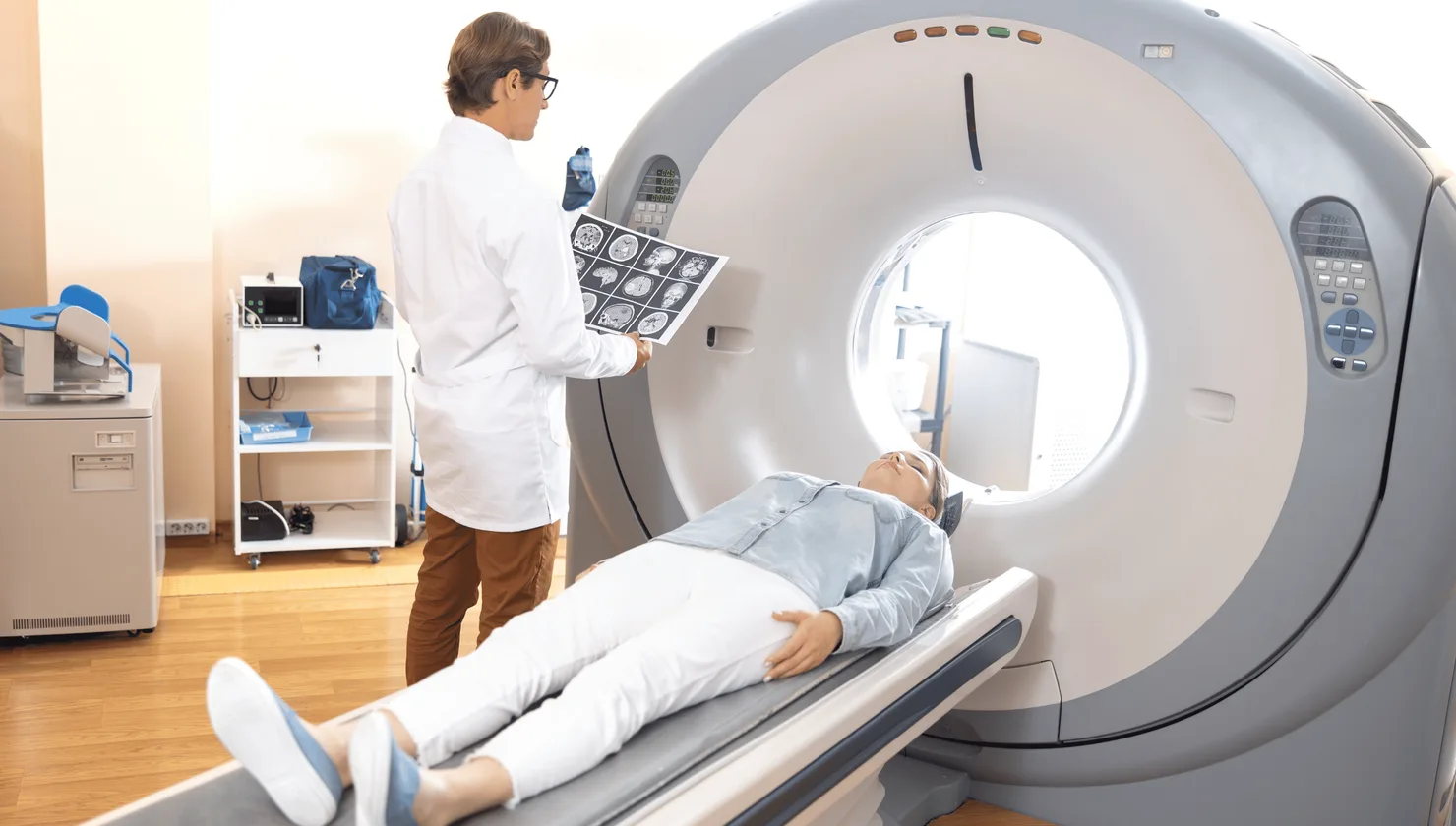
The scan itself is quick and painless. You lie still on a table that moves through the CT scanner while it captures cross-sectional images; some scans use contrast dye, given by mouth or through an IV, to highlight blood vessels or organs.
The board-certified emergency physician caring for you reviews the images on site. Based on what the CT shows, your care team can diagnose the problem and start treatment during the same visit.
Bellaire ER also has on-site X-ray, ultrasound, and a full lab, so additional testing can be done in the same visit if needed. Both self-pay and insured patients are welcome.
Tests we can run on site
- CT without contrast
- Imaging using X-rays alone, with no dye. It is the standard scan for head injury, suspected bleeding in the brain, kidney stones and most spine and facial fractures. Nothing is injected, no preparation is needed, and the part of the examination you spend inside the scanner is brief, you lie still on a table that moves through a ring that is open at both ends, not an enclosed tube.
- CT with intravenous contrast
- The same scan with iodine-based dye injected through an IV, which lights up blood vessels and makes organs and inflammation far easier to interpret. It is used for most abdominal, chest and infection questions. The injection commonly causes a warm flush and a metallic taste for a few seconds, which is expected. Tell the team if you have had a reaction to contrast before, have kidney disease, or take metformin.
- CT angiography
- Contrast timed to the moment it fills the arteries, producing a map of the blood vessels themselves. This is how a clot in the lung, a tear in the aorta or an aneurysm is identified. It is a specific study rather than a general scan, requested because a particular vessel is in question.
- CT of the abdomen and pelvis
- The workhorse study for unexplained abdominal pain, usually with contrast, sometimes with oral contrast as well. It covers the appendix, bowel, liver, gallbladder, pancreas, kidneys, ureters, bladder, reproductive organs and the blood vessels between them, in one examination.
- X-ray, as the first step or the whole answer
- Plain imaging, also on site, is quicker and uses far less radiation, and for many questions: most limb injuries, pneumonia, a swallowed object, a dislocation. It is all that is needed. A CT is not a better X-ray; it is a different test with a different cost in radiation, and it is requested when the question genuinely needs it.
- Ultrasound, as the alternative to CT
- Sound-wave imaging with no radiation at all, available on site. It is the preferred first test for gallbladder disease, for suspected appendicitis in children and in pregnancy, for deep vein clots, for early pregnancy problems and for looking at the heart and kidneys. Where ultrasound can answer the question, it is used instead.
- Blood work before and alongside the scan
- The on-site laboratory checks kidney function, which informs the decision about contrast, and performs a pregnancy test where relevant, because radiation exposure in pregnancy is weighed differently. Blood tests also narrow the question so the right scan is requested rather than a broad one.
- Physician review of the images
- The scan is reviewed on site by the board-certified emergency physician caring for you. What the images show is explained to you alongside the examination findings and the blood results, because a scan interpreted without the person in front of you is only half an answer.
Treated here, or transferred
Bellaire ER is a licensed freestanding emergency room, open 24 hours a day, 365 days a year, staffed by board-certified emergency physicians and nurse practitioners, with on-site CT, X-ray, ultrasound and laboratory, and medication given on site during your visit. It is equipped for emergency evaluation, stabilization and treatment, and it is not a hospital. The scanner is here, which is the point: the imaging that decides what is wrong with you does not need to be arranged somewhere else first.
A CT scan is not treatment, it is the step that determines treatment, and for a large share of patients the finding is one that is managed here completely. Kidney stones small enough to pass, appendicitis-like pain that turns out to be something simpler, diverticulitis that can be treated with oral antibiotics, a fracture that needs splinting rather than surgery, pneumonia, a soft tissue infection, a reassuring head CT after a head injury: all of these are treated at Bellaire ER with medication given during your visit, a prescription written for you to fill at your own pharmacy, written instructions and specific follow-up.
A normal CT is a real result, not a wasted visit. Knowing that there is no bleeding in the brain, no clot in the lung and no perforated bowel is what allows a symptom to be treated at home safely, and it is often the only way to establish that.
Some findings mean a hospital. Bleeding in the brain, a stroke, a surgical abdomen, a large pulmonary embolism, a problem with the aorta, significant internal bleeding or organ injury, an abscess that requires drainage, an obstructed and infected kidney, and most fractures requiring an operation all need services a freestanding emergency room does not have. In those cases the scan has already been done, the diagnosis is already made, and the images and results go with you, Bellaire ER stabilizes and transfers to the appropriate hospital service rather than sending you to start again. Transfer is a normal part of how a freestanding emergency room works, not a failure of the visit.
Children
Bellaire ER treats adults and children, and imaging decisions for children are made differently and deliberately. A child's tissues are more sensitive to radiation than an adult's, and a child has more years ahead in which any effect could appear, so the threshold for scanning is higher and the alternatives are tried first.
In practice this means a physician may recommend watching a child rather than scanning them. For head injuries, established criteria identify the children at low enough risk that a period of observation with repeated examinations is safer than a CT. For suspected appendicitis, ultrasound is the usual first imaging in children. For many limb injuries an X-ray is sufficient. A recommendation to observe instead of scan is following the evidence, not withholding care, and the same criteria identify the children who clearly do need a scan, which is then done without hesitation.
When a child does need a CT, the settings are adjusted for the child's size so that the dose used is the lowest that still produces a usable image. The examination itself is painless, the ring is open at both ends rather than an enclosed tunnel, and the main challenge is staying still. A parent can usually stay in the room, and explaining the scan beforehand in plain terms, bringing a comfort object and letting a child hear the noise the machine makes all help more than expecting them to simply cooperate.
Tell the team about any previous reaction to contrast, any kidney problem, and for a teenager whether there is any chance of pregnancy, that question is asked routinely and privately, and it genuinely changes which test is used. Afterward, ask for the scan and the report to be shared with your pediatrician, and keep a note of what imaging your child has had, so that future clinicians can build on it rather than repeat it.
After you leave
Before you leave, make sure you understand three things: what the scan showed, what it did not rule out, and what should bring you back. A CT answers a specific question, and it is not a general check of your health: a normal abdominal CT, for example, does not exclude every cause of abdominal pain, and a normal head CT does not mean you have not had a concussion. Ask which question yours was asked to answer.
If you had contrast, drink fluids freely over the rest of the day to help clear it. Mild flushing or a metallic taste during the injection passes within minutes. Contact a clinician or come back if you develop a rash, itching, facial swelling, wheezing or breathlessness afterward, which would be a delayed reaction and is uncommon. If you take metformin or have reduced kidney function, follow the specific instructions you were given. Contrast is not iodine-in-food allergy and not shellfish allergy, though a previous reaction to contrast itself is important and should always be mentioned.
Radiation is a fair thing to ask about and a fair thing to weigh. A CT uses more radiation than an X-ray, and the additional lifetime risk from a single scan is very small: small enough that when a physician is genuinely looking for bleeding, a clot or a perforation, the risk of not knowing is the larger one. It is still reasonable to ask whether an ultrasound could answer the same question, and to keep a record of scans you have had so that imaging is not repeated unnecessarily.
Take your results and images to your follow-up appointment. Scans sometimes show something unrelated to the reason you came in: a small nodule, a cyst, a gallstone, and these incidental findings usually need nothing more than an outpatient recheck, but they do need that recheck arranged rather than forgotten. Come back if the symptom that brought you in worsens, changes character or returns, because a scan describes one moment and a condition that is still developing can look normal early on.
What this visit costs
We accept most major insurance and bill your insurer directly. For emergency care, federal law caps what you pay at in-network rates and bars surprise bills, your deductible and copay still apply. Never delay emergency care over cost.
See how ER billing worksInsurance and coverage questionsRead the facility notice
Questions about a specific plan? Call (713) 660-0001. Only your plan can tell you how a claim will be processed.
Common questions
How much does an emergency CT scan cost at Bellaire ER?
The cost of a CT scan depends on the body area scanned, whether contrast dye is used, and your insurance coverage. Bellaire ER welcomes both insured and self-pay patients, and our team can discuss pricing and payment options with you. Call (713) 660-0001 if you have questions about cost before your visit.
How long does it take to get CT scan results?
Because our CT scanner is on site, the board-certified emergency physician caring for you reviews the images here. This lets us diagnose the problem and begin treatment during the same visit.
Is a CT scan safe? Does it use radiation?
A CT scan uses X-ray radiation, and the dose is higher than a standard X-ray but is generally considered low-risk when the scan is medically necessary. Physicians order a CT only when the diagnostic benefit outweighs the small radiation risk. If you are or might be pregnant, tell the staff so they can choose the safest imaging approach.
What is the difference between a CT scan and an MRI or X-ray?
An X-ray is a quick, flat image best for bones and the chest. A CT scan combines many X-rays into detailed cross-sectional views and is excellent for finding bleeding, blood clots, and injuries fast, making it well-suited to emergencies. An MRI uses magnets instead of radiation and gives greater soft-tissue detail but takes longer, so the ER often uses CT when speed matters.
Do I need an appointment or a referral for a CT scan at Bellaire ER?
No. Bellaire ER is a 24/7 emergency room, so you do not need an appointment or a referral. If our emergency physician determines you need a CT scan, it is performed on-site right away as part of your emergency visit.
Why prompt attention matters
A CT scan resolves questions a physical exam cannot, showing internal bleeding, organ injury, blockages, and infection. Because our scanner is on site, imaging happens during the same visit rather than at an outside appointment.
Get care at Bellaire ER
Walk in any time at 5302 Bellaire Blvd, Bellaire, TX 77401 (get directions) or call 713-660-0001. No appointment is required to be seen, though you can save your spot online if you prefer.
Sources & further reading
Medical information on this page is consistent with guidance from these trusted organizations:
People also ask
When should I go to the ER for ct scan?
Go to the ER for a CT scan when symptoms are severe, sudden, or from major trauma: such as stroke signs, a serious head injury, or intense abdominal pain. Routine or follow-up CT scans should be scheduled through your doctor or an outpatient imaging center instead.
Read full answer →