
Life-Saving Cardiac Care: Chest Pain Red Flags, 12-Lead EKG, and When to Go to the ER
Clinically reviewed by Mario Quintanilla, MD, Board-Certified Emergency Physician, on October 16, 2026.
Bellaire ER is a freestanding emergency room at 5302 Bellaire Blvd, open 24/7/365. Walk in or call ((713) 660-0001) anytime.
- Open now, 24/7/365
- Walk in, no appointment needed
- 5302 Bellaire Blvd, free parking
If you or someone near you develops chest pain, central tightness, or heavy squeezing, especially if it spreads to the arm, the shoulder, the neck, or the jaw, or comes with shortness of breath, cold sweats, nausea, and lightheadedness, call 911 or get to a 24/7 emergency room immediately. Never drive yourself if you feel dizzy or faint, and never use an urgent care clinic for chest pain.
When chest pain (classified clinically under ICD-10-CM code R07.9) strikes, uncertainty is the greatest danger. Many patients lose critical hours hoping the sensation is just acid reflux, a pulled pectoral muscle, or stress, because the pain feels more like heavy pressure or indigestion than the dramatic “crushing” pain shown on television.
In cardiovascular medicine, time is heart muscle. When a coronary artery is blocked during an acute myocardial infarction (ICD-10-CM I21.9) or unstable angina (ICD-10-CM I20.0), heart muscle cells begin suffering irreversible injury within 20 to 40 minutes. At Bellaire ER (5302 Bellaire Blvd), our ACLS-certified, board-certified emergency physicians initiate 12-lead EKG testing, STAT cardiac troponin blood analysis, and digital imaging immediately upon arrival, 24 hours a day, 7 days a week.
Cardiac vs. Non-Cardiac Chest Pain: Why Symptoms Overlap
Chest pain can originate from the heart, the lungs, the aorta, the esophagus, or the chest wall. Because the sensory nerves supplying the heart and the esophagus travel along the exact same spinal pathways, the brain often cannot tell them apart without diagnostic testing:
| Clinical Feature | Life-Threatening Cardiac or Vascular Emergency | Life-Threatening Pulmonary Emergency | Common Non-Life-Threatening Causes |
|---|---|---|---|
| Underlying Condition | Heart Attack (AMI), Unstable Angina, Pericarditis, or Aortic Dissection | Pulmonary Embolism (PE) (blood clot in the lung), Pneumothorax (collapsed lung), or Severe Pneumonia | Gastroesophageal reflux (GERD / Heartburn), Esophageal Spasm, Costochondritis (rib cartilage inflammation), or Panic Attack |
| How the Pain Feels | Central pressure, tightness, heavy squeezing, or burning; sudden “tearing” back pain in aortic dissection. | Sharp, stabbing pleuritic pain that worsens sharply when taking a deep breath or coughing. | Burning behind the breastbone after meals or when lying flat; or localized soreness reproducible by pressing a single rib joint. |
| Radiation & Accompanying Signs | Spreads to the left arm, right arm, both shoulders, the neck, the jaw, or upper stomach; paired with cold sweats (diaphoresis), nausea, or shortness of breath. | Sudden unexplained shortness of breath, rapid heart rate (> 100 bpm), coughing, low oxygen saturation, or unilateral leg swelling. |
Sour taste in mouth, frequent belching, or chest wall tenderness with movement, though cardiac ischemia must still be ruled out first. |
| Required Emergency Workup | 12-Lead EKG within 10 minutes, serial Cardiac Troponin, Chest X-ray, and CT Angiography if aortic dissection is suspected. | Pulse Oximetry, 12-Lead EKG, D-Dimer, Chest X-Ray, and CT Pulmonary Angiography (CTPA). | 12-Lead EKG and Cardiac Troponin first to safely exclude a heart attack before treating as reflux or musculoskeletal pain. |
What Peer-Reviewed Cardiology Research Tells Us About Chest Pain
Modern emergency cardiology relies on large-scale clinical trials to separate dangerous myths from life-saving facts:
1. Which Symptoms Most Strongly Signal a Heart Attack? (And the “Antacid Myth”)
In the landmark JAMA Rational Clinical Examination systematic review by Dr. Clifford Swap and Dr. John Nagurney (PMID: 16304077), emergency researchers calculated the exact diagnostic likelihood ratios (LR+) of specific chest pain symptoms in patients evaluated for acute coronary syndrome (ACS):
- Pain Radiating to the Right Arm or Shoulder increases the likelihood of a heart attack nearly 5-fold (
LR+ = 4.7). - Pain Radiating to Both Arms or Shoulders increases likelihood more than 4-fold (
LR+ = 4.1). - Associated Cold Sweats (Diaphoresis) (
LR+ = 2.0) and Nausea or Vomiting (LR+ = 1.9) nearly double the probability of acute myocardial infarction. - The Antacid & Nitroglycerin Myth: Crucially, the study proved that relief of chest pain after taking antacids, a “GI cocktail,” or even sublingual nitroglycerin (
LR+ = 1.1) does NOT rule out a heart attack. Many patients with active coronary artery blockages experience temporary symptom relief from antacids or nitroglycerin and fatally delay emergency care.
2. Why 42% of Women Experience a Heart Attack Without Classic Chest Pain
One of the most important findings in modern cardiology comes from the National Registry of Myocardial Infarction (NRMI) study published in JAMA by Dr. John Canto and colleagues (PMID: 22357832), which analyzed 1,143,513 patients hospitalized with confirmed heart attacks:
- Overall, 35.4% of heart attack patients arrived at the emergency room without chest pain.
- Women were significantly more likely than men to have a heart attack without chest pain (42.0% of women vs. 30.7% of men,
p < 0.001), with the biggest gap seen in women under age 45 and adults with diabetes. - Instead of chest pressure, these patients experienced anginal equivalents: sudden unexplained shortness of breath, pain in the jaw or between the shoulder blades, unexplained nausea or indigestion, cold sweats, or sudden profound exhaustion. Because patients without chest pain delayed seeking emergency care, their in-hospital mortality rate was significantly higher (14.6% vs. 10.3%).
3. The 10-Minute EKG Standard & High-Sensitivity Troponin Testing
According to the 2021 AHA/ACC Multisociety Chest Pain Guideline published in Circulation (PMID: 34709879), written jointly by the American Heart Association, American College of Cardiology, and Society for Academic Emergency Medicine:
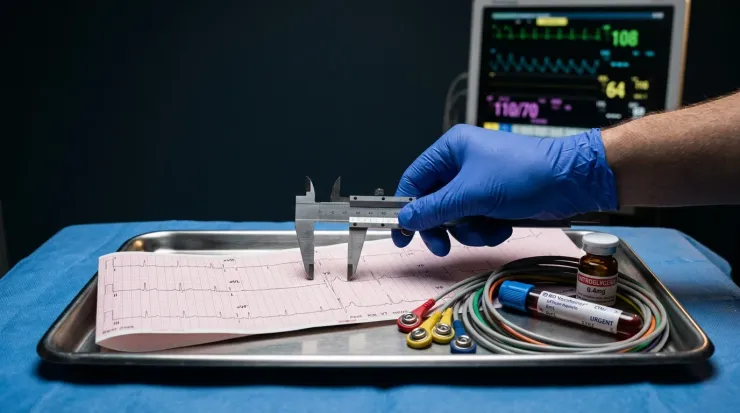
- 12-Lead EKG Within 10 Minutes: Every patient arriving with acute chest pain or an anginal equivalent must receive a 12-lead electrocardiogram within 10 minutes to check for ST-segment elevation myocardial infarction (STEMI) or dangerous arrhythmias.
- Cardiac Troponin Biomarker Testing: When heart muscle cells are deprived of oxygen, they release a structural protein called troponin into the bloodstream. A collaborative meta-analysis of 9,241 emergency patients published in the Annals of Internal Medicine by Dr. John Pickering and colleagues (
PMID: 28418520) demonstrated that pairing a non-ischemic 12-lead EKG with modern cardiac troponin testing achieves a 99.3% Negative Predictive Value (98.7% sensitivity) for ruling out acute myocardial infarction. - HEART Score Risk Stratification: Emergency physicians combine five objective factors, History, EKG, Age, Risk factors, and Troponin (the HEART Score), to guide care. In a prospective multicenter validation of 2,440 emergency chest pain patients published in the International Journal of Cardiology by Dr. Barbra Backus and colleagues (
PMID: 23465250), patients with a low-risk HEART score (0 to 3) had only a 1.7% 6-week risk of major adverse cardiac events, whereas high-risk scores (7 to 10) carried a 50.1% event rate requiring immediate cardiology intervention.
How Bellaire ER Evaluates and Stabilizes Chest Pain 24/7
Never visit an urgent care clinic or book a telemedicine visit for chest pain, chest pressure, or sudden shortness of breath. At Bellaire ER, cardiac triage begins the moment you enter our doors:
- Direct Private Exam Suite Intake: You are placed immediately on continuous cardiac telemetry and pulse oximetry without sitting in a crowded hospital waiting room.
- Bedside 12-Lead EKG in Minutes: Interpreted immediately by our on-duty, board-certified emergency physician.
- On-Site STAT Cardiac Lab Panel: Our on-site laboratory runs cardiac troponin, D-dimer (to screen for pulmonary embolism), BNP, serum electrolytes, and coagulation studies.
- 24/7 On-Site Chest X-Ray, Ultrasound & Multi-Slice CT: Our diagnostic imaging suite evaluates the heart, the lungs, and the thoracic aorta on site.
- Immediate ACLS Stabilization & Hospital Cath-Lab Coordination: Our emergency physicians and nurses administer targeted cardiac medications (aspirin, nitroglycerin, anticoagulants, beta-blockers, or antiarrhythmics). If your EKG or troponin identifies a blockage requiring cardiac catheterization (stenting), we stabilize you and arrange direct, priority EMS transfer to a specialized Texas Medical Center or Houston cardiac catheterization lab, bypassing the hospital’s emergency waiting room completely.
If you are experiencing active chest pain, central pressure, fainting, or shortness of breath right now, call 911 immediately. For 24/7 emergency cardiac evaluation in Bellaire, Meyerland, West University Place, and Southwest Houston, Bellaire ER is open around the clock at 5302 Bellaire Blvd, Bellaire, TX 77401. Call (713) 660-0001.
Frequently asked questions
When should you go to the ER or call 911 for chest pain?
Call 911 or go to the nearest 24/7 emergency room immediately for any chest pain, heavy pressure, or central tightness that lasts more than a few minutes or goes away and comes back, especially if it radiates to one or both arms, the shoulder, the neck, or the jaw, or occurs with shortness of breath, cold sweats, nausea, acute dizziness, or a racing heartbeat.
Can you have a heart attack without chest pain?
Yes. A landmark JAMA study of 1.14 million heart attack patients found that 35.4% overall, and 42.0% of women, presented to the hospital without classic chest pain. Instead, they experienced 'anginal equivalents' such as sudden unexplained shortness of breath, jaw or upper back pain, indigestion-like nausea or vomiting, cold sweats, or sudden extreme fatigue.
Does chest pain that improves with antacids or nitroglycerin rule out a heart attack?
No. According to the JAMA Rational Clinical Examination systematic review of emergency chest pain, relief after taking antacids, a 'GI cocktail,' or sublingual nitroglycerin does not distinguish heartburn from a heart attack (myocardial infarction). Only a 12-lead EKG and cardiac troponin blood test can safely rule out heart muscle injury.
How fast should an emergency room perform an EKG for chest pain?
The American Heart Association and American College of Cardiology (AHA/ACC) Chest Pain Guidelines establish a strict Class 1 standard: a 12-lead electrocardiogram (EKG) must be acquired and interpreted within 10 minutes of arrival at the emergency department, paired with cardiac troponin blood testing and continuous cardiac telemetry.
Should I go to urgent care or an emergency room for chest pain?
Never go to a walk-in urgent care clinic or schedule a telemedicine visit for acute chest pain or pressure. Urgent care clinics lack emergency cardiac resuscitation equipment, STAT cardiac troponin assays, and continuous telemetry, and will call an ambulance to transfer you to an ER, losing critical minutes when heart muscle is at risk.
Clinical references & peer-reviewed sources
- Gulati M et al. 2021 AHA/ACC/ASE/CHEST/SAEM/SCCT/SCMR Guideline for the Evaluation and Diagnosis of Chest Pain. Circulation. 2021;144(22):e368-e454. PMID: 34709879
- Swap CJ, Nagurney JT. Value and limitations of chest pain history in the evaluation of patients with suspected acute coronary syndromes. JAMA. 2005;294(20):2623-2629. PMID: 16304077
- Backus BE et al. A prospective validation of the HEART score for chest pain patients at the emergency department. Int J Cardiol. 2013;168(3):2153-2158. PMID: 23465250
- Pickering JW et al. Rapid Rule-out of Acute Myocardial Infarction With a Single High-Sensitivity Cardiac Troponin T Measurement: A Collaborative Meta-analysis. Ann Intern Med. 2017;166(10):715-724. PMID: 28418520
- Canto JG et al. Association of age and sex with myocardial infarction symptom presentation and in-hospital mortality (NRMI Study, n=1,143,513). JAMA. 2012;307(8):813-822. PMID: 22357832
Experiencing Urgent or Unclear Symptoms?
Call our clinical triage desk at (713) 660-0001. An on-duty board-certified emergency physician will evaluate your symptoms before you leave home.