
Sepsis
Sepsis is the body's life-threatening, overwhelming response to an infection, and it is always a medical emergency. Call 911 if the person is hard to wake, struggling to breathe or losing consciousness. Signs of sepsis, which is fever with confusion, a fast heart rate or breathing, clammy or discolored skin, or extreme pain, need treatment within the hour. Bellaire ER is open 24/7 and starts antibiotics and IV fluids on site. Bellaire ER provides 24/7 sepsis evaluation and treatment in Houston at 5302 Bellaire Blvd, with on-site labs and imaging to start care fast.
- Open now, 24/7/365
- Walk in, no appointment
- 5302 Bellaire Blvd, free parking
Unsure if Your Symptoms Require Emergency Care?
Call our clinical triage desk at (713) 660-0001. An on-duty board-certified emergency physician will evaluate your symptoms before you leave home.
Symptoms
- Confusion or disorientation: New mental fog, slurred speech, or trouble staying awake is one of the most dangerous warning signs.
- Fast heart rate: A racing or pounding pulse as the body reacts to infection.
- Rapid or difficult breathing: Fast, shallow breathing or shortness of breath.
- Fever, chills, or low body temperature: A high fever, shaking chills, or an unusually low temperature.
- Clammy or sweaty skin: Skin that feels cold, damp, or looks pale, blotchy, or bluish.
- Extreme pain or discomfort: Patients often describe it as the worst pain or the sickest they have ever felt.
- Low blood pressure: Dizziness, lightheadedness, or feeling faint from a drop in blood pressure.
- Little or no urine: Passing much less urine than usual can signal the kidneys are affected.
When it's an emergency
Emergency care for sepsis
Call 911 immediately for life-threatening symptoms or if you cannot travel safely. Do not drive yourself or delay for online booking.
For other urgent symptoms, seek prompt emergency evaluation. Bellaire ER accepts walk-ins 24/7. For facility questions, call (713) 660-0001.
Sepsis is a life-threatening emergency and every minute counts. Go to the nearest emergency room immediately if a person with a known or suspected infection develops confusion, a fast heart rate, rapid breathing, clammy or discolored skin, extreme pain, or a fever with shaking chills. Do not wait to see if symptoms improve on their own.
Call 911 rather than driving if the person is hard to wake, struggling to breathe, has slurred speech, or seems to be losing consciousness. These can be signs of septic shock, which is rapidly fatal without immediate treatment.
Be especially urgent if symptoms follow a recent surgery, hospital stay, catheter or IV line, wound, or a diagnosed infection such as pneumonia, a urinary tract infection, or a skin infection. Infants, adults over 65, pregnant or recently pregnant people, and those with diabetes or weakened immune systems can deteriorate very quickly.
Bellaire ER begins sepsis treatment immediately on-site with IV antibiotics and fluids, stabilizes you, and arranges hospital admission when intensive care is required.
When it's not an emergency
Sepsis itself can never be managed at home, by phone, or through telemedicine. It requires urgent, in-person evaluation with IV antibiotics and fluids.
Telemedicine or a primary care visit is reasonable only for a mild, ordinary infection with no warning signs, for example a minor cold, an uncomplicated cough, or a small skin irritation in an otherwise healthy person who is alert, breathing comfortably, and has no fever with confusion.
If you are unsure, treat it as an emergency. Sepsis can worsen within hours, so when any red-flag symptom appears, go straight to the ER rather than waiting for an appointment.
What else could be causing this
- Pneumonia and other chest infections
- The single most common source of sepsis. Cough, breathlessness, chest pain on breathing and fever are the usual signs, but in older adults pneumonia can present as confusion, a fall or simple exhaustion with no cough at all. A chest X-ray is part of almost every sepsis evaluation for this reason.
- Urinary tract and kidney infection
- The second most common source, and the most common in older adults. Burning on urination, needing to go frequently, flank or back pain, and foul or cloudy urine point to it, but again, confusion or simply being off their feet may be the only sign in an elderly person. A kidney stone blocking an infected kidney is a surgical emergency rather than a prescription.
- Infection inside the abdomen
- Appendicitis, diverticulitis, gallbladder infection, a perforated bowel or an abscess. Abdominal pain with fever, vomiting, or a rigid, exquisitely tender belly is the pattern. This group matters because antibiotics alone are not enough, the source usually has to be drained or operated on, which is a hospital decision.
- Skin and soft tissue infection
- Cellulitis, an abscess, an infected wound or ulcer, or a surgical site that has turned. Spreading redness, warmth, swelling and pain are visible, which makes this the source people recognize. Pain wildly out of proportion to what can be seen, skin that is dusky or blistering, or crackling under the skin suggests a necrotizing infection, which is a surgical emergency and deteriorates by the hour.
- Bloodstream infection from a line or device
- A central line, dialysis catheter, port, urinary catheter, pacemaker or prosthetic joint can seed bacteria directly into the blood. Fever and chills, sometimes starting while a line is being flushed, with no obvious infection anywhere else. Anyone with an indwelling device and a new fever needs to be evaluated rather than observed at home.
- Infection of the brain or spinal covering
- Meningitis and related infections. Fever with severe headache, a stiff neck, light sensitivity, confusion or a seizure, and in some cases a rash of small purple or red spots that do not fade when pressed. This combination is a call-emergency care emergency, both because it progresses quickly and because the people around the patient may need preventive treatment.
- Bone and joint infection
- Osteomyelitis or an infected joint, which can follow an injury, surgery, a foot ulcer in diabetes, or spread through the blood. A single hot, swollen joint that is too painful to move, or deep persistent bone pain with fever, is the presentation. These need drainage or prolonged intravenous antibiotics, so they are hospital problems.
- Dental, postoperative and pregnancy-related infections
- A dental abscess that has spread into the neck, a wound infection after an operation, or an infection during or after pregnancy. These are easy to underestimate because the original problem seemed minor or was thought to be resolving. Fever, swelling, severe pain or feeling systemically unwell after any of these is a reason to be seen the same day.
- Conditions that imitate sepsis
- Severe dehydration, uncontrolled diabetes going into ketoacidosis, a major blood clot in the lung, heat stroke, a thyroid crisis, adrenal insufficiency and some drug reactions can all produce fever, a racing heart, fast breathing, low blood pressure and confusion. They are distinguished by testing, not by appearance, and the early treatment of the sickest patients overlaps a great deal. Which is why evaluation and treatment start at the same time.
What happens when you arrive
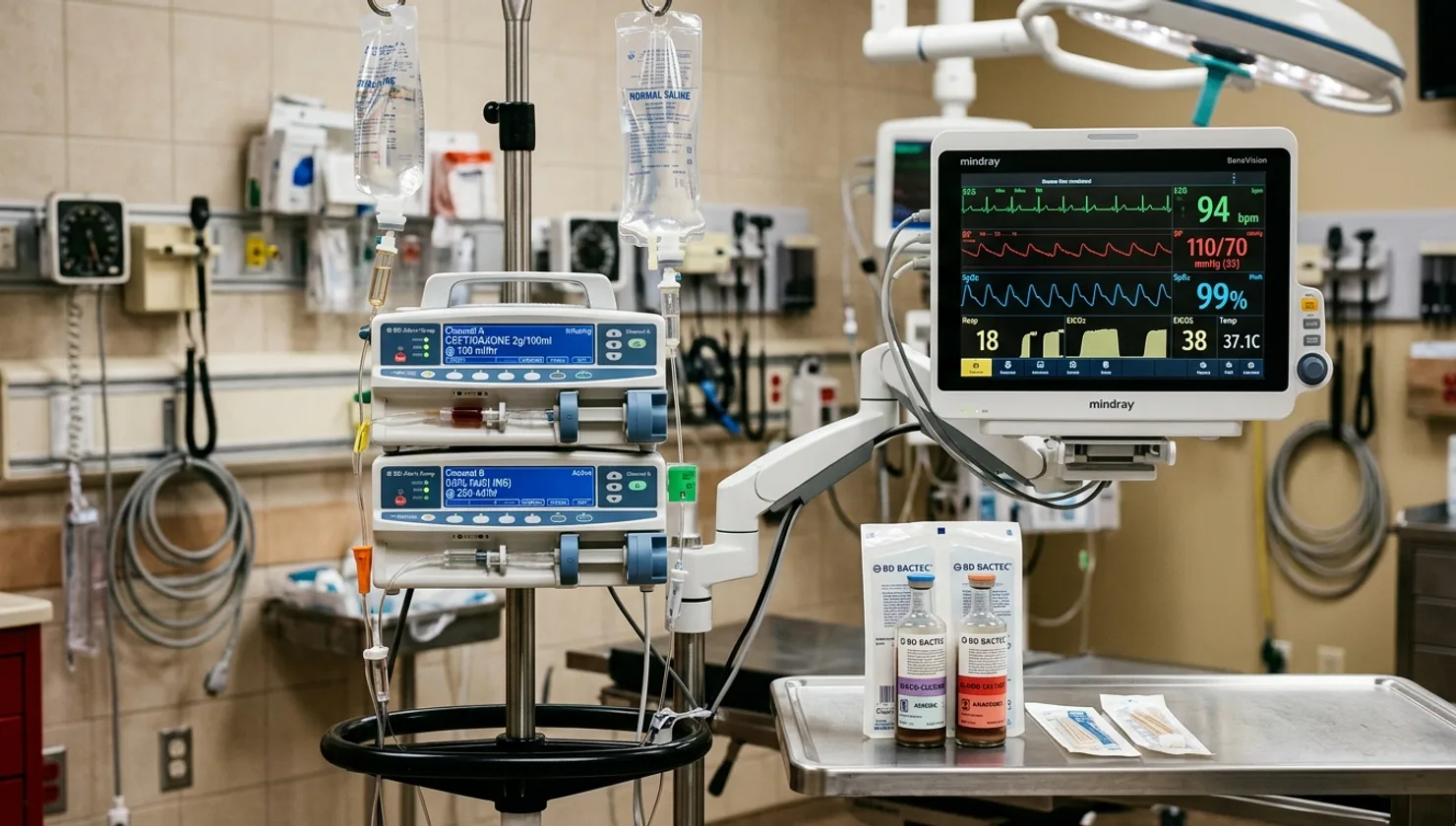
At Bellaire ER a board-certified emergency physician checks your vital signs and looks for the source of infection. Because sepsis is time-sensitive, we can draw labs (including blood counts, lactate, and cultures) and perform X-ray, CT, or ultrasound on-site to identify the infection fast.
Treatment typically begins right away with IV fluids and IV antibiotics, along with oxygen and close monitoring as needed. Starting these early is critical to stopping sepsis from progressing to organ failure or septic shock.
We diagnose and stabilize in a single visit. Many patients can be treated and discharged with a clear follow-up plan, and if your condition requires hospital admission or intensive care, we arrange and coordinate that transfer promptly.
Tests we can run on site
- Vital signs and mental status
- Temperature, heart rate, breathing rate, blood pressure, oxygen level and how clear-headed you are. These are what identify sepsis, and they are repeated throughout the visit rather than taken once. New confusion in someone with an infection is one of the most important findings in emergency medicine, and a fast breathing rate is often the earliest sign of all.
- Lactate blood test
- Lactate rises when tissues are not getting enough oxygen delivered to them. It is the single most useful blood test for judging how severe sepsis is, it guides how much intravenous fluid is needed, and it is repeated after treatment to see whether the body is responding. Available from the on-site laboratory.
- Blood cultures
- Blood drawn into bottles and grown in the laboratory to identify bacteria in the bloodstream and which antibiotics kill them. They are taken before antibiotics start wherever possible, because antibiotics can make the cultures negative. Results take a day or more, so they refine treatment later rather than guide it now.
- Blood count, chemistry and clotting panel
- A broad look at how the body is coping. The white cell count can be high or abnormally low, kidney and liver function show whether organs are being affected, and the clotting panel and platelet count reveal the blood's clotting system being consumed, one of the more dangerous features of severe sepsis.
- Urine testing
- A urine sample examined and cultured. It identifies the urinary tract as the source, which it very often is in older adults, and the culture tells which antibiotic to continue. How much urine you are producing is itself a measure of how the kidneys are holding up.
- Chest X-ray
- On-site imaging of the lungs, looking for pneumonia, fluid or collapse. It is done in nearly every sepsis evaluation because the chest is the most common source and because breathing is often affected regardless of where the infection started.
- CT scan
- Cross-sectional imaging, available on site, used to find a source that the examination and basic tests have not explained: an abscess, appendicitis, diverticulitis, a blocked and infected kidney, or infection in the deep tissues. Finding the source matters because some sources cannot be cured with antibiotics alone and need drainage or surgery.
- Ultrasound
- Bedside sound-wave imaging, without radiation, used to look at the gallbladder, the kidneys for obstruction, the heart's filling and function, and fluid in the abdomen. It also helps judge how someone is responding to intravenous fluid, which is a continuous question in sepsis rather than a single calculation.
Treated here, or transferred
Bellaire ER is a licensed freestanding emergency room, open 24 hours a day, 365 days a year, staffed by board-certified emergency physicians and nurse practitioners, with on-site CT, X-ray, ultrasound and laboratory, and medication given on site during your visit. It is equipped for emergency evaluation, stabilization and treatment, and it is not a hospital. There is no intensive care unit and no operating room here. For sepsis, that distinction is the whole point of understanding what this visit does: it begins the treatment that cannot wait, and it gets you to the place that can continue it.
Treatment starts before the diagnosis is complete, because in sepsis the two run together. That means intravenous fluids, intravenous antibiotics chosen to cover the likely source, oxygen, continuous monitoring, medication for fever and pain, and the blood work and imaging that identify where the infection is. Antibiotics given early, rather than after every result is back, is the part of sepsis care that most changes outcomes.
Sepsis itself almost always needs hospital admission, and often intensive care. A patient whose blood pressure stays low despite fluids, who needs medication to support their circulation, who needs a procedure or an operation to drain the source, or who needs admission for intravenous antibiotics and monitoring will be stabilized here and transferred to the appropriate hospital service. The receiving team gets the cultures, the imaging and the lactate already drawn, so nothing restarts from the beginning.
Not every infection evaluated for sepsis turns out to be sepsis. Where the testing is reassuring and the source is one that can be treated as an outpatient, treatment is started here, with a prescription written for you to fill at your own pharmacy, specific return instructions and follow-up. Transfer is a normal part of how a freestanding emergency room works, and for a septic patient it is what the visit is for.
Children
Bellaire ER treats adults and children. Sepsis in children is less common than in adults, but it moves faster, and children hide it better, a child's body compensates well until it does not, so blood pressure falls late. By the time it does, the situation is critical. That is why the earlier signs are what matter.
In a baby, those signs are not a high fever. Watch for feeding much less than usual, unusual sleepiness or being difficult to wake, high-pitched or inconsolable crying, floppiness, grunting or fast breathing, pauses in breathing, fewer wet diapers, cold hands and feet with mottled or blotchy skin, and a temperature that is unusually low rather than high. Any fever in an infant under three months needs in-person evaluation the same day, without exception.
In an older child, the concerning pattern is fast breathing, a racing heart that does not settle as the fever comes down, cold or mottled hands and feet, severe pain anywhere, not passing urine, being unusually drowsy or confused, or a child who looks and behaves very unwell between fevers rather than just during them. A rash of small purple or red spots that does not fade when pressed, or a stiff neck with severe headache and light sensitivity, means calling emergency care rather than making a plan.
Some children need to be seen with any fever and without waiting: newborns, children with sickle cell disease, children without a functioning spleen, children receiving chemotherapy or on medication that suppresses the immune system, children with a central line or a shunt, and children who are not fully immunized. Tell the physician about any of these on arrival, because it changes how urgently your child is assessed.
Parental judgment counts here. If your child looks sicker than any previous illness, or something seems fundamentally wrong even though you cannot name it, say so plainly and ask to be reassessed, in pediatric emergency medicine that observation is treated as information, not as anxiety.
After you leave
If you were evaluated for a possible infection and sent home, the instructions you were given about coming back are the most important part of the visit. Sepsis is a process that develops over hours, and a reassuring set of tests describes the moment they were taken. Have someone stay with you for the first day if you can.
Call 911 if the person is hard to wake, struggling to breathe or losing consciousness. Seek emergency care immediately for new confusion, slurred speech or difficulty staying awake, breathlessness or fast breathing, a racing heart, feeling faint or being unable to stand, skin that is cold, clammy, pale, mottled or bluish, a rash of small purple or red spots that does not fade when you press on it, passing little or no urine, repeated vomiting that stops you keeping fluids or medication down, or a sense that you are getting sicker rather than better. That last one is a legitimate reason to come back on its own, and people with sepsis often describe knowing something was badly wrong.
Finish every dose of the antibiotic you were prescribed, even once you feel better, and keep taking fluids. Keep the follow-up appointment and the recheck of any wound, and make sure the culture results are followed up, they sometimes change which antibiotic you should be on.
Recovery after sepsis takes longer than people expect. Weeks to months of fatigue, weakness, poor appetite, disturbed sleep, difficulty concentrating, low mood and anxiety are common after a severe episode, and this is a recognized pattern rather than a complication. Build activity gradually, ask your physician about what rehabilitation is appropriate, and raise cognitive or mood symptoms rather than waiting for them to pass. Having had sepsis once raises the chance of another infection, so treat new infections promptly and keep vaccinations current.
What this visit costs
We accept most major insurance and bill your insurer directly. For emergency care, federal law caps what you pay at in-network rates and bars surprise bills, your deductible and copay still apply. Never delay emergency care over cost.
See how ER billing worksInsurance and coverage questionsRead the facility notice
Questions about a specific plan? Call (713) 660-0001. Only your plan can tell you how a claim will be processed.
Lowering your risk
Because sepsis starts with an infection, preventing and promptly treating infections lowers your risk. Stay up to date on recommended vaccines, including flu and pneumonia vaccines, and clean and care for any wounds properly.
Manage chronic conditions such as diabetes, take prescribed antibiotics exactly as directed, and practice good hand hygiene. If you have an infection that is getting worse instead of better, seek care early rather than waiting.
Common questions
When should I go to the ER for sepsis?
Call 911 if the person is hard to wake, struggling to breathe or losing consciousness. Seek emergency care immediately if someone with a known or suspected infection develops confusion, a fast heart rate or breathing, clammy or discolored skin, extreme pain, or a fever with shaking chills. Sepsis worsens by the hour, so do not wait. When in doubt, treat it as an emergency.
What are the warning signs of sepsis?
Common signs include new confusion or disorientation, a racing heartbeat, rapid or difficult breathing, fever or chills (or an unusually low temperature), clammy or pale skin, extreme pain, and low blood pressure causing dizziness. These often appear together and can escalate quickly, especially after a recent infection, surgery, or hospital stay.
Can sepsis be treated with telemedicine or at home?
No. Sepsis is a medical emergency that cannot be treated at home or by video visit. It requires urgent in-person care with IV antibiotics and fluids. Telemedicine may help with a mild, ordinary infection that has no warning signs, but any sign of sepsis needs the ER right away.
What happens when I come to Bellaire ER with sepsis symptoms?
A board-certified emergency physician evaluates you quickly and uses on-site labs and imaging (X-ray, CT, or ultrasound) to find the infection. Treatment often starts immediately with IV fluids and antibiotics. We diagnose and stabilize in a single visit and coordinate hospital admission if your condition requires it.
Who is most at risk for sepsis?
Anyone can develop sepsis, but the risk is highest for infants, adults over 65, pregnant or recently pregnant people, and those with chronic illnesses like diabetes, lung, or kidney disease, or weakened immune systems. A recent surgery, hospital stay, catheter, or wound also raises the risk.
Why prompt attention matters
Sepsis is a medical emergency. Prompt intervention is what prevents progression to severe sepsis or septic shock, which can cause multiple organ failure and death. It can develop from any infection, which is why fever combined with confusion, breathlessness, or a very fast heartbeat needs immediate evaluation.
Get care at Bellaire ER
Walk in any time at 5302 Bellaire Blvd, Bellaire, TX 77401 (get directions) or call 713-660-0001. No appointment is required to be seen, though you can save your spot online if you prefer.
Sources & further reading
Medical information on this page is consistent with guidance from these trusted organizations:
People also ask
When should I go to the ER for sepsis?
Come straight to the ER immediately if you suspect sepsis. There is no safe window to wait. If someone with a known or suspected infection develops confusion, fast breathing, a racing heart, fever with shivering, or clammy, discolored skin, seek emergency care right away. Call 911 if symptoms are life-threatening or the person cannot travel safely.
Read full answer →