
UTI & Kidney Infection Treatment: When a Urinary Tract Infection Needs 24/7 Emergency Care
Clinically reviewed by Mario Quintanilla, MD, Board-Certified Emergency Physician, on October 17, 2026.
Bellaire ER is a freestanding emergency room at 5302 Bellaire Blvd, open 24/7/365. Walk in or call ((713) 660-0001) anytime.
- Open now, 24/7/365
- Walk in, no appointment needed
- 5302 Bellaire Blvd, free parking
Clinical Triage Answer: Burning urination and frequent urges without fever typically indicate lower bladder inflammation (acute cystitis, ICD-10 N30.00). However, if urinary symptoms are accompanied by fever (>= 100.4°F) or shaking chills, mid-back or flank pain, nausea and vomiting, inability to urinate, or confusion in an older adult, the infection may have ascended into the kidneys (acute pyelonephritis, ICD-10 N10) or bloodstream (urosepsis). These warning signs require immediate emergency room evaluation, intravenous antibiotics, and diagnostic imaging.
At Bellaire ER, board-certified emergency physicians provide 24/7 rapid urinalysis, urine culture setup, metabolic and sepsis blood panels, non-contrast abdominopelvic CT scans, and initial intravenous antimicrobial therapy in private exam suites.
Lower Bladder UTI (Cystitis) vs. Upper Kidney Infection (Pyelonephritis)
The urinary tract is a continuous anatomical system connecting the urethra, bladder, ureters and kidneys. Most urinary tract infections begin when uropathogenic bacteria (most commonly Escherichia coli, causing over 80% to 90% of cases) colonize the urethra and bladder lining.
In the JAMA Rational Clinical Examination systematic review by Dr. Stephen Bent and colleagues (PMID: 12020306), researchers demonstrated that the combination of painful urination (dysuria) and urinary frequency in the absence of vaginal discharge or irritation raises the probability of an acute urinary tract infection to over 90% (positive likelihood ratio 24.6). However, when the clinical picture includes fever, flank pain, or costovertebral angle (CVA) tenderness over the lower ribcage, simple oral cystitis regimens are no longer sufficient.
| Clinical Feature | Uncomplicated Bladder UTI (ICD-10 N30.00) |
Acute Kidney Infection / Pyelonephritis (ICD-10 N10) |
|---|---|---|
| Primary Anatomical Site | Lower urinary tract (bladder mucosa and urethra) | Upper urinary tract (renal pelvis and kidney parenchyma) |
| Temperature | Normal (< 99.5°F), no systemic chills |
Fever (>= 100.4°F, often > 102°F) or shaking rigors |
| Pain Location | Mild suprapubic pressure above the pubic bone | Deep, aching unilateral or bilateral flank/back pain (CVA tenderness) |
| GI Symptoms | Normal appetite; able to tolerate oral liquids and pills | Nausea, vomiting or anorexia preventing oral medication intake |
| Hemodynamic Status | Normal heart rate and blood pressure | Risk of tachycardia (HR > 90 bpm), hypotension, and urosepsis |
| Standard of Care | Targeted oral antibiotics (3 to 5 days) + urine testing | Urine culture + blood work + initial IV antibiotics + CT/ultrasound if obstructed |
6 Emergency Red Flags That Require a 24/7 ER
According to the Infectious Diseases Society of America (IDSA) and European Society for Microbiology and Infectious Diseases (ESCMID) International Clinical Practice Guidelines, authored by Dr. Kalpana Gupta and colleagues (PMID: 21292654), and the multicenter JAMA pyelonephritis trial by Dr. David Talan and colleagues (PMID: 10735395), rising antimicrobial resistance (18% to > 20% E. coli resistance to trimethoprim-sulfamethoxazole) makes urine culture testing and initial parenteral (IV) antibiotic administration critical in complicated or severe infections.
Skip urgent care and come directly to the emergency room for any of these six scenarios:
- Fever, Chills and Flank Pain (
Acute Pyelonephritis): High fever paired with pain under the back ribs means bacteria have invaded the vascular kidney tissue, where untreated infection can enter the bloodstream within hours. - Suspected Kidney Stone + UTI (
Obstructive Pyelonephritis,ICD-10 N13.6): This is one of the most time-critical emergencies in urology. When a kidney stone blocks the ureter while infection is present, pus builds up behind the stone like an abscess under pressure, and oral antibiotics cannot penetrate the blocked kidney. In a study of 1,712 septic ureteral stone patients published in the Journal of Urology by Dr. Michael Borofsky and colleagues (PMID: 23017519), mortality more than doubled (19.2% vs. 8.82%,p < 0.001) when patients did not receive urgent diagnosis and urologic decompression. - Nausea and Vomiting: If you cannot keep water or pills down, oral antibiotics are useless. Intravenous antiemetics (
ondansetron), IV crystalloid hydration, and IV antibiotics (ceftriaxone,ertapenem, oraminoglycosides) are required to halt progression. - Acute Urinary Retention or Gross Blood Clots: Straining without being able to pass urine, severe lower abdominal distension, or passing thick blood clots requires immediate bladder ultrasound scanning and sterile catheter decompression.
- Pregnancy, Diabetes, Immunosuppression or Male Patients: UTIs during pregnancy carry a high risk of pyelonephritis and preterm labor; UTIs in diabetic or immunocompromised patients can progress rapidly to emphysematous pyelonephritis or septic shock.
- Pediatric Febrile UTIs & Elderly Delirium: In a meta-analysis of 18 pediatric studies published in the Pediatric Infectious Disease Journal by Dr. Nader Shaikh and colleagues (PMID: 18316994), 7.0% of febrile infants under 24 months had a UTI, rising to 20.1% in uncircumcised febrile male infants under 3 months. At the other end of life, older adults frequently present with sudden confusion, dizziness or lethargy as their sole sign of urosepsis.
How Bellaire ER Diagnoses and Treats Complicated UTIs 24/7
When a UTI strikes at midnight or progresses to flank pain and fever, waiting two days for a clinic appointment or sitting in a crowded hospital waiting room puts your kidneys at risk. At Bellaire ER (5302 Bellaire Blvd, Bellaire, TX 77401), we deliver complete diagnostic and therapeutic care in a single visit:
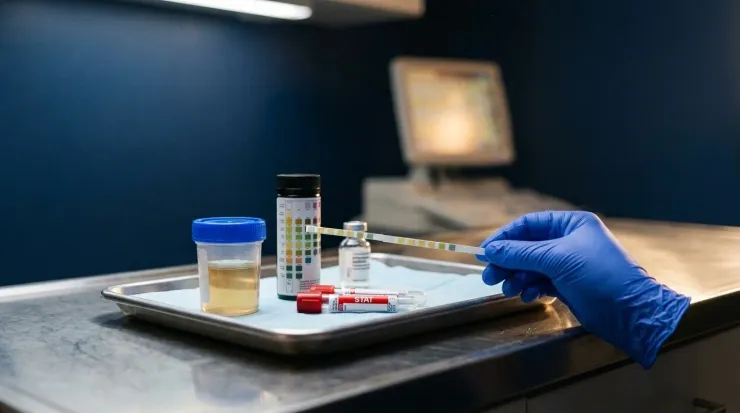
- Rapid On-Site Urinalysis & Microscopy: Our COLA-certified on-site laboratory performs immediate dipstick and microscopic urinalysis (measuring leukocyte esterase, nitrites, white blood cell count, red blood cells, and bacteria) in minutes while sending a definitive urine culture and antimicrobial susceptibility panel so your ongoing oral antibiotic is matched to the exact organism.
- Renal Function & Sepsis Blood Panels: For patients with fever or flank pain, we run an immediate Complete Blood Count (
CBC), Comprehensive Metabolic Panel (CMPto verify serum creatinine andeGFRkidney filtration), serum lactate, and blood cultures. - Non-Contrast Helical CT & Bedside Renal Ultrasound: If you have severe flank pain or a history of stones, our on-site multi-slice CT scanner and bedside ultrasound immediately rule out an obstructing ureteral stone, hydronephrosis (kidney swelling), or perinephric abscess.
- Immediate IV Antibiotics, Hydration & Pain Relief: Before you head home, or while we coordinate inpatient urology care if a stone is obstructing the kidney, our physicians administer long-acting intravenous antibiotics, IV fluid resuscitation, and targeted analgesia (
ketorolacor urinary tract analgesics) so burning and flank pain begin subsiding before you head home.
Walk into Bellaire ER 24/7 at 5302 Bellaire Blvd or call (713) 660-0001 for immediate emergency evaluation.
Frequently asked questions
How do I know if my UTI has spread to my kidneys?
A simple bladder infection (cystitis) causes local lower urinary symptoms such as burning during urination, frequent small voids, and mild suprapubic pressure without a fever. Once bacteria ascend the ureters into the kidneys (acute pyelonephritis), systemic symptoms appear, including fever over 100.4°F, shaking chills, deep one-sided back or flank pain, nausea and vomiting.
When should I go to the emergency room for a UTI?
Go to a 24/7 emergency room immediately if you develop fever or chills, mid-to-upper back or flank pain, nausea and vomiting that prevent you from keeping oral antibiotics down, visible blood clots or inability to pass urine, confusion in an older adult, or UTI symptoms during pregnancy or alongside a known history of kidney stones.
Why is a UTI combined with a kidney stone a life-threatening emergency?
When a kidney stone blocks the ureter while a urinary tract infection is present, infected urine becomes trapped under high pressure inside the kidney (obstructive pyelonephritis). A nationwide study in the Journal of Urology found that mortality in patients with sepsis and obstructing ureteral stones more than doubles (19.2% vs. 8.82%) without urgent CT diagnosis, IV antibiotics, and urologic decompression.
Can a urinary tract infection cause confusion in elderly patients?
Yes. Older adults with a severe UTI or early urosepsis frequently do not complain of painful urination or mount a high fever. Instead, sudden confusion, agitation, lethargy, dizziness or an unexplained fall is often the primary warning sign requiring immediate emergency blood and urine workup.
Can children and infants get serious urinary tract infections?
Yes. According to a meta-analysis in the Pediatric Infectious Disease Journal, 7.0% of infants under 24 months presenting with an unexplained fever have a urinary tract infection, with rates reaching 20.1% in uncircumcised febrile male infants under 3 months. Prompt catheterized or clean-catch urinalysis and culture prevent permanent renal scarring.
Clinical references & peer-reviewed sources
- International clinical practice guidelines for the treatment of acute uncomplicated cystitis and pyelonephritis in women: A 2010 update by the Infectious Diseases Society of America and the European Society for Microbiology and Infectious Diseases
- Does this woman have an acute uncomplicated urinary tract infection?
- Surgical decompression is associated with decreased mortality in patients with sepsis and ureteral calculi
- Prevalence of urinary tract infection in childhood: a meta-analysis
- Comparison of ciprofloxacin (7 days) and trimethoprim-sulfamethoxazole (14 days) for acute uncomplicated pyelonephritis in women: a randomized trial
Have Questions About Visiting Bellaire ER?
Call our team at (713) 660-0001 any time with questions about visiting our independent, physician-owned freestanding emergency room at 5302 Bellaire Blvd, open 24/7 with short waits.