
Skull and Face Fractures
A suspected skull or facial fracture after a blow, fall, or crash should be evaluated in an emergency room, not urgent care, because these injuries often accompany a brain injury and can affect the eyes, airway, and nerves. Bellaire ER, a 24/7 freestanding emergency room in Bellaire near Houston, has on-site CT and X-ray to confirm a fracture and check for bleeding in a single visit. If there is heavy bleeding, loss of consciousness, or clear fluid draining from the nose or ears, call 911 immediately rather than driving yourself.
- Open now, 24/7/365
- Walk in, no appointment
- 5302 Bellaire Blvd, free parking
Unsure if Your Symptoms Require Emergency Care?
Call our clinical triage desk at (713) 660-0001. An on-duty board-certified emergency physician will evaluate your symptoms before you leave home.
Symptoms
- Pain and tenderness: Focused pain, tenderness, or a step-off you can feel at the injured bone.
- Swelling and bruising: Rapid swelling or bruising, including bruising around both eyes or behind the ear.
- Facial deformity: A flattened cheek, crooked nose, sunken eye, or teeth that no longer meet correctly.
- Double or blurred vision: Trouble moving the eye or double vision, which can signal an eye-socket fracture.
- Numbness: Numbness of the cheek, upper lip, gums, or forehead from injury to facial nerves.
- Bleeding or clear drainage: Nosebleed, bleeding from the ear, or thin clear fluid draining from the nose or ear.
- Head-injury signs: Headache, confusion, drowsiness, nausea, or vomiting suggesting a possible concussion or brain injury.
When it's an emergency
Emergency care for skull and face fractures
Call 911 immediately for life-threatening symptoms or if you cannot travel safely. Do not drive yourself or delay for online booking.
For other urgent symptoms, seek prompt emergency evaluation. Bellaire ER accepts walk-ins 24/7. For facility questions, call (713) 660-0001.
Call 911 immediately for loss of consciousness, a seizure or difficulty waking after a head injury. Seek emergency evaluation for any head or face injury with loss of consciousness, repeated vomiting, a seizure, worsening confusion or drowsiness, weakness or numbness on one side, unequal pupils, or a severe or worsening headache. These can be signs of bleeding or swelling in the brain, which is a life-threatening emergency.
Go to the ER right away, or call 911 if you cannot travel safely, for thin clear fluid draining from the nose or ears, bruising around both eyes or behind the ear, a visibly deformed or unstable face, a nosebleed you cannot control, or any injury to the eye or vision.
Seek emergency care for facial injuries that affect breathing or swallowing, cause the jaw or teeth to no longer line up, or come with heavy bleeding. High-energy injuries such as car crashes, assaults, and falls from a height carry a higher risk of serious fracture and hidden brain injury and should be evaluated in an ER.
Because skull and facial fractures so often overlap with head injury, when in doubt it is safer to be checked. Blood thinners, older age, and a bleeding disorder raise the risk and lower the threshold for going in.
Bellaire ER evaluates and stabilizes skull and facial injuries 24/7 with on-site CT and X-ray, and arranges rapid hospital transfer when neurosurgical or specialist repair is required.
When it's not an emergency
A very minor, isolated facial injury with no fracture signs may be reasonable to watch at home or discuss by telemedicine first. Examples include a small nose bump with no deformity and normal breathing, mild swelling that improves with ice, or a superficial bruise or scrape with no other symptoms.
Telemedicine or a primary care or dental visit can be appropriate for lingering questions after a known minor injury, such as a small chip in a tooth, mild jaw soreness with a normal bite, or follow-up on a previously evaluated injury.
If you are unsure, or if pain, swelling, or vision changes worsen over the following hours, get an in-person exam. Telemedicine cannot perform the CT or X-ray imaging needed to rule out a fracture or bleeding, so any real concern for a broken bone belongs in the ER.
What else could be causing this
- Nasal fracture
- The most common facial fracture, from a ball, an elbow, a fall or an assault. Swelling, a nosebleed, a bend that was not there before, and difficulty breathing through one side. The part that matters most is not visible from outside: a blood collection on the septum inside the nose needs urgent treatment, because left alone it destroys the cartilage and collapses the bridge.
- Orbital floor fracture
- A blow to the eye raises pressure in the socket and cracks the thin bone beneath it. The giveaways are double vision when looking up, numbness of the cheek and upper lip, a sunken-looking eye, and air crackling under the skin after blowing the nose. The eye itself must be examined separately, because the socket and the globe are injured by the same force.
- Cheekbone fracture
- The cheekbone usually breaks in several places at once where it joins the skull, flattening the cheek, pushing the eye slightly out of position and limiting how far the mouth will open. Numbness over the cheek is common. Because it forms the outer wall of the eye socket, these fractures are assessed for the eye and for the bite as well as for appearance.
- Midface fracture
- A high-energy injury, usually from a crash or a serious assault, in which the upper jaw separates from the skull along one of several recognized patterns. The face may feel mobile when gently moved, the bite is wrong, and the swelling is dramatic. This group threatens the airway and is managed as major trauma, not as a facial injury.
- Jaw fracture
- The lower jaw breaks from a blow to the chin or side of the face, often in two places because of its shape. The signs are pain on opening, teeth that no longer meet properly, numbness of the lower lip, bleeding in the gum line, and difficulty speaking or swallowing. A jaw that will not close, or a bite that is suddenly wrong, is a fracture or a dislocation until imaging says otherwise.
- Skull vault fracture
- A break in the bone covering the brain, which may be a simple line or a depressed segment pushed inward. On its own a linear fracture often needs no specific treatment; what matters is the brain underneath and whether there is bleeding. A depressed fracture, or any fracture with an overlying wound, is a different matter and needs neurosurgical assessment.
- Skull base fracture
- A fracture through the floor of the skull, which carries the specific risk of tearing the lining of the brain. The classic signs are bruising around both eyes or behind the ear, blood or thin clear fluid draining from the nose or ear, and new hearing loss. Clear fluid draining after a head injury is a reason to be seen now, because it is a direct route for infection to the brain.
- Forehead and frontal sinus fracture
- A blow to the forehead can break the front wall of the sinus, the back wall, or both. A visible dent, a wound over the brow, or numbness of the forehead points to it. Because the back wall of that sinus is the front of the brain's compartment, these fractures are examined for both a cosmetic deformity and a route for infection, and they are usually a specialist decision.
- Temporal bone fracture
- A fracture through the dense bone around the ear, from a blow to the side of the head. Hearing loss, bleeding from the ear canal, bruising behind the ear, vertigo, or weakness of the face on that side are the signs. Facial weakness or new deafness after a head injury always needs specialist assessment rather than waiting to see whether it recovers.
What happens when you arrive
At Bellaire ER a board-certified emergency physician examines the injured area, checks your vision, eye movements, facial sensation, bite, and airway, and screens for signs of brain injury. We assess how the injury happened to gauge the risk of a serious fracture.
We have CT and X-ray on-site. CT is the main test for skull and facial fractures and also shows bleeding around the brain; X-ray and our on-site lab support the workup as needed, so appropriate imaging can be performed on site. Timing depends on clinical needs and availability.
Many stable, isolated fractures are managed with pain control, ice, wound care, and specialist follow-up with ear-nose-throat, oral-maxillofacial, plastic surgery, or ophthalmology. We handle diagnosis and initial treatment in a single visit, and most patients do not need a hospital transfer.
If imaging shows bleeding in the brain, an open or complex fracture, an unstable airway, or an injury that needs an operation, we stabilize you and arrange rapid transfer to the appropriate specialty or trauma service.
Tests we can run on site
- Structured facial examination
- A physician works systematically over the face: feeling along the orbital rims, cheekbones, nose and jaw for steps or crepitus, looking down on the face from above and behind to spot flattening, checking how far the mouth opens, and asking you to bite together. A bite that has changed is one of the most reliable signs of a facial fracture there is, and most people notice it immediately when asked.
- Eye examination
- Vision in each eye, pupil reaction, and whether the eye moves fully in every direction, along with an examination of the eye itself for injury. Double vision on looking up, an eye that will not move in one direction, pain on movement, or any drop in vision are findings that change the urgency. Vision that is deteriorating after a facial injury, with a tense, bulging eye, is a sight-threatening emergency.
- Facial sensation and nerve testing
- Numbness over the cheek, upper lip, gums, lower lip, chin or forehead maps precisely onto which bone is broken, because each fracture pattern traps a particular nerve. Weakness of the muscles of facial expression on one side points instead to injury of the facial nerve, usually with a temporal bone fracture.
- Airway, nose and mouth inspection
- Inside the nose, a physician looks for a septal blood collection that requires urgent treatment. Inside the mouth, for bruising along the gum line, loose or missing teeth, and whether the jaw moves as one piece. Difficulty swallowing, a changing voice, or noisy breathing after a facial injury is an airway problem and takes priority over everything else.
- Neurological examination
- Alertness, memory of the event, pupils, limb strength and coordination. Any force that fractures the skull or face transmits to the brain, so this examination runs alongside the bone assessment rather than after it, and it is repeated to detect a change.
- CT scan of the head and face
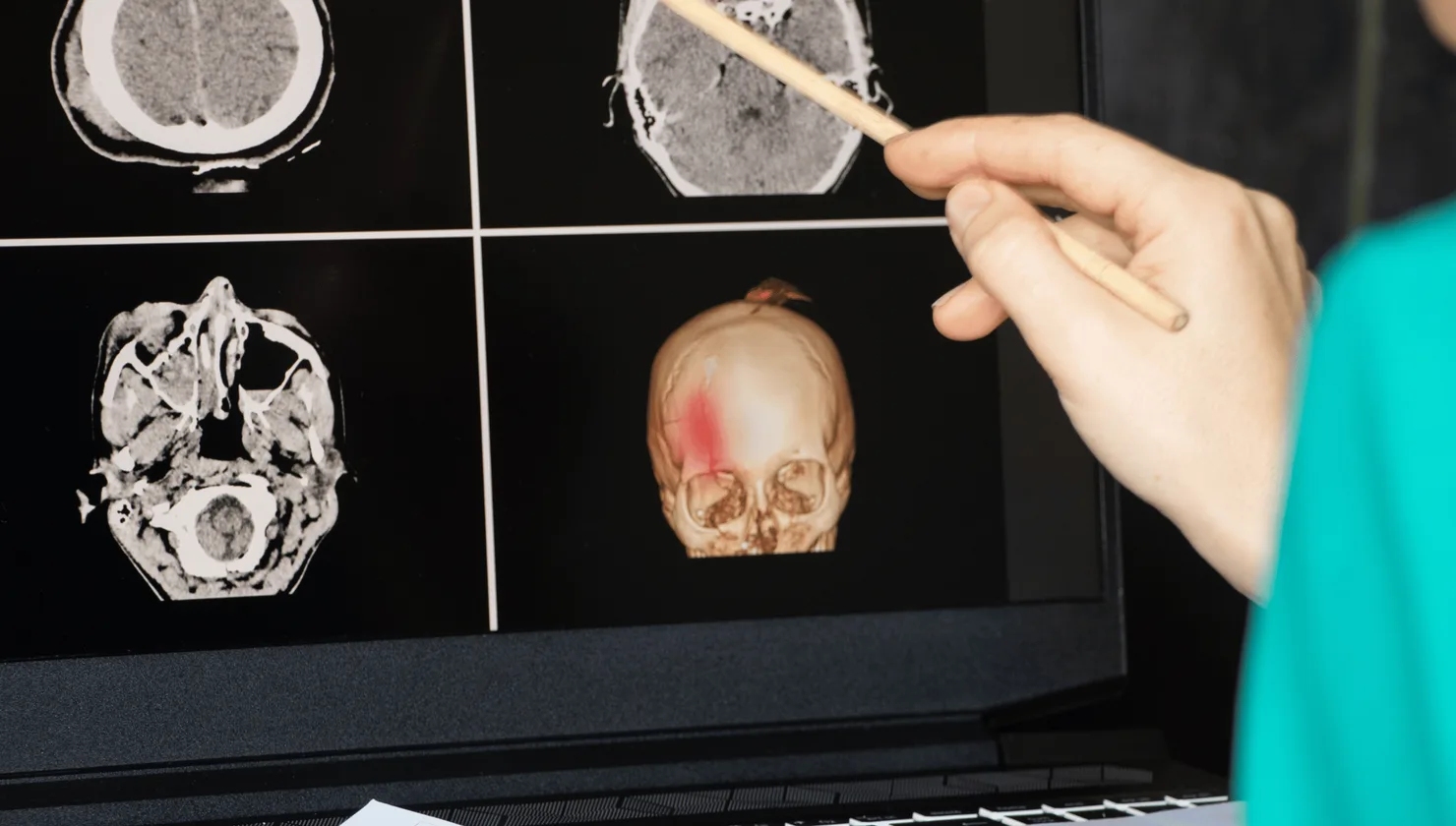
- The definitive test, and it is on site. Thin-slice imaging shows exactly which bones are broken, how many fragments there are, whether a fragment is pressing on something, whether the eye socket floor has given way, and at the same time whether there is bleeding around or within the brain. Facial fractures are no longer diagnosed by plain X-ray for this reason.
- CT scan of the cervical spine
- Imaging of the neck, added routinely for significant facial trauma because the mechanisms overlap, the force that breaks a cheekbone in a crash also loads the neck. Neck pain or midline tenderness makes it essential.
- X-ray and blood work
- On-site X-ray has a limited but real role: dental films for tooth and jaw injuries, and chest and limb imaging for the other injuries sustained in the same event. The on-site laboratory checks a blood count and clotting, which matters a great deal for anyone taking a blood thinner, and provides the baseline results a receiving surgical team will need.
Treated here, or transferred
Bellaire ER is a licensed freestanding emergency room, open 24 hours a day, 365 days a year, staffed by board-certified emergency physicians and nurse practitioners, with on-site CT, X-ray, ultrasound and laboratory, and medication given on site during your visit. It is equipped for emergency evaluation, stabilization and treatment, and it is not a hospital. There is no operating room, no neurosurgeon and no facial surgeon on site, so a central purpose of this visit is to establish precisely what is broken, what the brain and the eye look like, and who needs to see you and how quickly.
Many facial fractures need no operation at all, and those are managed here. An undisplaced nasal fracture, a simple cheekbone or orbital floor fracture with normal vision and eye movement, an isolated linear skull fracture with a reassuring CT, and most dental and soft tissue injuries are treated with pain control, ice, wound cleaning and closure, antibiotics where the fracture involves a sinus or an open wound, a tetanus update, a soft diet where the jaw is involved, and a referral to the right specialist: ear, nose and throat, oral and maxillofacial, plastic surgery or ophthalmology, with a timeframe attached.
A few things are treated here urgently because waiting causes permanent harm. A blood collection on the nasal septum is drained rather than left. Heavy nosebleeds are controlled. An eye at risk is assessed immediately rather than after the fracture is characterized.
Some injuries need a hospital. Bleeding in the brain, a depressed or open skull fracture, clear fluid leaking from the nose or ear, a midface fracture, any threat to the airway, an entrapped eye muscle, rising pressure behind the eye, a fracture requiring surgical fixation, and anyone needing admission or intensive monitoring will be stabilized here and transferred to the appropriate hospital, trauma or specialty service. Stabilization means airway and breathing support, bleeding control, pain and nausea treatment, immobilization where the neck is involved, and the imaging already completed so the receiving team starts from where you are rather than from the beginning. Transfer is a normal part of how a freestanding emergency room works, not a failure of the visit.
Children
Bellaire ER treats adults and children. A child's facial bones are more elastic than an adult's, so they bend and crack in patterns adults do not, and the bones themselves are still growing. That second fact is why childhood facial fractures are referred to specialists more readily than equivalent adult injuries: a fracture through a growth area of the jaw or the nose can alter how the face develops over years, and the follow-up is about growth as much as healing.
One pattern is specific to children and is an emergency. The thin floor of a child's eye socket can crack and snap shut on the muscle beneath the eye, trapping it. The outward signs can be deceptively mild: little swelling and a normal-looking eye, while the child cannot look upward, sees double, feels nauseated and vomits, and may have a slow heart rate. A child who cannot move an eye normally after a facial injury needs surgical assessment urgently, not observation, and the absence of a dramatic black eye is not reassurance.
Dental injuries run to a clock. A permanent tooth knocked completely out should be handled by the crown rather than the root, rinsed gently, and either placed straight back into the socket or kept in milk or saliva while you come in immediately, the chance of saving it falls with every passing hour. A knocked-out baby tooth is not replaced. A loosened or displaced tooth, or a tooth broken with the inner tissue exposed, also needs same-day dental assessment.
In infants, skull fractures can produce a soft, dented area, and any head injury in a baby under a year is evaluated in person. Imaging decisions follow the same principle as elsewhere in pediatrics: established criteria determine which children need a CT and which are safer observed, because radiation is weighed more heavily in a child.
Where an injury does not fit the account given: a facial injury in a baby too young to move themselves, bruising of several different ages, injuries to the ears, neck or inside the mouth, or a history that changes between tellings. Clinicians are required to look further. Those questions are routine and are part of caring for the child, not an accusation against a family.
After you leave
Swelling and bruising get worse before they get better, usually peaking at 48 to 72 hours, and bruising around the eyes commonly spreads and changes color over a week or two. Ice for the first couple of days, sleep with your head raised on extra pillows, and expect the face to look worse on the second morning than it did on the first.
Do not blow your nose, and sneeze with your mouth open, for as long as you were advised after any fracture involving the nose, the eye socket or a sinus. Blowing forces air through the break into the tissues around the eye or under the skin, which hurts, looks alarming and can introduce infection. Avoid straws if you were told to, keep to a soft diet if the jaw is involved, and do not test a sore jaw by chewing something hard to see how it feels.
Keep the specialist appointment, and keep it even if the face looks better. A nasal fracture is usually reassessed around five to seven days, once swelling has settled enough to judge whether the bones need to be straightened, and the window for doing that comfortably closes within a couple of weeks. Orbital and cheekbone fractures are reviewed for double vision and position. Numbness of the cheek or lip can take weeks to months to recover and is followed rather than treated.
Call 911 immediately for a seizure, difficulty waking or bleeding that will not stop after an injury. Seek prompt emergency evaluation for any change in vision, double vision, worsening eye pain, or an eye becoming more prominent; for thin clear fluid draining from the nose or ear; for a worsening headache, repeated vomiting, increasing confusion or difficulty waking; for a seizure; for new facial weakness or hearing loss; for a fever with increasing facial pain, redness or swelling, which suggests infection in a sinus or in the bone; for bleeding that will not stop; or for a bite that will not come together or a jaw that will not close. Avoid contact sport until the specialist clears you, which is usually several weeks at least, a second injury before the bone has healed is how a fracture that needed no operation becomes one that does.
What this visit costs
We accept most major insurance and bill your insurer directly. For emergency care, federal law caps what you pay at in-network rates and bars surprise bills, your deductible and copay still apply. Never delay emergency care over cost.
See how ER billing worksInsurance and coverage questionsRead the facility notice
Questions about a specific plan? Call (713) 660-0001. Only your plan can tell you how a claim will be processed.
Lowering your risk
Wear a seat belt and keep airbags in service, and use a properly fitted helmet for cycling, contact sports, skating, and motorcycles. Use a mouthguard and face protection for high-contact sports.
Reduce fall risk at home by improving lighting, removing loose rugs and clutter, using grab bars and non-slip mats in the bathroom, and having vision checked regularly, which matters most for older adults and young children.
Common questions
Do I need to go to the ER for a suspected skull or face fracture, or is urgent care enough?
Choose an ER. Skull and facial fractures often accompany a brain injury and can affect the eyes, airway, and nerves, and confirming them requires a CT scan that most urgent care clinics do not have. Bellaire ER is open 24/7 with on-site CT and X-ray, so we can diagnose and begin treatment in one visit.
What are the warning signs of a serious skull fracture?
Call 911 immediately for loss of consciousness, a seizure or difficulty waking after a head injury. For other urgent symptoms, seek emergency evaluation. Emergency evaluation is needed for loss of consciousness, repeated vomiting, a seizure, worsening confusion or drowsiness, one-sided weakness, or unequal pupils. Thin clear fluid draining from the nose or ears, bruising around both eyes or behind the ear, and a visibly deformed face are also red flags that need emergency care right away.
How does Bellaire ER diagnose a facial or skull fracture?
A board-certified emergency physician examines the injury and checks your vision, facial sensation, bite, and neurologic status, then uses on-site CT, which is the best test for these fractures and also reveals bleeding around the brain. X-ray and lab testing are available on-site to complete the workup without sending you elsewhere.
Will I need surgery for a broken facial bone?
Many stable, isolated facial fractures, such as some nasal or cheekbone fractures, heal without surgery and are managed with pain control, ice, and specialist follow-up. Fractures that shift the bones, affect the eye socket or bite, or block the airway may need an operation, and we coordinate the right specialist for you. Your physician will explain your specific CT results before you leave.
Why prompt attention matters
Timely treatment of skull and facial fractures is vital. Delay can allow complications including brain injury, lasting neurological deficits, and infection. Imaging identifies the fracture and any bleeding around the brain.
Get care at Bellaire ER
Walk in any time at 5302 Bellaire Blvd, Bellaire, TX 77401 (get directions) or call 713-660-0001. No appointment is required to be seen, though you can save your spot online if you prefer.
Sources & further reading
Medical information on this page is consistent with guidance from these trusted organizations:
People also ask
When should I go to the ER for skull and face fractures?
Go to the ER for any suspected skull or facial fracture, because confirming the break and ruling out brain bleeding requires a CT scan urgent care does not have. Call 911 instead if there is loss of consciousness, repeated vomiting, one-sided weakness, or clear fluid from the nose or ears. A truly minor, isolated bump with no fracture signs can often start with telemedicine or primary care.
Read full answer →