
Dislocations
A dislocation happens when the bones of a joint are forced out of their normal position, most often in the shoulder, finger, kneecap, elbow, or hip. It is an emergency: go to Bellaire ER in Houston for prompt on-site X-ray and joint reduction (realignment). Do not try to pop the joint back in yourself, as this can damage nerves, blood vessels, and surrounding tissue.
- Open now, 24/7/365
- Walk in, no appointment
- 5302 Bellaire Blvd, free parking
Unsure if Your Symptoms Require Emergency Care?
Call our clinical triage desk at (713) 660-0001. An on-duty board-certified emergency physician will evaluate your symptoms before you leave home.
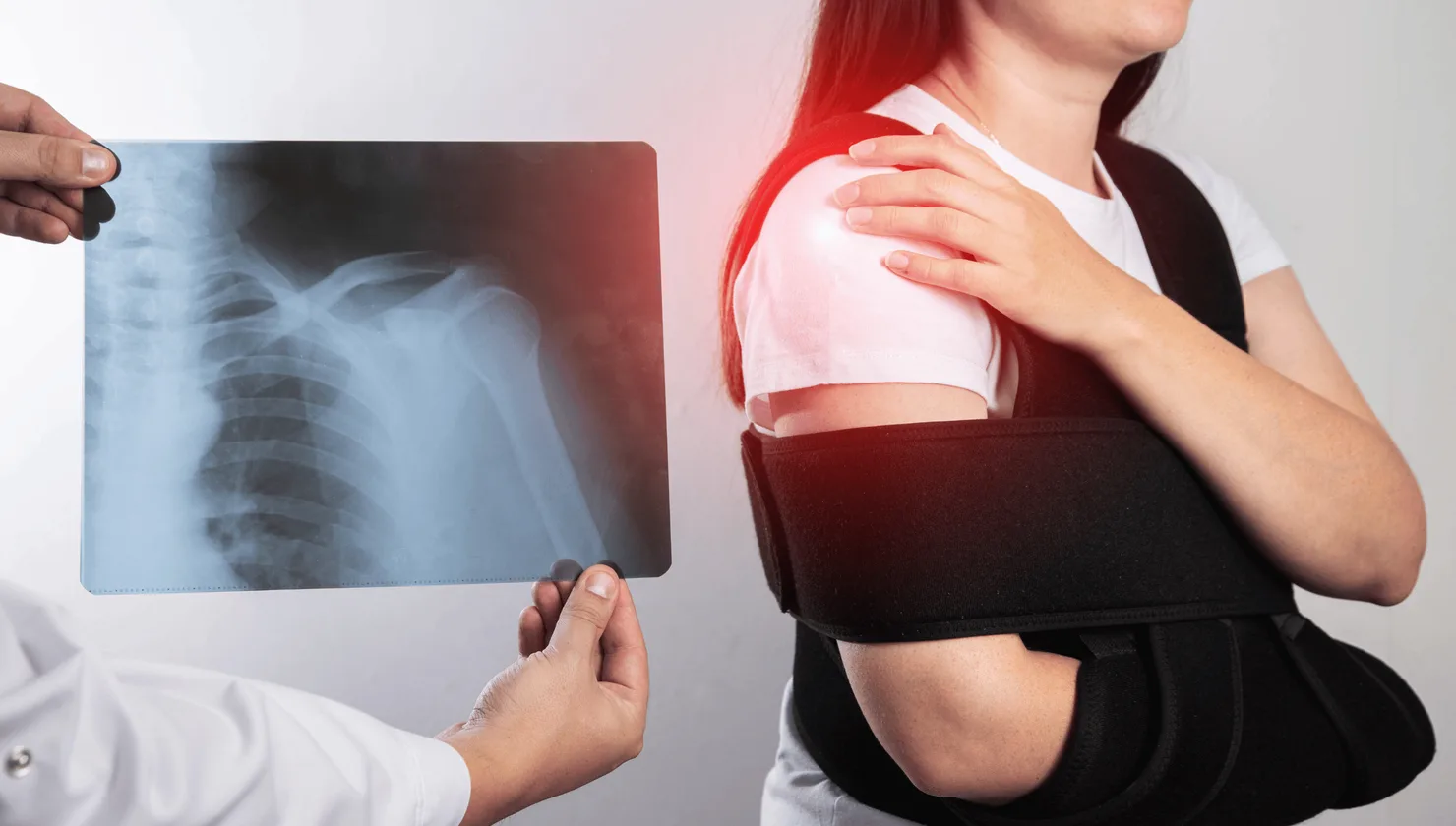
Symptoms
- Visible deformity: The joint looks out of place, crooked, or misshapen compared with the other side.
- Sudden severe pain: Intense pain at the joint that worsens with any attempt to move it.
- Inability to move the joint: The joint feels locked or stuck, with little or no normal range of motion.
- Swelling and bruising: Rapid swelling and discoloration around the injured joint.
- Numbness or tingling: Reduced sensation below the injury can signal nerve involvement.
- Pale, cold, or bluish skin: A limb that looks pale or cool below the joint may mean blood flow is affected and needs emergency care.
When it's an emergency
Emergency care for dislocations
Call 911 immediately for life-threatening symptoms or if you cannot travel safely. Do not drive yourself or delay for online booking.
For other urgent symptoms, seek prompt emergency evaluation. Bellaire ER accepts walk-ins 24/7. For facility questions, call (713) 660-0001.
Most joint dislocations should be treated as an emergency. Come to Bellaire ER right away, or come in now, if a joint is visibly out of place, you cannot move it, or the pain is severe. The sooner a dislocation is reduced (realigned), the lower the risk of lasting damage.
Call 911 immediately if the skin below the injury turns pale, cold, or blue, if you have numbness or loss of feeling, or if you cannot feel a pulse in the limb. These can be signs that blood vessels or nerves are being pinched, which is a limb-threatening emergency.
A suspected hip dislocation, neck or spine injury, or any dislocation that follows a major fall or car crash needs emergency evaluation. Do not walk on or move the joint, and do not let anyone try to force it back into place outside a medical setting.
Seek emergency care if the joint is stuck out of position, if there is an open wound over the joint, or if you cannot rule out a broken bone. Dislocations and fractures often occur together and look similar without an X-ray.
When it's not an emergency
A finger or toe that briefly slipped and popped back into place on its own, with only mild soreness and near-normal movement, can often be managed conservatively. Even then, an X-ray is wise to rule out a small fracture or chip.
Once a dislocation has been reduced and cleared at the ER, follow-up questions about splinting, physical therapy, or a recurring joint that feels loose are usually appropriate for your primary care doctor or an orthopedic specialist rather than a repeat emergency visit.
Our telemedicine service is a reasonable option for guidance on aftercare, pain management, or whether a minor joint tweak needs to be seen in person. If there is visible deformity, numbness, color change, or you cannot move the joint, do not use telemedicine. Go straight to the ER.
What else could be causing this
- Shoulder dislocation
- The most commonly dislocated joint in adults, because the shoulder trades stability for range of motion. Most are anterior, from a fall on an outstretched arm or a blow with the arm raised; the arm is held slightly away from the body, the shoulder looks squared off, and any attempt to move it is refused. The nerve supplying sensation over the outer shoulder is the one most often affected.
- Finger and thumb dislocation
- Usually from a ball striking the end of the finger or a fall that bends a joint backward. The deformity is obvious and the joint will not bend. These look minor and are not always so: a dislocation with a torn ligament at the base of the thumb, or one with a fragment of bone pulled off, needs an X-ray and sometimes a hand specialist rather than simply being put back.
- Patellar (kneecap) dislocation
- The kneecap slides to the outside of the knee, typically during a twist with the foot planted, and the knee locks in a slightly bent position with an obvious lump on the outer side. It often pops back in by itself as the leg straightens, which can make people think nothing happened, but cartilage is frequently damaged in the process, and the joint should still be imaged.
- Elbow dislocation
- The second most commonly dislocated major joint in adults, usually from a fall on an outstretched hand. It is important because of what travels past the elbow: the artery and nerves to the forearm and hand. Numbness, a cold hand, or an absent pulse after an elbow injury is a limb-threatening emergency rather than a painful inconvenience.
- Hip dislocation
- Requires major force in a native hip, a car crash or a significant fall, and the leg is typically shortened and rotated, with the knee turned inward. A replaced hip can dislocate with far less force, sometimes just bending too far forward. Either way it is a time-critical reduction, because delay raises the risk of the femoral head losing its blood supply.
- Fracture-dislocation
- The joint is out of position and a bone around it is broken at the same time, which is common rather than exceptional. It looks identical to a simple dislocation from the outside, and attempting a reduction without knowing can displace the fracture or trap a fragment in the joint. This is the single clearest reason an X-ray comes before any attempt to realign.
- Fracture without dislocation
- A broken bone near a joint produces the same picture: sudden severe pain, swelling, deformity and an unusable limb, and cannot be distinguished from a dislocation by looking at it. The treatment is different: splinting and often orthopedic management rather than reduction. Imaging decides.
- Subluxation and ligament injury
- A joint that partly slips and returns on its own, or a torn ligament without the joint displacing. The joint still moves but feels unstable or gives way, and swelling can be considerable. A shoulder or kneecap that has subluxed once tends to do it again, which is why these are followed up rather than simply rested.
- Septic arthritis
- Infection inside a joint. There is no injury, the joint is hot, swollen and extremely painful on the smallest movement, and there is usually fever and feeling unwell. It is included here because it produces a joint that cannot be moved, and it is an emergency in its own right, an infected joint can be destroyed within days.
What happens when you arrive
When you arrive at Bellaire ER with a suspected dislocation, a board-certified emergency physician evaluates the joint quickly and works to control your pain. We check the circulation, sensation, and movement in the limb to make sure nerves and blood vessels are not compromised.
We confirm the injury with on-site X-ray, which shows whether the joint is dislocated and whether there is also a fracture. Additional imaging such as CT or ultrasound is available on-site if needed.
Once the injury is clear, the physician performs a reduction, gently guiding the bones back into their normal position, usually after pain medication or sedation to keep you comfortable. A repeat X-ray confirms the joint is back in place.
After reduction, the joint is supported with a splint, sling, or brace to protect it while it heals. We diagnose and treat in a single visit, and most patients do not need a hospital transfer. Before you leave, your physician explains your results and gives clear follow-up and orthopedic referral instructions.
Tests we can run on site
- X-ray
- The essential test, and the one that comes first. It confirms the joint is dislocated and in which direction, and it identifies an accompanying fracture. Which is what determines whether the joint can be reduced here at all. A second X-ray after reduction confirms the joint is genuinely back in position rather than merely feeling better.
- Neurovascular examination
- Not an imaging test, but the assessment that outranks all of them in urgency. Pulse, skin color and temperature, sensation and movement below the injury are checked before and after reduction. A pale, cold or pulseless limb, or new numbness, means a nerve or artery is compromised, and that changes the timeline from hours to minutes.
- CT scan
- Cross-sectional imaging, used when an X-ray leaves a question open: a complex fracture pattern around the joint, a hip or shoulder that will not reduce, or a fragment of bone that may be sitting inside the joint. It shows the three-dimensional relationship that a plain film flattens.
- Ultrasound
- Bedside sound-wave imaging with no radiation. It is used to look at soft tissue around the joint, to identify fluid or blood in the joint, and to guide the placement of local anesthetic for a reduction. It is also used to check blood flow in a limb when the pulse is hard to feel.
- Complete blood count and inflammatory markers
- Run when infection rather than injury is a possibility. A raised white cell count and inflammatory markers in a hot, swollen joint with no trauma point toward septic arthritis, which needs urgent orthopedic management rather than reduction.
- Comprehensive metabolic panel
- Kidney function and electrolytes, which matter when procedural sedation is going to be used for the reduction, and which guide safe medication dosing. It is part of preparing for the procedure rather than diagnosing the injury.
Treated here, or transferred
Bellaire ER is a licensed freestanding emergency room: board-certified emergency physicians and nurse practitioners, on-site X-ray, CT, ultrasound and laboratory, medication administered during your visit, open 24 hours a day, 365 days a year, for adults and children. It is equipped and staffed to evaluate, stabilize and treat, and it is not a hospital. Dislocations are one of the clearer examples of what an emergency room is for, because most of them are finished here.
The treatment is reduction, guiding the bones back into position, and it happens after imaging, not before. Pain control comes first, and depending on the joint that may be intravenous medication, a local anesthetic injected into or around the joint, or procedural sedation with monitoring. The physician then reduces the joint using a technique chosen for that joint and that direction of displacement. A repeat X-ray confirms the position, the limb is re-examined for pulse, sensation and movement, and the joint is immobilized in a sling, splint or brace appropriate to it. Pain medication for the following days is written as a prescription for you to fill at your own pharmacy, and you leave with the orthopedic referral and instructions.
Some dislocations need a hospital. A joint that will not reduce despite an appropriate attempt, a fracture-dislocation requiring surgical fixation, an open dislocation with a wound into the joint, an injury where the artery or nerve is compromised, a native hip dislocation, a spine or neck injury, and a dislocation that is part of major trauma all need operating-room capability or an inpatient service, a freestanding emergency room has neither. Septic arthritis needs urgent hospital management too. In all of those, the imaging, pain control, splinting, intravenous fluids and antibiotics where indicated start here, and care continues without interruption during transfer to a hospital with the service required. Transfer when a joint needs an operating room is the system working as intended.
One thing worth stating plainly: do not let anyone try to force a joint back into place outside a medical setting. Without imaging you cannot know whether a bone is broken, and an uncontrolled attempt can tear ligaments, damage cartilage, injure the nerve or artery running past the joint, or displace a fracture that was stable.
Children
Bellaire ER treats adults and children. Children's joints and bones behave differently from adults', and the practical consequence is that a child with an injured joint needs imaging more readily, not less. The growth plate, the zone of cartilage near the end of a growing bone, is weaker than the surrounding ligaments, so the same force that dislocates an adult's joint often fractures through the growth plate in a child instead. Those fractures can be subtle on X-ray and have long-term consequences for growth if missed, which is why a child with a painful joint after an injury is X-rayed rather than observed.
A few patterns are specific to children. A toddler who suddenly refuses to use an arm after being pulled or swung by the hand, holding it slightly bent and turned inward with no swelling or bruising, usually has a radial head subluxation, nursemaid's elbow. Which is a straightforward reduction. Patellar dislocation is common in adolescents, particularly during sport, and often reduces itself. A shoulder that dislocates in a teenager has a high chance of dislocating again, which makes the orthopedic follow-up more important rather than less.
One pattern is a red flag beyond the injury itself: a dislocation or fracture in an infant who is not yet walking, an injury that does not match the explanation given, or a delay in seeking care. These are evaluated carefully, because that is part of a child's safety.
Bring a child in for any joint that looks out of place, any refusal to use a limb or bear weight after an injury, numbness or a limb that looks pale or cold, or a joint that is hot, swollen and exquisitely painful with a fever and no injury, that last picture suggests an infected joint, which is an emergency at any age. Reduction in a child is done with appropriate pain control and monitoring; it is not something to attempt at home.
After you leave
A reduced joint is in position, not healed. The ligaments and the joint capsule that were stretched or torn letting it come out still have to recover, and that takes weeks. The immediate pain relief after a reduction is dramatic and can be misleading, the recovery is governed by the soft tissue, not by how the joint feels an hour later.
Wear the sling, splint or brace exactly as long as you were told, and no longer: too little immobilization risks the joint coming out again, too much leaves a stiff joint that takes months to loosen. Use ice over the joint for twenty minutes at a time in the first few days, keep the limb elevated where that is possible, and take the pain medication you were given as directed rather than waiting for the pain to build. Move the joints above and below the injury: fingers, wrist, hand, to limit swelling and stiffness. Do not drive while you are in a sling, while a leg is splinted, or while taking medication that makes you drowsy, and do not go back to sport or heavy lifting until you have been cleared.
Come back immediately, or call 911 if you cannot travel safely, if the limb below the injury becomes numb, tingling, pale, blue, cold, or you cannot feel a pulse in it; if the pain becomes severe and out of proportion to what you were told to expect, particularly with tightness or swelling that keeps increasing inside a splint; or if the joint visibly comes out of position again. Return for a fever, spreading redness or discharge from a wound over the joint, or a splint that becomes too tight, too loose, or wet.
Keep the orthopedic follow-up you were given. This is the part people skip, and it is the part that determines the long-term result: a joint that has dislocated once is significantly more likely to dislocate again, and physical therapy to rebuild the muscle that stabilizes it is what lowers that risk. Bring your discharge paperwork and your X-ray results to the appointment.
What this visit costs
We accept most major insurance and bill your insurer directly. For emergency care, federal law caps what you pay at in-network rates and bars surprise bills, your deductible and copay still apply. Never delay emergency care over cost.
See how ER billing worksInsurance and coverage questionsRead the facility notice
Questions about a specific plan? Call (713) 660-0001. Only your plan can tell you how a claim will be processed.
Lowering your risk
Strengthening the muscles around vulnerable joints, especially the shoulders and knees, helps stabilize them and lowers the chance of dislocation. Balance and conditioning exercises are useful if you have fallen before or have a joint that dislocates repeatedly.
Wear appropriate protective gear for contact sports and use proper technique when lifting or playing. Reduce fall risks at home by improving lighting, removing tripping hazards, and using handrails on stairs.
If a joint has dislocated once, it is more likely to dislocate again. Follow through with physical therapy and any orthopedic guidance to rebuild strength and stability.
Common questions
When should I go to the ER for a dislocation?
Go to the ER whenever a joint looks out of place, you cannot move it, or the pain is severe. Come in now if the limb below the injury becomes numb, pale, cold, or bluish, which can mean nerves or blood flow are affected. Prompt reduction lowers the risk of lasting joint, nerve, and blood-vessel damage.
Should I try to pop a dislocated joint back into place myself?
No. Forcing a joint back yourself can tear ligaments, damage cartilage, and injure the nerves and blood vessels around the joint, and it may worsen a fracture hidden underneath. Keep the joint still and supported, and let an emergency physician reduce it safely with pain control and X-ray confirmation.
Can Bellaire ER treat a dislocation, or do I need a hospital?
Bellaire ER treats dislocations on-site with X-ray, pain management, and joint reduction, all in a single visit. Most patients are realigned, splinted, and sent home the same day with follow-up instructions, and do not need a hospital transfer. Complex cases are stabilized and referred to an orthopedic specialist.
How is a dislocation different from a fracture?
A dislocation means the bones of a joint are pushed out of alignment, while a fracture means a bone is cracked or broken. They cause similar symptoms, such as pain, swelling, and deformity, and often happen together, so an X-ray is the reliable way to tell them apart. That is why on-site imaging at the ER is important before any joint is realigned.
Why prompt attention matters
A dislocation needs prompt evaluation. Imaging confirms the joint’s position and rules out an associated fracture before any attempt at reduction, and early treatment supports a fuller recovery.
Get care at Bellaire ER
Walk in any time at 5302 Bellaire Blvd, Bellaire, TX 77401 (get directions) or call 713-660-0001. No appointment is required to be seen, though you can save your spot online if you prefer.
Sources & further reading
Medical information on this page is consistent with guidance from these trusted organizations:
People also ask
When should I go to the ER for dislocations?
Go to the ER right away for any joint that is visibly out of place, locked, or severely painful. Prompt reduction lowers the risk of lasting damage. Telemedicine or a primary care visit is reasonable only for aftercare or a minor joint tweak that already resolved.
Read full answer →