
Laceration Treatment
Laceration treatment is the cleaning and closure of a cut so it heals with the lowest risk of infection and scarring. A wound is usually closed with stitches, skin glue, staples, or adhesive strips, and deeper or gaping cuts generally need repair within about 12 to 24 hours. Bellaire ER on Bellaire Blvd provides walk-in laceration repair 24/7 for Houston and Bellaire patients searching for treatment near me, with no appointment needed.
- Open now, 24/7/365
- Walk in, no appointment
- 5302 Bellaire Blvd, free parking
Unsure if Your Symptoms Require Emergency Care?
Call our clinical triage desk at (713) 660-0001. An on-duty board-certified emergency physician will evaluate your symptoms before you leave home.
Symptoms
- Gaping edges: The wound stays open or pulls apart and does not stay closed with gentle pressure, which usually means it needs stitches or glue.
- Deep wound: You can see fat, muscle, tendon, or bone, indicating a deeper repair is needed.
- Bleeding that soaks through: Blood continues through a dressing after 10 to 15 minutes of firm, direct pressure.
- Location that scars or moves: Cuts on the face, lips, hands, or over a joint often need careful closure for cosmetic and functional healing.
- Signs of infection: Increasing redness, warmth, swelling, pus, or red streaks spreading from the wound in the days after injury.
- Numbness or weakness: Loss of feeling or movement past the wound can signal nerve or tendon damage.
- Dirty or puncture wounds: Cuts contaminated with soil, glass, metal, or a bite may need thorough cleaning and a tetanus update.
When it's an emergency
Emergency care for laceration treatment
Call 911 immediately for life-threatening symptoms or if you cannot travel safely. Do not drive yourself or delay for online booking.
For other urgent symptoms, seek prompt emergency evaluation. Bellaire ER accepts walk-ins 24/7. For facility questions, call (713) 660-0001.
Come in now or come in immediately for bleeding that spurts, pulses, or will not slow after 10 to 15 minutes of firm direct pressure, since this can point to an arterial injury. Do not remove an object impaled in the wound; leave it in place, control bleeding around it, and get emergency care.
Come to Bellaire ER for any deep or gaping cut, a wound longer than about half an inch that will not stay closed, or a laceration on the face, hand, or over a joint where proper closure protects appearance and function.
Seek care right away if you cannot move or feel the area past the cut, which may mean a tendon or nerve is involved, or if the wound was caused by an animal or human bite, a rusty or dirty object, or crushing force.
Most cuts are best repaired within about 12 to 24 hours, so do not wait days. If the wound already shows spreading redness, warmth, swelling, pus, or you develop a fever, it needs to be evaluated for infection.
When it's not an emergency
A small, shallow cut with edges that fall neatly together and bleeding that stops with a few minutes of pressure can often be managed at home. Clean it under running water, apply an antibiotic ointment, and cover it with a clean bandage.
Minor scrapes and paper-cut-style wounds that are not deep, not gaping, and not on the face or hands usually heal on their own with basic wound care.
Bellaire ER can tell you whether a minor wound needs closure, update a tetanus booster, and check a healing cut for early infection, 24/7 and without an appointment. If a cut is deep, will not stop bleeding, or will not stay closed, choose emergency care instead.
What else could be causing this
- Clean linear cut
- A knife, glass or sheet metal injury with straight edges that fall together neatly. These are the most straightforward wounds to close and generally give the best cosmetic result, provided they are cleaned properly and closed within the usual window of about 12 to 24 hours. Depth is what decides whether this needs more than a dressing.
- Jagged, flap or star-shaped laceration
- Caused by a blunt impact that splits the skin rather than slicing it: a fall against a counter edge, a blow to the eyebrow, a door frame. The edges are irregular or form a flap, and some of the tissue at the margin may be bruised and unable to survive. Repair takes longer, may need trimming of the edges, and benefits from the layered closure that a straightforward cut does not.
- Crush injury
- A hand caught in a door, a finger struck by a hammer, a limb trapped under a weight. The visible skin wound is only part of it: the surrounding tissue is bruised and swollen, blood supply to the edges is impaired, and fractures underneath are common. These carry a higher infection risk and are sometimes deliberately not closed tightly.
- Puncture wound
- A nail, needle, tooth, splinter, high-pressure injection or a foot pushed onto something sharp. The opening is small and looks harmless, which is the problem: the track is deep, it has carried bacteria and debris inward, and it cannot be irrigated as effectively as an open cut. Punctures through a shoe into the sole of the foot and punctures over a joint deserve particular attention.
- Animal bite
- Dog bites tear and crush; cat bites are deep punctures with a high infection rate, especially on the hand. Infection risk is far higher than for a comparable cut, so many bites are cleaned thoroughly and left to heal open rather than closed, and many need antibiotics. Rabies risk is assessed from the animal and the circumstances, and bites in Texas are reportable to public health.
- Human bite and fight bite
- A small wound over the knuckle sustained by punching a mouth is one of the most consequential injuries in this category. The joint capsule beneath is often opened and seeded with mouth bacteria, and these infections destroy a joint quickly. These are never simply closed; they are explored, treated with antibiotics, and referred urgently for hand assessment.
- Abrasion and road rash
- The skin scraped off over a broad surface, from a bicycle, motorcycle, treadmill or pavement. Nothing needs stitching but everything needs cleaning, because dirt, gravel and asphalt left in the wound both cause infection and leave permanent tattooing of the skin. Thorough irrigation and scrubbing under anesthesia is the treatment here, and it is the part people are not expecting.
- Wound with something left inside it
- Glass, metal fragments, wood splinters, gravel, or a tooth from the object that caused the injury. A sensation that something is still in there is reliable enough to be acted on, and a wound that keeps hurting, keeps discharging or will not heal usually has something in it. Glass and metal show on X-ray; wood and plastic often do not, and ultrasound is better for those.
- Skin tear in fragile skin
- In older adults, people on long-term steroids and people on blood thinners, a minor knock lifts a flap of thin skin and bleeds a great deal. Stitches often will not hold in tissue this fragile, so these are usually managed with careful repositioning of the flap, adhesive strips or specialized dressings rather than sutures. They take weeks to heal and need follow-up dressing changes.
What happens when you arrive
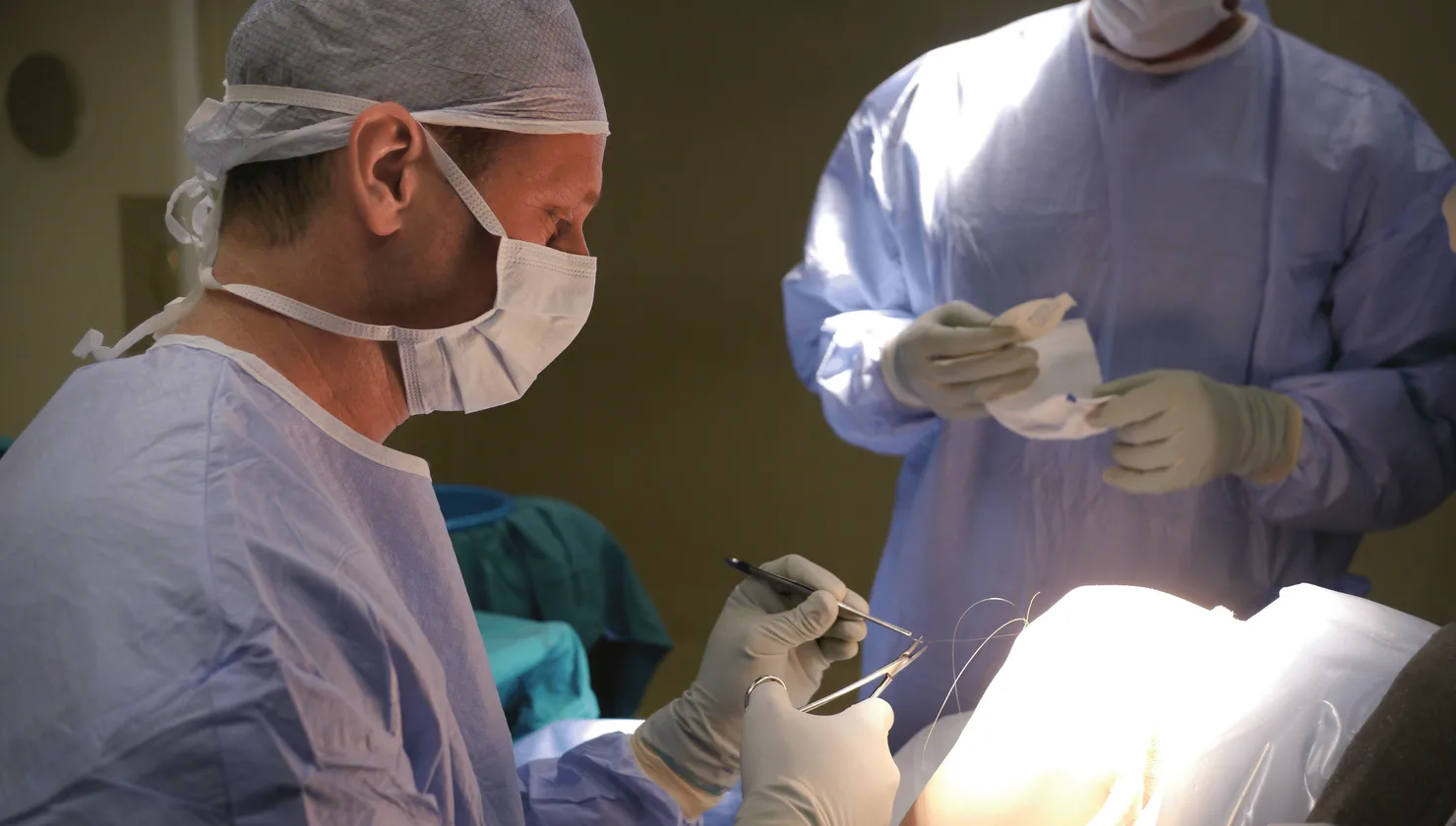
A board-certified emergency physician first controls any bleeding and examines the wound for depth and for damage to nerves, tendons, blood vessels, or nearby bone. If a fracture or a retained object such as glass or metal is a concern, on-site X-ray, CT, and ultrasound are available so imaging does not require a separate trip.
The wound is numbed with local anesthetic, then thoroughly cleaned and irrigated to flush out debris and lower infection risk. Any foreign material is removed under proper lighting.
Your physician closes the cut using the method that fits the wound: sutures (stitches), skin adhesive (glue), staples, or adhesive strips. The choice depends on the wound's depth, length, and location.
Before you leave, the wound is dressed and you receive a tetanus shot if you are not up to date, along with clear instructions on keeping it clean and dry, watching for infection, and when stitches or staples should be removed. Diagnosis and treatment happen in one visit, and most patients do not need a hospital transfer.
Tests we can run on site
- Wound exploration
- After the wound is numbed, a physician opens it and looks all the way to its base in good light, checking its true depth, whether fat, muscle, tendon, joint capsule or bone is visible, and whether anything is retained inside. This is the central step of the assessment: the surface of a wound consistently understates it, and the plan changes based on what exploration finds.
- Sensation testing
- Light touch and the ability to distinguish two nearby points, compared with the same spot on the other side, done before the local anesthetic goes in. Numbness in a specific area beyond a cut indicates a nerve has been divided, which needs repair by a specialist rather than closure of the skin over it.
- Tendon and muscle function testing
- Moving the joints beyond the wound through their full range and then against resistance. A partially cut tendon can move normally but gives way under resistance or hurts in a particular arc, and a tendon injury found now is a far better situation than one discovered two weeks later. The position the limb was in at the moment of injury matters too, because the cut end of a tendon retracts away from the skin wound.
- Circulation check
- Pulses, skin color, warmth and capillary refill beyond the wound, plus the character of the bleeding. Bright red blood that spurts or pulses indicates an arterial injury and changes the priority from repair to control.
- X-ray
- On-site imaging that shows glass, metal, gravel and bone. It is used for any wound caused by glass or metal, any wound where something may have broken off inside, and any cut over bone, where an underlying fracture turns this into an open fracture needing different treatment.
- Ultrasound
- Sound-wave imaging, used for the foreign bodies X-ray cannot see: wood, thorns, plastic, and to look for a fluid collection or abscess in a wound that has become infected. It is also used to guide the numbing of a larger area when that makes a repair more comfortable.
- CT scan
- Cross-sectional imaging, available on site, for deep or complex wounds: facial injuries where a fracture or an eye injury is a possibility, wounds that may have entered a joint, and scalp wounds with a significant mechanism where the head underneath has to be assessed as well as the skin.
- Tetanus status review
- Not a test but a necessary question, and one most people cannot answer precisely. Adults need a booster every ten years, and sooner for a dirty or puncture wound. If your status is unclear, protection is updated here rather than assumed.
Treated here, or transferred
Bellaire ER is a licensed freestanding emergency room, open 24 hours a day, 365 days a year, staffed by board-certified emergency physicians and nurse practitioners, with on-site CT, X-ray, ultrasound and laboratory, and medication given on site during your visit. It is equipped for emergency evaluation, stabilization and treatment, and it is not a hospital. There is no operating room here, which is the dividing line for a small number of wounds.
Most lacerations are repaired here from start to finish. The sequence is bleeding control, numbing with local anesthetic, thorough irrigation and cleaning, removal of debris and dead tissue, then closure with the method that suits the wound: sutures, skin adhesive, staples or adhesive strips. Deeper wounds may be closed in layers so that the skin is not carrying the tension. A splint may be added across a joint to protect the repair, antibiotics are prescribed where the wound warrants them rather than routinely, tetanus protection is updated if needed, and medication is given during your visit, with a prescription written for anything you need afterward to fill at your own pharmacy.
Some wounds are deliberately not closed. Many animal bites, older contaminated wounds, deep punctures and infected wounds heal better and more safely left open with a dressing and a plan for review, because closing bacteria inside a wound causes more harm than an open wound does. If that is recommended for your wound, it is a considered decision rather than a shortcut.
Some injuries need more than wound care. A cut tendon, a divided nerve, an arterial injury, a wound that has entered a joint, an open fracture, a fight bite over the knuckle, a complex facial wound involving the eyelid margin, the border of the lip or the tear duct, and any amputated or partly amputated part need specialist hands. For these, Bellaire ER controls the bleeding, cleans and dresses the wound, immobilizes it, starts antibiotics and provides pain relief, then arranges urgent hand, plastic surgery or ophthalmology care, or transfers to the appropriate hospital service. Transfer and specialist referral are a normal part of how a freestanding emergency room works, not a failure of the visit.
Children
Bellaire ER treats adults and children. Most childhood lacerations are forehead, eyebrow, scalp, chin and lip wounds from falls, and most are repaired without difficulty. Where the wound allows it, skin adhesive is often preferred for children because it avoids needles and needs no removal visit, simple scalp and facial cuts frequently close beautifully this way.
How a child is prepared matters as much as the technique. Numbing gel applied to the wound before any injection, a parent present, distraction, and being told truthfully what will happen all make a repair go better. If a child genuinely cannot tolerate a necessary repair, the physician will discuss the options with you, which may include arranging care in a setting where sedation is available rather than forcing it.
A few childhood wounds need more than skin closure. A cut that crosses the border between the lip and the face, a wound through the full thickness of the lip, an eyelid margin injury, a cut near the inner corner of the eye where the tear duct runs, and dog bites to the face are referred for specialist repair because alignment matters permanently on a growing face. A cut tongue or inside of the mouth often needs no repair at all and heals remarkably well, but one that bleeds persistently or splits the tongue edge does.
Check immunizations, including tetanus, and tell the physician about any animal involved and whether it is known and vaccinated, that assessment cannot be made later from memory. Afterward, keep a child away from sand, mud and swimming pools until the wound is sealed, keep fingernails short, and cover a wound that will otherwise be picked at.
Where an injury does not match the explanation given: a wound in a baby too young to have moved themselves, several injuries of different ages, or a history that changes between tellings. Clinicians are required to ask further questions. That is routine, it happens in every emergency department, and it is part of caring for the child.
After you leave
Keep the wound clean and dry for the first 24 to 48 hours. After that, gentle washing with soap and water and patting dry is better for it than keeping it sealed, unless you were told otherwise. Change the dressing as instructed, or whenever it becomes wet or dirty. If the wound was closed with skin adhesive, do not pick at the film, do not put ointment on it because that dissolves it, and keep it out of prolonged soaking, it sheds on its own over five to ten days.
Stitches and staples come out on a schedule that depends on where the wound is: around five days on the face, roughly seven to ten days on the scalp, arm or trunk, and ten to fourteen days over a joint, on the hand, or on the leg where the skin is under tension. Have them removed on time. Left in too long they leave stitch marks; taken out too early the wound opens. Keep a splint on if you were given one, and avoid the activity that would pull the wound apart, a repair that reopens on day four usually did so during something avoidable.
Come back promptly for the signs of infection, which generally appear two to five days after the injury: redness spreading outward from the wound, increasing rather than easing pain, swelling, warmth, pus or a bad smell, red streaks tracking away from the wound, a fever, or swollen glands above it. Return as well if the wound reopens, if bleeding restarts and does not stop with ten to fifteen minutes of firm pressure, if you lose sensation or movement beyond the wound, or if you become convinced something is still in there, that feeling is right often enough to be worth a second look.
Scars continue to change for up to a year. A new scar is red and firm and fades gradually; keeping it out of the sun or covered with high-factor sunscreen for the first six to twelve months makes a real difference to the final appearance. Once fully healed, gentle massage and moisturizer help. If a scar becomes raised, itchy, thickened or tight across a joint, that is worth raising at follow-up rather than waiting out, because it is more treatable early.
What this visit costs
We accept most major insurance and bill your insurer directly. For emergency care, federal law caps what you pay at in-network rates and bars surprise bills, your deductible and copay still apply. Never delay emergency care over cost.
See how ER billing worksInsurance and coverage questionsRead the facility notice
Questions about a specific plan? Call (713) 660-0001. Only your plan can tell you how a claim will be processed.
Lowering your risk
Keep tetanus vaccination current; adults generally need a booster every 10 years, or sooner for a dirty or puncture wound.
Use cut-resistant gloves and proper technique when handling knives, box cutters, glass, or power tools, and keep blades sharp so they slip less.
Clean and cover any break in the skin promptly to lower infection risk, and keep walkways and work areas clear of broken glass and sharp objects.
Common questions
When should I go to the ER for laceration treatment?
Go to the ER for a cut that is deep, gaping, longer than about half an inch, or bleeding that will not slow after 10 to 15 minutes of firm pressure. Also seek emergency care for cuts on the face, hands, or over a joint, wounds with an embedded object, bites, or any loss of feeling or movement past the wound. Most lacerations are best repaired within 12 to 24 hours, so do not wait days.
How is a laceration closed at Bellaire ER?
After numbing and thoroughly cleaning the wound, the physician closes it with the method that best fits the cut: stitches, skin glue, staples, or adhesive strips. Deeper wounds may need stitches placed in layers. The choice depends on the wound's depth, length, and location, with attention to reducing scarring on visible areas like the face.
Do I need stitches or will skin glue work?
Small, clean, straight cuts with edges that line up easily can sometimes be closed with skin glue or adhesive strips. Deeper cuts, wounds under tension, those over joints, or jagged and gaping wounds usually need stitches. A physician decides after examining the wound, which is why gaping or deep cuts should be evaluated in person.
Will I need a tetanus shot for my cut?
You may need one if your last tetanus booster was more than 10 years ago, or more than 5 years ago for a dirty, deep, or puncture wound. Bellaire ER can give a tetanus shot during your visit if you are not up to date. Bring your vaccination history if you have it.
How long do stitches stay in and how do I care for the wound?
Timing depends on location: stitches on the face often come out in about 5 days, while those over joints or high-tension areas may stay 10 to 14 days. Keep the wound clean and dry as instructed, watch for spreading redness, warmth, swelling, or pus, and return if signs of infection appear. Your discharge instructions will list exactly when and where to have stitches or staples removed.
Why prompt attention matters
Treating a laceration promptly helps prevent infection and supports proper healing. Care includes cleaning the wound, closing it appropriately, and providing tetanus immunization where it is indicated.
Get care at Bellaire ER
Walk in any time at 5302 Bellaire Blvd, Bellaire, TX 77401 (get directions) or call 713-660-0001. No appointment is required to be seen, though you can save your spot online if you prefer.
Sources & further reading
Medical information on this page is consistent with guidance from these trusted organizations:
People also ask
When should I go to the ER for laceration treatment?
Go to the ER for a laceration that is deep, gaping, longer than about half an inch, or bleeding that will not slow after 10 to 15 minutes of pressure, and for cuts on the face, hands, or over a joint. Most cuts repair best within 12 to 24 hours, so do not wait days.
Read full answer →