Burns
Go to the ER for any deep or blistering burn, any burn larger than your palm, and any burn on the face, hands, feet, genitals or a major joint. Bellaire ER provides 24/7 emergency burn care at 5302 Bellaire Blvd in Bellaire: pain treated early, then cleaning, dressing and an assessment of depth, with on-site lab and imaging when smoke, chemicals or electricity are involved, and transfer to a burn center arranged for the few burns that need one. Small, shallow burns that are red but not blistered can be cared for at home.
- Open now, 24/7/365
- Walk in, no appointment
- 5302 Bellaire Blvd, free parking
Unsure if Your Symptoms Require Emergency Care?
Call our clinical triage desk at (713) 660-0001. An on-duty board-certified emergency physician will evaluate your symptoms before you leave home.
Symptoms
- First-degree burn: Red, dry, painful skin with no blisters, affecting only the outer layer; mild sunburn is a common example.
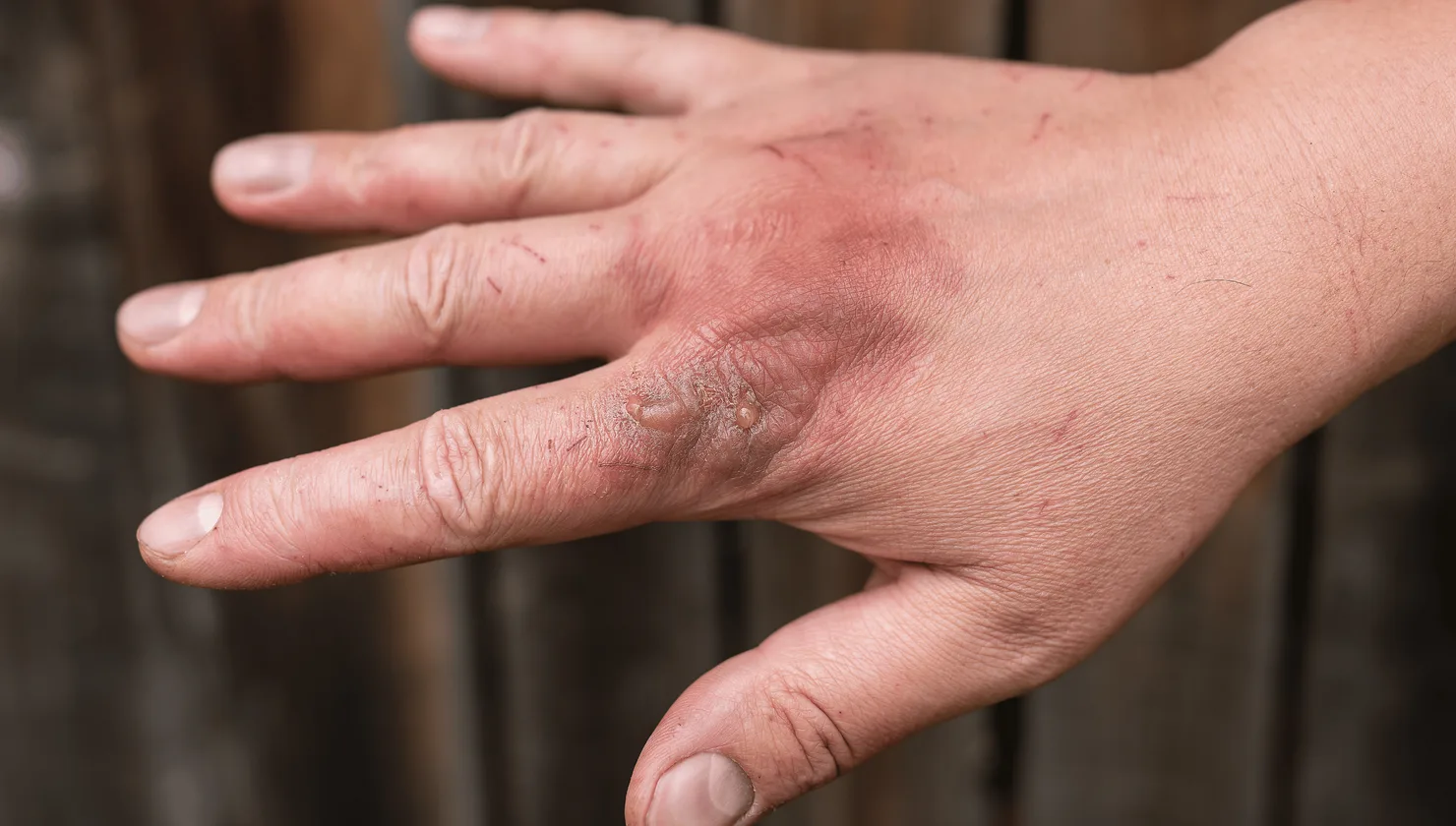
- Second-degree burn: Blisters, wet or shiny skin, swelling, and significant pain; the burn extends into the deeper skin layer.
- Third-degree burn: White, brown, black, or leathery skin that may feel numb because nerve endings are damaged.
- Spreading redness, warmth, pus, or increasing pain after a day or two: Signs the burn may be infected.
- Cough, hoarseness, singed nasal hairs, or trouble breathing: Signs of possible airway or smoke-inhalation injury after a fire.
When it's an emergency
Emergency care for burns
Call 911 immediately for life-threatening symptoms or if you cannot travel safely. Do not drive yourself or delay for online booking.
For other urgent symptoms, seek prompt emergency evaluation. Bellaire ER accepts walk-ins 24/7. For facility questions, call (713) 660-0001.
Go to the nearest emergency room for any burn with trouble breathing, a burn to the airway, or burns from a house or enclosed-space fire where smoke may have been inhaled. These can involve life-threatening swelling of the airway.
Seek emergency care for deep (third-degree) burns of any size, for burns larger than about three inches across, and for burns that wrap fully around an arm, leg, finger, or the chest. Also go to the ER for burns on the face, hands, feet, genitals, or over a major joint, where scarring and loss of function are real risks.
All electrical burns and significant chemical burns need emergency evaluation, even if the skin looks minor, because damage can extend deep beneath the surface. For chemical exposure you can also call Poison Control at 1-800-222-1222 while arranging care.
Get emergency care if a burn victim shows confusion, fainting, a fast heartbeat, or signs of shock, or if the burn is on an infant, older adult, or someone with diabetes or a weakened immune system.
Bellaire ER evaluates and stabilizes burns 24/7, treats most in a single visit, and coordinates rapid transfer to a specialized burn center when one is needed.
When it's not an emergency
Most small first-degree burns and small (under about three inches) second-degree burns on low-risk areas can be cared for at home. Cool the burn under cool: not ice-cold, running water for about 10 to 20 minutes, then cover it loosely with a clean, non-stick dressing.
Judging how deep a burn is takes someone looking at it. Bellaire ER checks a small burn, dresses it, and looks for early infection 24/7 with no appointment, so an uncertain burn does not have to wait for a clinic to open. Over-the-counter pain relievers and keeping the area clean are usually enough for minor burns.
Watch a healing burn for a day or two. If redness spreads, pus develops, pain worsens, or you develop a fever, have it evaluated promptly, as these suggest infection.
What else could be causing this
- Scalds from hot liquid or steam
- The most common burn seen in homes: coffee, tea, soup, cooking oil, bath water and steam from a kettle or microwaved food. Scalds tend to be irregular in shape with a splash pattern, and depth varies across the same wound. Hot oil and steam burn deeper than water at the same temperature because they hold heat against the skin for longer.
- Contact with a hot surface
- Ovens, stovetops, irons, curling wands, engine parts, grills and pavement. The burn mirrors the shape of the object and is usually well defined. Depth depends on how long the contact lasted, so a brief touch and a fall against the same surface produce very different injuries.
- Flames and fire
- House fires, gas flare-ups, grills, fire pits and clothing that catches alight. The skin injury is often the lesser problem: a fire in an enclosed space also means smoke, heat to the airway, and carbon monoxide exposure. Hoarseness, coughing, soot around the nose or mouth, or singed facial hair change this from a wound to an airway emergency.
- Electrical injury
- Household outlets, extension cords, power tools, industrial equipment and lightning. What you can see on the skin at the entry and exit points tells you very little, because the current travels through muscle, nerve and heart along the way. Every electrical injury is evaluated beyond the visible wound, including the heart rhythm.
- Chemical burns
- Drain cleaners, oven cleaner, pool chemicals, cement, bleach and industrial acids and alkalis. These keep damaging tissue until the substance is removed, so prolonged rinsing with water comes before anything else, and alkalis such as cement and lye penetrate deeper and for longer than acids. Poison Control at 1-800-222-1222 can advise on a specific product while you arrange care.
- Sun and radiation
- Sunburn, tanning beds and radiation therapy. Most sunburn is a first-degree injury, but a blistering sunburn over a large area is a second-degree burn and causes real fluid loss, especially in a child. Fever, chills, faintness or widespread blistering after sun exposure is worth being seen for.
- Friction injuries
- Road rash from a motorcycle, bicycle or treadmill. These combine a burn with an abrasion, and they frequently carry dirt and debris into the wound, so cleaning matters as much as dressing. They also tend to accompany other injuries from the same fall.
- Conditions that look like a burn but are not
- Severe cellulitis, shingles, a blistering drug reaction such as Stevens-Johnson syndrome, and staphylococcal scalded skin syndrome in young children can all produce red, blistered, peeling skin with no burn at all. The clue is usually a history that does not include heat, along with fever and illness that came first. These are treated very differently, which is why the account of how it happened is part of the examination.
What happens when you arrive
At Bellaire ER, a board-certified emergency physician evaluates the burn's depth, size, and location to determine severity. Deep or large burns, and those on high-risk areas like the hands, face, or joints, are assessed for the risk of infection, scarring, and loss of function.
Treatment typically includes cleaning the wound, removing dead tissue when needed, applying appropriate dressings, and managing pain. We check whether your tetanus vaccination is current and can update it on-site. Our full lab and on-site imaging (X-ray, CT, ultrasound) are available if a fall, electrical injury, or inhalation injury needs to be ruled out.
We diagnose and treat in a single visit, and most patients are treated and discharged with a clear wound-care and follow-up plan. If a burn is severe enough to require a specialized burn center or admission, we stabilize you first and coordinate the transfer.
Tests we can run on site
- Depth assessment
- A physician judges which layers of skin are involved: whether the skin is dry and red, blistered and wet, or leathery and numb, and whether sensation and blood flow are intact. Depth is the single biggest factor in how a burn is treated, and it is assessed by examination rather than by any machine.
- Surface area measurement
- The proportion of the body burned, estimated with the standard methods, the rule of nines, or the patient's own palm as roughly one percent. Size determines whether fluid loss is a concern and whether specialist burn care is needed, and it is measured rather than eyeballed because it is easy to overestimate.
- Airway and breathing assessment
- After any fire in an enclosed space, a physician looks for a hoarse voice, a cough, soot in the nose or mouth, singed nasal hair, burns inside the mouth, and the oxygen level. Airway swelling after an inhalation injury develops over hours, so this assessment drives the decision about where you need to be before symptoms peak.
- EKG and cardiac monitoring
- Standard after an electrical injury. Current passing through the chest can disturb the heart's rhythm, and a monitor catches an abnormal rhythm that the skin wounds give no hint of.
- Blood and urine testing
- The on-site laboratory checks kidney function, electrolytes and markers of muscle breakdown, which matter after electrical injury or a large burn. Dark or tea-colored urine is a specific finding that points to muscle injury releasing pigment into the bloodstream.
- X-ray
- Used when the burn came with a fall, a jump from a window, an explosion, or an electrical shock that threw the person, all of which cause fractures that the burn distracts from. Available on site.
- CT scan
- Cross-sectional imaging for a head, spine, chest or abdominal injury sustained in the same event. A burn rarely happens in isolation in a fire or a blast, and the associated injuries are often the more urgent ones.
Treated here, or transferred
Bellaire ER is a licensed freestanding emergency room, open 24 hours a day, 365 days a year, staffed by board-certified emergency physicians and nurse practitioners, with on-site CT, X-ray, ultrasound and laboratory, and medication given on site during your visit. It is equipped for emergency evaluation, stabilization and treatment, and it is not a hospital. It is also not a burn center, and knowing where the line falls is a reasonable thing to ask before you come in.
Most burns are treated here. That includes cooling and cleaning the wound, managing blisters, applying the appropriate dressing, pain control, updating tetanus protection, and a prescription written for the pain relief or antibiotics you need, which you fill at your own pharmacy. Chemical burns are irrigated. Smaller second-degree burns on low-risk areas are dressed with a plan for the follow-up wound checks that burns need as they declare their true depth.
Some burns belong at a specialized burn center, and that decision follows established criteria rather than judgment in the moment: deep burns, burns over a significant proportion of the body, burns that circle a limb or the chest, burns to the face, hands, feet, genitals or across a major joint, electrical and major chemical burns, inhalation injury, and burns in infants and older adults. Any patient who needs admission, surgery, skin grafting or intensive monitoring also needs a hospital.
In those cases Bellaire ER stabilizes first: airway assessment, oxygen, IV fluids, pain control, wound cover, and the imaging and bloodwork the receiving team will want, and coordinates transfer. Treatment starts here and continues on the way. Transfer to a burn center is the correct outcome for a serious burn, not a failure of the visit.
Children
Bellaire ER treats adults and children. Scalds are the most common serious burn in young children, usually from a pulled-down hot drink or hot tap water, and a toddler's reach is the reason a mug at the edge of a counter is a hazard. Setting the water heater to 120 degrees Fahrenheit and turning pot handles inward prevents most of them.
Children's skin is thinner than an adult's, so the same liquid at the same temperature burns deeper and in less time. A burn that would be superficial on an adult forearm can be a full-thickness injury on a toddler. Children also have a larger surface area for their size, which means a burn covering a smaller patch can still cause significant fluid loss, so size thresholds for seeking care are lower in children, not the same.
Take a child to an emergency room for any burn with blistering, any burn larger than the child's own palm, any burn to the face, hands, feet, genitals or across a joint, and any electrical or chemical burn. Come in for any burn in an infant. Go straight in, or come in now, for a burn from a house fire or any enclosed space, for coughing, hoarseness or soot around the mouth, and for a child who is becoming sleepy, pale or difficult to rouse. While you are on the way, cool the burn with cool, not iced, running water and cover it loosely with a clean cloth; do not use ice, and do not wrap a child so tightly that they become cold.
Some burn patterns do not match the account given, and emergency clinicians are required to consider that. Sharply bordered burns, symmetrical burns of both hands or both feet, a burn in the shape of an object, cigarette-sized circular burns, and burns in an infant too young to have moved themselves are all looked at carefully. Asking those questions is routine and is part of caring for the child, not an accusation against a family.
After you leave
Burns change over the first two or three days. A wound that looked shallow can declare itself deeper as swelling develops and dead tissue separates, which is why the follow-up wound check you were given matters even when the burn seems to be settling. Keep that appointment.
Change dressings as instructed and keep the wound clean and dry in between. Do not put butter, oil, toothpaste or ice on a burn, and do not open blisters yourself, intact skin over a blister is the best dressing there is. Take pain relief before a dressing change rather than after, and keep a burned hand or foot elevated for the first couple of days to limit swelling.
Come back promptly for the signs of infection: spreading redness beyond the wound edge, increasing rather than easing pain, pus or a bad smell, red streaks running away from the burn, a fever, or feeling generally unwell. Return as well if the dressing becomes soaked, if a limb beyond the burn becomes numb, cold, pale or severely swollen, if you cannot move a joint through its normal range, or if you cannot keep pain controlled with what you were given.
As the burn heals, itching is normal and persistent. New skin over a healed burn sunburns easily for a year or more, so keep it covered or use high-factor sunscreen. Keep moving a joint near a burn, within the limits of your instructions, because stiffness develops quickly and is harder to undo than to prevent. If scarring or tightness is developing, ask about a referral. That is a question for the follow-up visit, not something to wait out.
What this visit costs
We accept most major insurance and bill your insurer directly. For emergency care, federal law caps what you pay at in-network rates and bars surprise bills, your deductible and copay still apply. Never delay emergency care over cost.
See how ER billing worksInsurance and coverage questionsRead the facility notice
Questions about a specific plan? Call (713) 660-0001. Only your plan can tell you how a claim will be processed.
Lowering your risk
Set your water heater to 120 degrees Fahrenheit or lower and test bath water before use to prevent scald burns, the most common burn in young children. Turn pot handles toward the back of the stove and keep hot liquids away from table and counter edges.
Install and maintain smoke alarms on every level of your home, keep space heaters clear of anything flammable, and use caution with grills, fireworks, and gasoline. Wear sunscreen and protective clothing to prevent sunburn, and store household chemicals safely out of children's reach.
Common questions
When should I go to the ER for a burn?
Go to the ER for any third-degree burn (white, brown, or leathery skin), burns larger than about three inches across, burns that circle a limb, and burns on the face, hands, feet, genitals, or a major joint. All electrical burns, significant chemical burns, and any burn with trouble breathing or possible smoke inhalation are emergencies. When in doubt about a burn's depth, an ER evaluation is the safer choice.
What are the degrees of burns?
First-degree burns affect only the outer skin layer and cause redness and pain without blisters, like most sunburns. Second-degree burns go deeper, causing blisters, swelling, and wet-looking skin. Third-degree burns destroy the full thickness of the skin, leaving it white, brown, black, or leathery, and can feel numb because nerve endings are damaged; these always need emergency care.
Can I treat a minor burn at home?
Yes. Small first-degree burns and small second-degree burns on low-risk areas can usually be treated at home. Cool the burn under cool running water for 10 to 20 minutes, cover it with a clean non-stick dressing, and use over-the-counter pain relief. Do not use ice, butter, or ointments on a fresh burn, and watch for spreading redness, pus, or fever, which signal infection.
Does Bellaire ER treat burns, and where are you located?
Yes. Bellaire ER provides 24/7 emergency burn care at 5302 Bellaire Blvd, Bellaire, TX 77401, serving the greater Houston area. Board-certified emergency physicians clean and dress burns, manage pain, update tetanus vaccination, and use on-site labs and imaging when needed. Most patients are treated in a single visit, and we coordinate transfer to a burn center for the most severe cases.
Why prompt attention matters
Burns vary widely, from minor kitchen injuries to serious ones. Burn depth and surface area, rather than pain alone, determine how urgently a burn needs to be treated.
Get care at Bellaire ER
Walk in any time at 5302 Bellaire Blvd, Bellaire, TX 77401 (get directions) or call 713-660-0001. No appointment is required to be seen, though you can save your spot online if you prefer.
Sources & further reading
Medical information on this page is consistent with guidance from these trusted organizations:
People also ask
When should I go to the ER for burns?
Go to the ER for any deep, blistering, or large burn (over about three inches), any burn that circles a limb, and burns on the face, hands, feet, genitals, or a joint. All electrical and chemical burns need emergency care. Small, shallow burns can often be handled at home or by telemedicine.
Read full answer →