
Kidney Stone Emergency Care: Non-Contrast CT, Stone Size & 24/7 Pain Relief
Bellaire ER is a freestanding emergency room at 5302 Bellaire Blvd, open 24/7/365. Walk in or call ((713) 660-0001) anytime.
- Open now, 24/7/365
- Walk in, no appointment needed
- 5302 Bellaire Blvd, free parking
Clinical Triage Answer: A kidney stone causes sharp, cramping flank or back pain (renal colic, ICD-10 N23) when a mineral deposit leaves the kidney (ICD-10 N20.0) and blocks urine flow down the narrow ureter tube (ICD-10 N20.1). Go to a 24/7 emergency room right away if suspected stone pain is paired with fever or shaking chills, repeated vomiting, inability to urinate, visible blood clots in the urine, or unrelenting pain.
At Bellaire ER (5302 Bellaire Blvd, Bellaire, TX 77401), board-certified emergency physicians evaluate kidney stone emergencies 24 hours a day with on-site multi-slice CT and ultrasound, urinalysis and kidney-function blood work inside our emergency laboratory, and intravenous medications for pain and nausea. Call 911 immediately for fainting or any life-threatening emergency.
Why Kidney Stone Pain Strikes So Suddenly
A stone sitting quietly inside the kidney rarely hurts. Pain starts the moment the stone drops into the ureter, a muscular tube only 3 to 4 millimeters wide. When the stone plugs that passage, urine backs up and stretches the fibrous capsule around the kidney (hydronephrosis). That sudden internal pressure triggers waves of spasm that radiate from the ribs in the back down toward the lower abdomen and groin.
Because the kidneys share nerve pathways with the stomach and small intestine, severe renal colic often sets off intense nausea and vomiting (R11.2). Many patients also notice pink or tea-colored urine (hematuria) as the rough crystal scrapes the lining of the urinary tract. See our guide on common symptoms of kidney stones for what patients typically feel as a stone moves toward the bladder.
Red Flags: When a Kidney Stone Becomes Dangerous
Most small stones eventually pass, yet two complications can damage kidney tissue or turn life-threatening within hours:
- Fever or Chills with a Blocking Stone (
Obstructive Pyelonephritis,ICD-10 N13.6): When a urinary tract infection develops behind an obstructing stone, infected urine is trapped under pressure like a closed abscess. In an analysis of 1,712 septic ureteral stone patients published in the Journal of Urology by Dr. Michael Borofsky and colleagues (PMID: 23017519), inpatient mortality more than doubled (19.2% vs. 8.82%,P < 0.001) when patients did not receive prompt urologic decompression (a ureteral stent or nephrostomy tube) alongside intravenous antibiotics. - Acute Kidney Injury or Solitary Kidney Obstruction: If you have a single functioning kidney, transplanted kidney, or stones blocking both ureters at once, urine output can drop to zero (
anuria). Even in patients with two kidneys, severe vomiting and dehydration (ICD-10 E86.0) can push serum creatinine up rapidly.
Read when to go to the ER for kidney stones and is a kidney stone an emergency if you are deciding between home observation and an immediate emergency visit.
Stone Size vs. Spontaneous Passage Rates
Patients arriving in pain want to know two facts: how big the stone is, and whether it will pass without surgery. Clinical outcomes depend heavily on the stone’s exact millimeter diameter and where it sits along the ureter.
According to the American Urological Association (AUA) / Endourological Society Guideline authored by Dr. Dean Assimos and colleagues (PMID: 27238616) and a BMJ meta-analysis of 55 randomized trials by Dr. John Hollingsworth and colleagues (PMID: 27908918):
| Stone Diameter on CT | Likelihood of Passing on Its Own | Typical Clinical Path After Emergency Evaluation |
|---|---|---|
1 mm to 4 mm |
High (~68% to 75%+) |
Often passes within 1 to 3 weeks with hydration, pain control, and a mesh stone strainer. |
5 mm to 10 mm |
Moderate (~40% to 60%) |
In the BMJ review (PMID: 27908918), alpha-blocker therapy (tamsulosin) increased stone passage by 57% (RR 1.57) and cut surgical procedures by 56% (RR 0.44) for stones >= 5 mm. |
Greater than 10 mm |
Low (< 20%) |
Rarely passes unaided. Usually requires ER pain stabilization and urology referral or transfer for lithotripsy or ureteroscopy. |
Non-Contrast Helical CT vs. Ultrasound in the ER
Walk-in urgent care clinics rarely have multi-slice CT scanners on site, and a plain abdominal X-ray (KUB) misses radiolucent uric acid stones and alternative surgical emergencies.
In the multicenter STONE Trial of 2,759 emergency department patients published in the New England Journal of Medicine by Dr. Rebecca Smith-Bindman and colleagues (PMID: 25229916), researchers compared bedside ultrasound, radiology ultrasound, and abdominal CT. Missed high-risk diagnoses at 30 days were 0.4% across all groups, while starting with ultrasound lowered 6-month cumulative radiation exposure (P < 0.001).
At Bellaire ER, our emergency physicians tailor imaging to the patient in front of them:
- Low-Dose Non-Contrast Helical CT: Measures the stone to the exact millimeter, pinpoints where it sits along the ureter, grades kidney swelling, and rules out dangerous look-alikes such as acute appendicitis, diverticulitis, ovarian torsion, or an abdominal aortic aneurysm in patients with undifferentiated abdominal pain.
- Point-of-Care & Diagnostic Ultrasound: Ideal for pregnant patients and young adults with recurrent stones when avoiding radiation is a priority, quickly showing kidney dilation (
hydronephrosis) and bladder ureteral jets.
What Happens During a Kidney Stone Visit at Bellaire ER
Bellaire ER is a licensed freestanding emergency room, open 24/7 at 5302 Bellaire Blvd for adults and children. Walk-ins never need an appointment. After a board-certified emergency physician examines you, care typically focuses on four steps:
- Rapid Intravenous Pain & Nausea Relief: When you are vomiting, oral pain pills come right back up. In a double-blind randomized trial of 1,644 ED renal colic patients published in The Lancet by Dr. Sameer Pathan and colleagues (PMID: 26993881), parenteral nonsteroidal anti-inflammatory therapy (
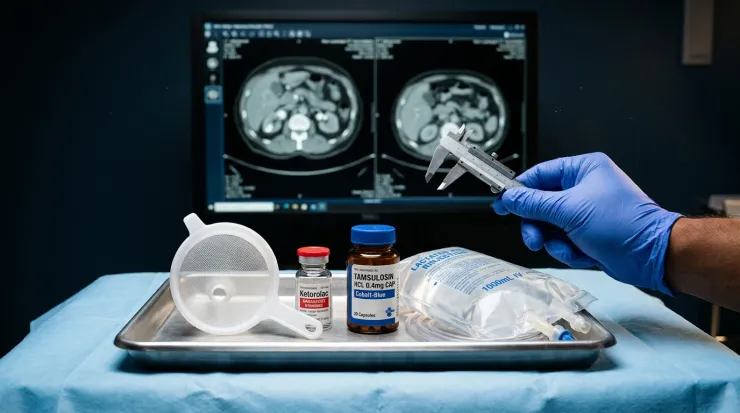
NSAIDs, which directly relax ureteral smooth-muscle spasm and drop pressure inside the kidney) achieved>= 50%pain relief at 30 minutes in 68% of patients vs. 61% with intravenous morphine (P = 0.0187), with one-third as many acute side effects (1% vs. 3%). When clinically appropriate and kidney function allows, physicians often combine an IV anti-inflammatory (ketorolac) with an IV antiemetic (ondansetron) for vomiting and dehydration plus targeted rescue analgesia. - On-Site Lab Testing (
Urinalysis,CBC,Creatinine): Our on-site lab checks your urine for white blood cells and bacteria to catch a hidden infection (UTI & kidney infection), while a metabolic panel checks serum creatinine (kidney filtration) and electrolytes. - Cross-Sectional Imaging: On-site CT or ultrasound confirms stone size and location during the same visit.
- Clear Discharge Plan or Hospital Transfer: Most patients with uncomplicated stones under 8 to 10 mm whose pain and nausea settle after IV treatment go home the same day with a fine-mesh stone strainer and prescriptions to fill at their pharmacy. If imaging or lab work shows an infected obstructing stone or acute kidney failure, we begin IV antibiotics and fluids on site and arrange direct transfer to a hospital with inpatient urology coverage.
Visit Bellaire ER 24/7 for Kidney Stone & Flank Pain
Do not wait at home with severe flank pain or fever. Bellaire ER is open 24 hours a day, 365 days a year at 5302 Bellaire Blvd, Bellaire, TX 77401, serving Bellaire, Meyerland, West University Place, Gulfton, and Southwest Houston. Standard emergency-room billing applies; see our insurance information and when to visit the ER guide for details.
- Get Directions to 5302 Bellaire Blvd
- Call Our Team 24/7: (713) 660-0001
- Optionally Save Your Spot for an In-Person Visit (Online check-in is optional and never replaces triage; call 911 for any life-threatening emergency.)
Frequently asked questions
When does a kidney stone require an emergency room visit?
Go to a 24/7 emergency room right away if flank or lower abdominal pain comes with a fever or chills, persistent vomiting that keeps you from drinking fluids, inability to pass urine, or severe pain that does not ease with home medication. Patients with a single working kidney or diabetes should also be evaluated promptly. Call 911 for fainting or any life-threatening emergency.
What size kidney stone passes on its own?
According to American Urological Association guidelines and pooled clinical trials, ureteral stones 4 mm or smaller pass on their own in roughly 68% to 75% of patients. Stones between 5 mm and 10 mm pass less often without help and may benefit from physician-prescribed medical expulsive therapy, while stones larger than 10 mm usually require urologic intervention.
Why is fever with a kidney stone a medical emergency?
A fever alongside a blocking ureteral stone can mean infected urine is trapped behind the stone under pressure, a condition called obstructive pyelonephritis. Because oral antibiotics cannot clear a blocked collecting system, national inpatient data show mortality doubles from 8.82% to 19.2% when urgent hospital decompression and intravenous antibiotics are delayed.
Does Bellaire ER use CT or ultrasound for suspected kidney stones?
Bellaire ER has both multi-slice helical CT and bedside ultrasound on site at 5302 Bellaire Blvd. An emergency physician examines you first and chooses the appropriate scan based on your symptoms, pregnancy status, prior stone history, and whether another cause of abdominal or flank pain needs to be ruled out.
Clinical references & peer-reviewed sources
- Ultrasonography versus Computed Tomography for Suspected Nephrolithiasis (STONE Trial, N Engl J Med 2014; Smith-Bindman R et al.)
- Surgical decompression is associated with decreased mortality in patients with sepsis and ureteral calculi (J Urol 2013; Borofsky MS et al.)
- Alpha blockers for treatment of ureteric stones: systematic review and meta-analysis (BMJ 2016; Hollingsworth JM et al.)
- Surgical Management of Stones: American Urological Association/Endourological Society Guideline (J Urol 2016; Assimos D et al.)
- Delivering safe and effective analgesia for management of renal colic in the emergency department (Lancet 2016; Pathan SA et al.)
Have Questions About Visiting Bellaire ER?
Call our team at (713) 660-0001 any time with questions about visiting our independent, physician-owned freestanding emergency room at 5302 Bellaire Blvd, open 24/7 with short waits.