
Thrombophlebitis
Thrombophlebitis is inflammation of a vein caused by a blood clot, most often a superficial vein near the skin's surface in the leg. It usually shows up as a firm, red, warm, tender cord you can feel along the vein. If you have thrombophlebitis symptoms in Houston or the Bellaire area, Bellaire ER offers 24/7 walk-in evaluation with on-site ultrasound at 5302 Bellaire Blvd to rule out a dangerous deep clot and start treatment in a single visit.
- Open now, 24/7/365
- Walk in, no appointment
- 5302 Bellaire Blvd, free parking
Unsure if Your Symptoms Require Emergency Care?
Call our clinical triage desk at (713) 660-0001. An on-duty board-certified emergency physician will evaluate your symptoms before you leave home.
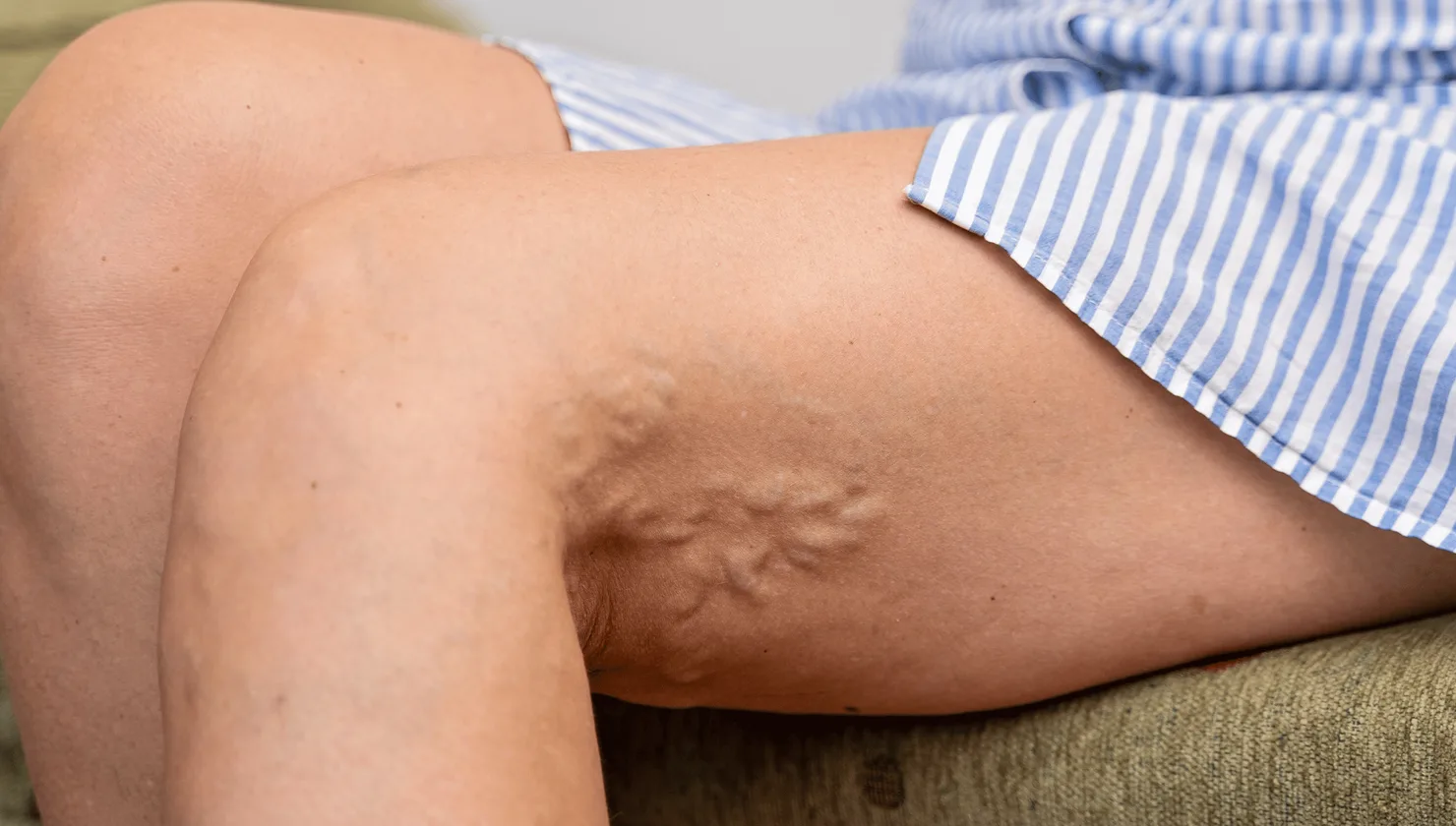
Symptoms
- Firm, cord-like vein: A hardened, rope-like vein you can feel just under the skin, most often in the leg.
- Redness along the vein: The skin over the affected vein looks red or discolored and follows the vein's path.
- Warmth: The area over the inflamed vein feels warm to the touch.
- Pain or tenderness: Aching or tenderness along the vein that often worsens with standing, walking, or pressing on it.
- Localized swelling: Mild swelling in the immediate area around the affected vein rather than the whole limb.
- Itching or skin darkening: The skin over an inflamed surface vein may itch or become darker over time.
When it's an emergency
Emergency care for thrombophlebitis
Call 911 immediately for life-threatening symptoms or if you cannot travel safely. Do not drive yourself or delay for online booking.
For other urgent symptoms, seek prompt emergency evaluation. Bellaire ER accepts walk-ins 24/7. For facility questions, call (713) 660-0001.
Call 911 immediately if you have chest pain, shortness of breath, a fast heartbeat, or you cough up blood. These can be signs that a clot has traveled to the lungs (pulmonary embolism), which is a medical emergency.
Come to Bellaire ER if a whole leg or arm becomes suddenly swollen, painful, warm, or discolored, or if the swelling and pain reach deeper into the calf or thigh. This pattern can signal deep vein thrombosis (DVT), a clot in a deep vein that carries a higher risk of breaking loose.
Seek emergency care if the redness spreads quickly, the area becomes very painful, or you develop fever or chills, which can point to an infected vein.
Don't wait to be seen if you have a history of blood clots, recent surgery, cancer, a long period of immobility, or if you are pregnant or recently gave birth, as these raise your risk of a serious clot.
When it's not an emergency
Small areas of superficial thrombophlebitis are often not emergencies. If you have a short, tender, red streak over a surface vein but no leg-wide swelling and no chest or breathing symptoms, a telemedicine visit or your primary care doctor can guide initial care, which usually includes a warm compress, keeping the leg elevated, and an over-the-counter anti-inflammatory such as ibuprofen if it is safe for you.
Thrombophlebitis that develops at an IV site during a hospital or clinic stay is common and often settles with simple measures once the IV is removed.
That said, symptoms of a superficial clot can overlap with a dangerous deep clot, and only an ultrasound can reliably tell them apart. If you are unsure, if the area is near the groin, or if symptoms are spreading, get evaluated in person rather than waiting.
What else could be causing this
- Superficial vein thrombosis
- The diagnosis itself: a clot and inflammation in a vein just under the skin, usually in the leg. It presents as a firm, tender, rope-like cord you can trace with a finger, with redness following the line of the vein rather than spreading as a patch. Varicose veins are the commonest setting, because blood moves slowly through them.
- Deep vein thrombosis
- A clot in a deep vein, and the diagnosis that matters most to exclude, because it can break loose and travel to the lungs. The pattern is different: the whole limb swells rather than one streak, the aching is deeper and diffuse, and there is usually no palpable cord. The two can also coexist, which is why swelling of the whole leg prompts an ultrasound even when a superficial cord is obvious.
- An extending superficial clot
- A superficial clot that grows along the vein and reaches the junction where the superficial system joins the deep system, at the groin, or behind the knee. At that point it can propagate into the deep veins and becomes a different problem with different treatment. This is why the location of a superficial clot, not just its presence, changes the plan.
- Cellulitis
- A bacterial skin infection, and the closest mimic. The redness is a spreading area with a defined advancing edge rather than a line following a vein, the skin is hot and tender across that whole area, and there is usually fever and feeling unwell. Antibiotics treat it; anti-inflammatory measures alone do not.
- Lymphangitis
- Infection tracking along the lymphatic channels, which produces red streaks running up a limb from a wound, bite or break in the skin, often with tender lymph nodes in the groin or armpit and a fever. The streaks are the giveaway, they lead away from an entry point rather than following the course of a visible vein.
- Septic thrombophlebitis
- An inflamed, clotted vein that is also infected. It is most often seen at the site of an intravenous line, and the features that separate it are fever, chills, pus, rapidly spreading redness and pain that is worsening rather than settling. It needs antibiotics and sometimes drainage, not warm compresses, and it can seed infection into the bloodstream.
- Chemical phlebitis from an intravenous line
- Irritation of a vein from the catheter itself or the medication running through it, which is extremely common in the arm after a hospital or clinic stay. It produces redness, tenderness and a firm vein along the line's course, and it usually settles over days once the catheter is removed. Infiltration, fluid leaking into the surrounding tissue, causes similar swelling and discomfort by a different mechanism.
- Ruptured Baker's cyst or torn calf muscle
- A fluid-filled cyst behind the knee that bursts, or a torn calf muscle, both of which cause sudden calf pain, swelling and sometimes bruising that tracks down to the ankle. There is often a clear moment of onset during activity. Because these also produce a swollen, painful calf, an ultrasound is usually still done to settle the clot question.
- Migratory thrombophlebitis
- Repeated episodes of superficial vein inflammation appearing in different places over time, without an obvious local cause. It is uncommon, and it matters because it is associated with underlying conditions, including some cancers and inflammatory vascular diseases, so a recurring pattern warrants investigation rather than repeated symptomatic treatment.
What happens when you arrive
At Bellaire ER a board-certified emergency physician examines the affected vein and reviews your risk factors for clots. Because the biggest priority is telling a superficial clot apart from a deep vein thrombosis, we use on-site ultrasound to look directly at the veins in your leg.
We can also run blood work on-site, including a D-dimer test when it is helpful, to support the diagnosis.
Most superficial thrombophlebitis is managed without a hospital stay: care may include anti-inflammatory medication, warm compresses, leg elevation, and compression. If the ultrasound shows a deep or extensive clot, your physician will start blood-thinning treatment and coordinate any further care.
Because we diagnose and treat in a single visit, most patients leave with a clear diagnosis, a treatment plan, and follow-up instructions rather than being transferred elsewhere.
Tests we can run on site
- Venous ultrasound (Doppler)
- Sound-wave imaging of the veins, with no radiation, performed at the bedside. It is the test that answers the central question: is this clot in a superficial vein or a deep one, and how far does it extend. Distinguishing the two is not possible by examination alone, and the two diagnoses have different treatments.
- D-dimer blood test
- Measures a fragment released as the body breaks down clot. Its value is mainly in a negative result in someone assessed as lower risk, where it makes a deep clot unlikely. A raised level is not a diagnosis on its own, since infection, injury, surgery, pregnancy and age all raise it.
- Complete blood count and inflammatory markers
- A markedly raised white cell count with inflammatory markers supports infection, cellulitis or an infected vein, rather than inflammation around a clot alone. This is the test pair that distinguishes a red leg that needs antibiotics from one that does not.
- Comprehensive metabolic panel and coagulation studies
- Kidney and liver function and clotting measurements. These are needed before an anticoagulant is started, because they determine which blood thinner is appropriate and at what dose, and they reveal a bleeding risk that would change the plan.
- Blood cultures
- Sent when fever, chills or pus suggest the vein is infected and bacteria may have entered the bloodstream. The result takes days rather than hours, but it guides antibiotic treatment over the course of the illness and is best drawn before antibiotics are given.
- Chest imaging and EKG
- Added when there is any breathlessness, chest pain, racing heart or coughing up blood alongside the leg findings. A chest X-ray and EKG begin the evaluation for a clot that has reached the lungs, and CT confirms it, the question the leg examination cannot answer.
Treated here, or transferred
Bellaire ER is a licensed freestanding emergency room: board-certified emergency physicians and nurse practitioners, on-site ultrasound, CT, X-ray and laboratory, medication administered during your visit, open 24 hours a day, 365 days a year, for adults and children. It is equipped and staffed to evaluate, stabilize and treat emergencies, and it is not a hospital. Thrombophlebitis is a condition where the evaluation carries most of the weight, and where most patients are treated and discharged.
The work here is to tell a superficial clot from a deep one and to treat what is found. On-site ultrasound answers that question directly and shows how far the clot extends, which is the detail that determines treatment. Most superficial thrombophlebitis is managed with anti-inflammatory medication, warm compresses, elevation, compression and continued walking rather than rest, and the medication is written as a prescription for you to fill at your own pharmacy. If the clot is extensive or sits close to the junction with the deep veins, a course of anticoagulation is often used instead, and that can be started here with the follow-up arranged. If the ultrasound shows a deep vein thrombosis in a stable patient, anticoagulation is started here too. If the leg is infected rather than clotted, antibiotics are started.
Some situations need a hospital, and a freestanding emergency room has no inpatient beds and no intensive care unit. An infected, suppurating vein that needs intravenous antibiotics or surgical drainage, a clot that has reached the lungs and is causing low blood pressure or a significant oxygen requirement, a very extensive deep clot threatening the limb, a patient who cannot take anticoagulation or is actively bleeding, and a clot in pregnancy all need inpatient management. In those cases the ultrasound, the laboratory work, the first antibiotics or the first dose of anticoagulation happen here, and care continues without interruption during transfer to a hospital with the service required.
The reason to be evaluated rather than to manage a red, tender vein at home is simply that the two diagnoses look the same from the outside and carry different risks. A small area of superficial thrombophlebitis genuinely is usually a minor problem, but establishing that is an ultrasound, not an assumption.
Children
Bellaire ER treats adults and children. Thrombophlebitis in a child is uncommon, and almost always has an identifiable cause rather than arising on its own, which changes both the evaluation and what happens afterward.
By far the most common setting is an intravenous line. A child who has had a catheter or a long line in an arm or leg can develop a tender, red, firm vein along its course, which usually settles over days once the line is removed, with warm compresses and simple pain relief. The feature that changes this from a nuisance to an emergency is infection: fever, chills, spreading redness, pus, or a child who is systemically unwell suggests an infected vein, which needs antibiotics and urgent assessment rather than observation at home. In a child with a central line, this is taken particularly seriously.
Outside that setting, a clot in a child's vein prompts a search for a reason. Significant trauma or recent surgery, serious infection, cancer and its treatment, immobility from a cast or prolonged illness, nephrotic syndrome, congenital heart disease, an inherited clotting disorder, and in adolescent girls estrogen-containing contraception are the usual contributors. A confirmed clot in a child involves pediatric hematology, because the choice of anticoagulant, the dose, the duration and the underlying investigation belong with that specialist rather than being settled in an emergency room.
Ultrasound is the imaging used, and it is particularly suited to children because it involves no radiation and no sedation. Bring a child in for a red, hot, tender limb with fever; for swelling of a whole arm or leg rather than one streak; or for redness spreading from an intravenous site. Call 911 for breathlessness, chest pain or a racing heart alongside limb symptoms. A red streak running up a limb from a cut or bite, with a fever, is more likely an infection tracking along the lymphatics than a clot, and it needs antibiotics promptly either way.
After you leave
Superficial thrombophlebitis settles over weeks rather than days, and the sequence is worth knowing so that normal progress is not mistaken for failure. The pain and redness usually ease within one to two weeks. The firm cord along the vein takes considerably longer to soften, often several weeks to a few months, and a palpable lump or a patch of darker skin can persist after everything else has resolved. That lingering cord is not an untreated clot; it is the vein healing.
Keep walking. Resting the leg is the instinct and it is the wrong one: movement keeps blood flowing through the deep veins and lowers the risk of a deep clot. Elevate the leg when you are sitting, use warm compresses over the tender area for comfort, and wear compression stockings if they were recommended. They help the aching more than most people expect. Take the anti-inflammatory medication you were given as directed with food, and if you were started on an anticoagulant, take it exactly as prescribed and do not stop early because the leg feels better.
Call 911 for breathlessness, chest pain, a racing heart, fainting or coughing up blood. These can mean a clot has reached the lungs, and they outrank everything else on this page. Come back if the redness or tenderness spreads along the vein toward the groin or behind the knee, if the whole leg becomes swollen or the calf becomes painful and tight, if you develop a fever, chills or pus, or if the area becomes markedly more painful rather than less. New swelling in the other leg is also a reason to be seen. If you are on a blood thinner, return for bleeding that will not stop, black or bloody stool, blood in the urine, unusual bruising, or any head injury.
See your primary care physician if episodes keep recurring, and say so plainly when you do. Repeated superficial vein inflammation in different places, or an episode with no varicose veins and no obvious trigger, is worth investigating rather than treating symptomatically each time. If you have significant varicose veins, a vascular referral addresses the underlying reason this happened.
What this visit costs
We accept most major insurance and bill your insurer directly. For emergency care, federal law caps what you pay at in-network rates and bars surprise bills, your deductible and copay still apply. Never delay emergency care over cost.
See how ER billing worksInsurance and coverage questionsRead the facility notice
Questions about a specific plan? Call (713) 660-0001. Only your plan can tell you how a claim will be processed.
Lowering your risk
You can lower your risk of thrombophlebitis by staying active and avoiding long stretches of sitting or standing. On long flights or car trips, stand up, walk, and flex your calves every hour or two.
Staying well hydrated, not smoking, and maintaining a healthy weight all support healthy circulation.
If you have varicose veins or a personal or family history of blood clots, ask your doctor about compression stockings and any extra precautions around surgery, pregnancy, or long periods of bed rest.
Common questions
When should I go to the ER for thrombophlebitis?
Go to the ER right away if a whole leg or arm becomes suddenly swollen, painful, warm, or discolored, if redness is spreading quickly, or if you have fever and chills. Call 911 for chest pain, shortness of breath, a racing heart, or coughing up blood, which can mean a clot has reached the lungs. A small, tender surface vein without these features is usually less urgent, but only an ultrasound can rule out a deep clot.
What is the difference between thrombophlebitis and deep vein thrombosis?
Thrombophlebitis usually refers to a clot and inflammation in a superficial vein close to the skin, which you can often see and feel as a firm, red, tender cord. Deep vein thrombosis (DVT) is a clot in a deeper vein, which tends to cause swelling and pain across the whole limb and carries a higher risk of traveling to the lungs. The symptoms can overlap, so Bellaire ER uses on-site ultrasound to tell them apart.
Where can I get thrombophlebitis treatment near me in Houston?
Bellaire ER is a 24/7 freestanding emergency room at 5302 Bellaire Blvd in Bellaire, TX, serving the Houston area with no appointment needed. We offer on-site ultrasound, lab testing, and board-certified emergency physicians who can evaluate vein pain and swelling and start treatment in a single visit. You can walk in any time or call (713) 660-0001.
How is thrombophlebitis treated?
Superficial thrombophlebitis is often treated with warm compresses, leg elevation, anti-inflammatory medication such as ibuprofen when appropriate, and sometimes compression stockings. If imaging shows a deep or extensive clot, treatment may include blood-thinning medication. Your physician will tailor the plan to your specific findings and risk factors.
Why prompt attention matters
Thrombophlebitis can lead to deep vein thrombosis and pulmonary embolism, both potentially life-threatening. Early intervention treats the clot, reduces inflammation, and lowers the risk of recurrence.
Get care at Bellaire ER
Walk in any time at 5302 Bellaire Blvd, Bellaire, TX 77401 (get directions) or call 713-660-0001. No appointment is required to be seen, though you can save your spot online if you prefer.
Sources & further reading
Medical information on this page is consistent with guidance from these trusted organizations:
People also ask
When should I go to the ER for thrombophlebitis?
Go to the ER for thrombophlebitis when a whole limb swells, redness spreads with fever, the vein is near the groin, or you have any chest or breathing symptoms. A small, tender surface vein with none of those features can often start with telemedicine or your primary care doctor.
Read full answer →