
Asthma Attacks
Seek emergency evaluation for an asthma attack when your rescue inhaler is not helping, you cannot speak in full sentences, your lips or fingernails look blue or gray, or you are working hard to breathe. Bellaire ER offers 24/7 emergency asthma treatment near you in Houston, with on-site oxygen, nebulizer breathing treatments, and chest X-ray to rule out other causes. If breathing is severe, or you cannot talk, walk, or stay awake, call 911 immediately rather than driving yourself.
- Open now, 24/7/365
- Walk in, no appointment
- 5302 Bellaire Blvd, free parking
Unsure if Your Symptoms Require Emergency Care?
Call our clinical triage desk at (713) 660-0001. An on-duty board-certified emergency physician will evaluate your symptoms before you leave home.
Symptoms
- Shortness of breath: A feeling of not getting enough air, often worse at night, early morning, or with activity.
- Wheezing: A high-pitched whistling sound, usually most noticeable when breathing out.
- Chest tightness: A squeezing or heavy sensation that makes each breath feel like work.
- Persistent cough: A nagging cough, often at night or early morning, that may or may not bring up mucus.
- Difficulty speaking: Needing to pause for breath partway through a sentence.
- Rapid breathing: A fast breathing rate as the body tries to take in more oxygen.
- Retractions: Skin pulling in between the ribs or at the base of the neck with each breath, a sign of respiratory distress.
- Bluish lips or fingernails: A serious sign of low oxygen that needs emergency care now.
When it's an emergency
Emergency care for asthma attacks
Call 911 immediately for life-threatening symptoms or if you cannot travel safely. Do not drive yourself or delay for online booking.
For other urgent symptoms, seek prompt emergency evaluation. Bellaire ER accepts walk-ins 24/7. For facility questions, call (713) 660-0001.
A severe asthma attack is a medical emergency. Call 911 immediately if your lips or fingernails look blue or gray, you cannot speak more than a few words without gasping, you are breathing very fast, or you feel drowsy or confused. These are signs of dangerously low oxygen.
Watch closely when your rescue inhaler is not enough. Quick-relief inhalers such as albuterol should ease symptoms within minutes. If your inhaler does not help, its effect wears off within an hour or two, or you find yourself needing it again and again, your airways are not responding and you need emergency evaluation. Come straight to Bellaire ER, where oxygen and breathing treatments start immediately, 24/7.
Other red flags include skin pulling in between the ribs or at the neck (retractions), a peak flow reading well below your personal best, or a chest that suddenly goes quiet because too little air is moving. Any of these, or symptoms that keep worsening despite your usual medicines, means it is time for the ER.
If you are severely short of breath, do not drive yourself. Call 911 so paramedics can begin treatment on the way.
When it's not an emergency
Many mild asthma flare-ups can be managed at home if your rescue inhaler works quickly and your symptoms fully settle. If you can speak in full sentences, your breathing returns to normal after treatment, and your peak flow stays near your personal best, you are usually safe to continue your asthma action plan and follow up with your regular doctor.
For mild or lingering symptoms, a refill question, or help adjusting a controller medication, telemedicine or your primary care physician is a reasonable choice. Bellaire ER also offers telemedicine for these lower-acuity concerns. When symptoms are severe or you are unsure, choose the ER.
What else could be causing this
- An asthma attack with an identifiable trigger
- The diagnosis itself. Airways narrow and fill with mucus in response to a trigger: a respiratory virus, smoke, cold air, pollen, dust, pet dander, exercise, strong fumes or aspirin-type medication in susceptible people. Wheezing is heard mainly on breathing out, and the rescue inhaler helps. A virus is the most common trigger of all, which is why attacks cluster with colds.
- Running out of controller medication
- Not a different diagnosis but the commonest reason a stable asthmatic ends up in an emergency room. Stopping a daily preventer inhaler, or using a rescue inhaler several times a week for months, lets airway inflammation build quietly until a small trigger produces a large attack. It is worth saying out loud at the visit, because it changes the discharge plan more than anything else.
- Pneumonia and other chest infections
- An infection of the lung tissue itself, rather than just the airways. Fever, a productive cough, one-sided chest pain that is worse on deep breaths, and breathlessness that does not improve with a rescue inhaler. It can be the trigger for an attack and a separate problem on top of it at the same time, and a chest X-ray is what separates the two.
- COPD exacerbation
- Chronic obstructive pulmonary disease, usually in a current or former smoker over about 40, with a long history of breathlessness and cough rather than discrete attacks. It wheezes like asthma and partly responds to the same treatments, but the baseline and the longer-term management are different.
- Anaphylaxis
- A severe allergic reaction, which causes wheeze and airway narrowing along with hives, swelling of the lips, tongue or throat, vomiting, or faintness, usually within minutes to an hour of a food, sting, medication or latex exposure. Wheeze with any of those other features is treated as anaphylaxis rather than asthma, because the treatment is different and time-critical.
- Heart failure
- Fluid backing up into the lungs produces breathlessness and wheeze, sometimes called cardiac asthma. That is typically worse lying flat and better sitting up, often with leg swelling and waking at night short of breath. It is more likely in older adults and in anyone with known heart disease, and a chest X-ray and blood work point the way.
- Pulmonary embolism
- A blood clot in the lung. Breathlessness is sudden, the heart races, and there may be sharp chest pain that is worse on breathing in. It usually does not wheeze and does not respond to inhalers. Risk rises after surgery, long immobility, pregnancy, cancer, estrogen-containing medication or a previous clot.
- Vocal cord dysfunction
- The vocal cords closing inappropriately during breathing, producing noisy breathing that is loudest on breathing in rather than out, often with throat tightness and a sense of not being able to get air in. It does not respond to asthma treatment and is frequently mistaken for difficult asthma for years. It can also coexist with genuine asthma.
- Inhaled foreign body
- Something inhaled into an airway, which produces sudden coughing and then wheeze that is often one-sided. It is most common in toddlers and in adults who choked while eating, and it does not improve with inhalers. Wheeze that is confined to one side of the chest is the finding that raises it.
What happens when you arrive
When you arrive at Bellaire ER with an asthma attack, a board-certified emergency physician checks your oxygen level. Treatment often starts right away with oxygen and nebulizer or inhaler breathing treatments to open your airways, and may include steroids to reduce airway inflammation.
We have on-site X-ray, CT, ultrasound, and a full lab to rule out other causes of shortness of breath, such as pneumonia or a lung problem, and to confirm you are responding to treatment. We diagnose and treat in a single visit, and most patients do not need a hospital transfer.
Before you leave, your physician explains your results, adjusts your medications if needed, and gives you a clear follow-up and asthma action plan.
Tests we can run on site
- Pulse oximetry and continuous monitoring
- Measures the oxygen saturation in your blood through a clip on a finger, alongside continuous monitoring of your heart rate and rhythm. It is how the response to treatment is tracked minute by minute, so a deterioration is caught while you are being treated rather than afterward.
- Physical examination of the chest
- Not a machine, but the test that drives the early decisions. How much air is moving, whether the wheeze is on both sides, whether you can complete a sentence, and whether accessory muscles are being used. A chest that has gone quiet in a severe attack is a serious finding, not an improving one, because too little air is moving to make a sound.
- Chest X-ray
- Looks at the lung tissue rather than the airways. It identifies pneumonia, fluid around the lung, a collapsed lung and the enlarged heart of heart failure, the conditions that either triggered the attack or are masquerading as one. It is not needed for every attack, and it is used when the picture does not fit.
- Complete blood count and metabolic panel
- A raised white cell count supports infection, and the metabolic panel shows electrolytes and kidney function. Potassium is specifically worth watching, because repeated nebulized treatments lower it, and that is relevant before more treatment is given.
- CT scan
- Cross-sectional imaging, used when a blood clot in the lung is a genuine possibility or when the chest X-ray raises a question it cannot answer. It is not part of a routine asthma evaluation; it is there for when the diagnosis is in doubt.
- Ultrasound
- Bedside sound-wave imaging with no radiation, used to look at the heart and the lung surfaces. It helps distinguish fluid in the lungs from airway disease and can identify a collapsed lung, which is useful when a wheezing patient is not responding as expected.
Treated here, or transferred
Bellaire ER is a licensed freestanding emergency room: board-certified emergency physicians and nurse practitioners, on-site CT, X-ray, ultrasound and laboratory, medication administered during your visit, open 24 hours a day, 365 days a year, for adults and children. It is equipped and staffed to evaluate, stabilize and treat emergencies, and it is not a hospital. Most asthma attacks are treated start to finish in a setting exactly like this one.
Treatment begins before the diagnosis is complete, which is appropriate in a breathing emergency. Oxygen is given if the saturation is low. Inhaled bronchodilators, usually given by nebulizer and often repeated, relax the muscle around the airways; ipratropium is commonly added in a more severe attack. Corticosteroids are given to reduce the airway inflammation underneath the spasm. They take hours to work, which is precisely why they are given early rather than at discharge. Magnesium sulfate given intravenously is used in severe attacks.
On-site chest X-ray and laboratory testing identify a pneumonia or another problem driving the attack, and antibiotics are given when there is evidence of bacterial infection rather than on suspicion alone. The inhaler and the steroid course you need are written as a prescription for you to fill at your own pharmacy, and filling it without delay is the part that matters, the steroid course is what settles the inflammation underneath the attack, and it only works if you actually start it.
Some attacks need a hospital. An attack that does not respond adequately to repeated treatment, one where carbon dioxide is building up, exhaustion from the work of breathing, drowsiness, or any patient approaching the need for breathing support requires intensive care, and a freestanding emergency room has no intensive care unit and no inpatient beds. The same applies when a severe pneumonia alongside the attack means admission. In those cases the full treatment runs here first, continuously, and continues without interruption during transfer to a hospital with critical care. For a condition that can deteriorate within an hour, starting treatment at the nearest emergency room and transferring if needed is the sequence that favours the patient; transfer is the design working, not the visit failing.
Before you leave, your physician should go through the written asthma action plan, the steroid course, inhaler technique and the follow-up with the clinician who manages your asthma. The attack is the event; the controller plan is what prevents the next one.
Children
Bellaire ER treats adults and children. Children in respiratory distress compensate well and then tire suddenly, so the signs are read differently and the threshold for being seen is lower than in an adult.
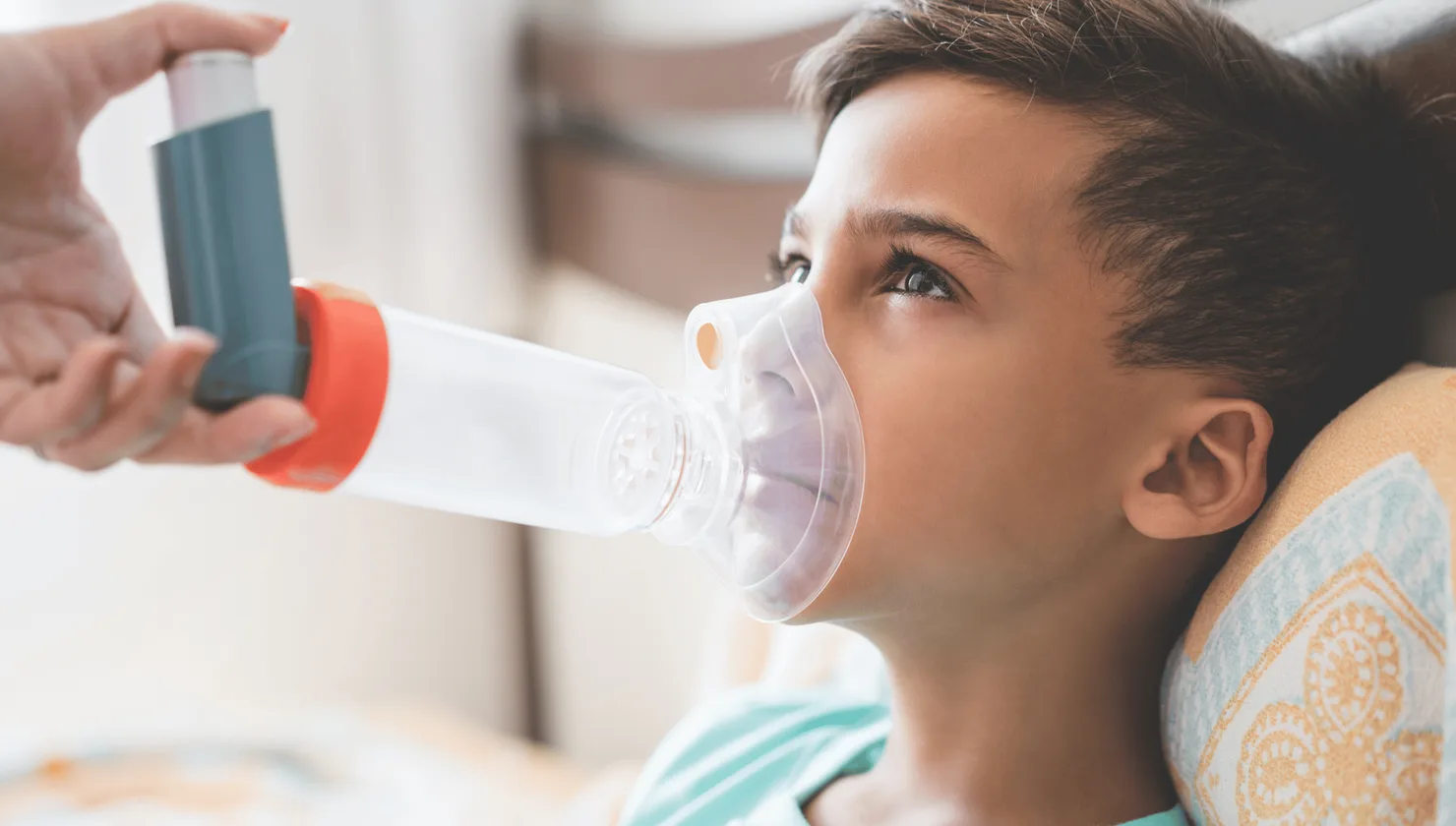
Watch for the work of breathing rather than the noise. Skin pulling in between the ribs, below the ribs or at the base of the neck, nostrils flaring, head bobbing in an infant, a child sitting forward and refusing to lie down, or grunting with each breath all indicate significant distress. A child who cannot speak in full sentences, cannot feed, or is too breathless to play needs emergency evaluation. Drowsiness, floppiness or a child who stops fighting the oxygen mask is a late and serious sign, not a calm one. Call 911 immediately for blue or grey lips, tongue or fingernails.
Not every wheezing child has asthma. In infants under about two, bronchiolitis from a respiratory virus is the usual cause of a first wheeze; a barking cough with noisy breathing on breathing in suggests croup, which is a different problem in a different part of the airway; and a sudden wheeze confined to one side in a well toddler raises an inhaled object. Wheeze with hives, facial or lip swelling or vomiting after a food or a sting is treated as anaphylaxis.
For a child with known asthma, the same principles apply as in an adult: inhaled bronchodilators, often repeated, with corticosteroids where indicated, and ultrasound or X-ray on site when the picture suggests pneumonia or another cause. A child who needed emergency treatment should be reviewed by their pediatrician or asthma clinician within a week or two, with inhaler and spacer technique checked in person, in children, technique and adherence account for more poor control than the severity of the disease does.
After you leave
An attack treated in an emergency room is not over when the wheeze stops. Airway inflammation settles over days, not hours, which is why a course of oral steroids is prescribed and why it matters that you finish it even once you feel well. Stopping on day two because breathing feels normal is the most common reason people are back within a week.
Use your rescue inhaler as directed for the next several days and keep track of how often you actually need it, that number is the most useful thing you can bring to your follow-up appointment. Restart or continue your daily controller inhaler, and check your technique, including the spacer if you use one, because poor technique delivers a fraction of the dose. If you monitor peak flow, record it twice a day and compare it with your personal best rather than a number on a chart. Stay away from the trigger that set this off where you can, and if the trigger was a cold, expect your airways to be twitchy for a couple of weeks.
Call 911 immediately if you cannot speak in full sentences. Seek prompt emergency evaluation if your rescue inhaler stops relieving symptoms or its effect wears off within an hour or two, if you are using your neck or chest muscles to breathe, or if your peak flow drops well below your personal best. Call 911 immediately for blue or grey lips or fingernails, drowsiness, confusion, or breathlessness that frightens you, in a severe attack it is not safe to be behind the wheel, and treatment can start in the ambulance.
Make the follow-up appointment with your primary care physician, pulmonologist or allergist within a week or two, even if you feel completely well. An attack that needed emergency treatment is evidence that the preventive plan needs revisiting, and that review is the single thing most likely to keep you out of an emergency room next time.
What this visit costs
We accept most major insurance and bill your insurer directly. For emergency care, federal law caps what you pay at in-network rates and bars surprise bills, your deductible and copay still apply. Never delay emergency care over cost.
See how ER billing worksInsurance and coverage questionsRead the facility notice
Questions about a specific plan? Call (713) 660-0001. Only your plan can tell you how a claim will be processed.
Lowering your risk
You can lower the chance of an asthma attack by identifying and avoiding your triggers, such as smoke, dust, pet dander, pollen, cold air, and respiratory infections. Taking a daily controller (preventer) inhaler exactly as prescribed keeps airway inflammation down between flare-ups.
Keep a written asthma action plan, carry your rescue inhaler, and check your peak flow if your doctor recommends it. Staying up to date on flu and pneumonia vaccines helps prevent infections that commonly set off attacks.
Common questions
When should I go to the ER for an asthma attack?
Call 911 immediately for severe breathing difficulty, blue lips, inability to speak or difficulty staying awake. For other urgent symptoms, seek emergency evaluation. Emergency evaluation is needed when your rescue inhaler does not relieve symptoms or wears off quickly, you cannot speak in full sentences, you have retractions (skin pulling in around the ribs or neck), or your lips or fingernails turn blue or gray. Call 911 immediately for severe breathing trouble, drowsiness, or confusion, which signal dangerously low oxygen.
What do I do when my rescue inhaler is not working?
Call 911 immediately for severe breathing difficulty, blue lips, inability to speak or difficulty staying awake. For other urgent symptoms, seek emergency evaluation. If your quick-relief inhaler does not help within minutes, or its effect keeps wearing off, seek emergency care. Keep using it as directed on the way, sit upright, and stay as calm as you can. If breathing is severe or you cannot talk, walk, or stay awake, call 911 immediately rather than driving yourself.
How does Bellaire ER treat an asthma attack?
A board-certified emergency physician checks your oxygen and usually starts oxygen and nebulizer breathing treatments right away, often with steroids to calm airway inflammation. On-site X-ray and lab testing help rule out pneumonia or other causes and confirm you are improving, all in a single visit with most patients avoiding a hospital transfer.
Can telemedicine or urgent care handle asthma instead of the ER?
Mild symptoms that respond to your rescue inhaler, a refill, or a controller adjustment suit Bellaire ER's virtual urgent care or your own doctor. An attack that is not responding is a different problem: severe breathlessness, not being able to speak in full sentences, or a rescue inhaler that has stopped working needs oxygen, nebulized treatment, steroids and monitoring, and sometimes a chest X-ray to check for pneumonia or a collapsed lung. Bellaire ER has all of that on site 24/7, for children and adults, with no appointment. Come in now if breathing is severely compromised.
Why prompt attention matters
An asthma attack that does not respond to a rescue inhaler, or that makes speaking in full sentences difficult, needs emergency evaluation rather than watchful waiting.
Get care at Bellaire ER
Walk in any time at 5302 Bellaire Blvd, Bellaire, TX 77401 (get directions) or call 713-660-0001. No appointment is required to be seen, though you can save your spot online if you prefer.
Sources & further reading
Medical information on this page is consistent with guidance from these trusted organizations:
People also ask
When should I go to the ER for asthma attacks?
Go to the ER for an asthma attack when your rescue inhaler is not working or keeps wearing off, you cannot speak in full sentences, or you have retractions. Call 911 for blue lips, severe breathlessness, or confusion. Mild flares that respond to your inhaler can be managed at home or by telemedicine.
Read full answer →