
Severe Asthma Attack Emergency Care: Nebulizer Protocols, Oxygen Thresholds & When to Go to the ER
Bellaire ER is a freestanding emergency room at 5302 Bellaire Blvd, open 24/7/365. Walk in or call ((713) 660-0001) anytime.
- Open now, 24/7/365
- Walk in, no appointment needed
- 5302 Bellaire Blvd, free parking
Clinical Triage Answer: A severe asthma attack (acute asthma exacerbation, ICD-10 J45.901, or status asthmaticus, ICD-10 J45.902) occurs when bronchial smooth muscle spasms and inflamed airway walls trap air inside the lungs. Call 911 or seek emergency care immediately if a rescue inhaler fails to ease symptoms within 15 to 20 minutes, if you cannot speak a full sentence without gasping, if blood oxygen (SpO2) falls below 92%, or if wheezing suddenly goes quiet while breathing stays labored (silent chest).
At Bellaire ER (5302 Bellaire Blvd, Bellaire, TX 77401), board-certified emergency physicians treat adult and pediatric asthma attacks 24 hours a day with nebulized dual bronchodilators, early systemic corticosteroids, intravenous magnesium, supplemental oxygen, and on-site digital chest X-ray.
Why Home Rescue Inhalers Stop Working in a Severe Flare
During a mild asthma flare, two puffs of a short-acting beta-agonist (albuterol) relax the outer ring of smooth muscle around the bronchial tubes within minutes. A severe exacerbation involves a second mechanism that a pocket inhaler cannot reverse on its own: mucosal edema and mucus plugging.
Inflammatory cells flood the airway lining, swelling the bronchial walls inward while thick mucus plugs the narrow bronchioles. When airways narrow past a critical point, forceful inhalation and exhalation collapse the small airways early, trapping stale air (dynamic hyperinflation) and forcing the diaphragm to work against mounting internal pressure. Read our full guide on difficulty breathing and shortness of breath for how emergency physicians evaluate acute respiratory distress.
Mild Flare vs. Severe & Life-Threatening Asthma (GINA Criteria)
Emergency physicians classify asthma severity at the bedside using objective physiological thresholds established by the Global Initiative for Asthma (GINA) Strategy Report authored by Dr. Helen Reddel and colleagues (PMID: 34658302) and the National Asthma Education and Prevention Program (NAEPP) Expert Panel (PMID: 33280709):
| Clinical Feature | Mild-to-Moderate Asthma Flare | Severe Asthma Exacerbation (ICD-10 J45.901) |
Life-Threatening Asthma (Status Asthmaticus, ICD-10 J45.902) |
|---|---|---|---|
| Speech Pattern | Speaks in full sentences | Speaks only in short phrases or single words | Too breathless to speak |
| Body Position | Able to lie down | Prefers sitting upright, leaning forward on hands (tripod posture) |
Exhausted, slumped, or agitated |
| Breathing Rate (Adults) | Increased (20 to 29 breaths/min) |
More than 30 breaths per minute | Slowing or gasping breaths from muscle fatigue |
| Heart Rate (Adults) | 100 to 120 bpm |
More than 120 beats per minute | Bradycardia (slowing heart rate) or arrhythmia |
Pulse Oximetry (SpO2) |
92% to 95% on room air |
Below 90% to 92% on room air | Persistent hypoxemia (< 90%) or cyanosis (blue lips) |
Peak Expiratory Flow (PEF) |
> 50% of personal best |
<= 50% of predicted or personal best |
Unable to perform peak flow |
| Lung Sounds | Moderate wheezing, mostly on exhalation | Loud wheezing throughout inhalation and exhalation | “Silent chest” (too little airflow to make a wheeze) |
Pediatric Warning Signs: Children cannot always describe chest tightness. Bring a child in immediately for intercostal or suprasternal retractions (skin sucking in between the ribs or at the base of the neck), nasal flaring, head bobbing, grunting, or refusal to drink or talk. Compare when to go to the ER for asthma attacks and pediatric emergency care for age-specific guidance.
Evidence-Based Emergency Asthma Treatment at Bellaire ER
When you walk into Bellaire ER, you go straight into a private exam room rather than waiting in a hospital lobby. After a physician evaluates your airway, oxygen level, and lung sounds, treatment follows proven emergency medicine protocols:
1. Combined Nebulized Albuterol + Ipratropium Bromide
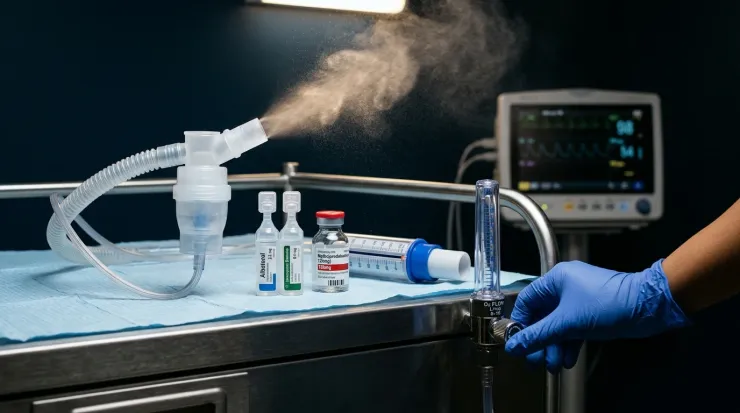
Instead of using albuterol alone, emergency physicians pair a beta-agonist (albuterol) with an inhaled anticholinergic (ipratropium bromide) delivered through an oxygen-driven nebulizer. In a Cochrane systematic review of 23 randomized trials (2,724 adult ED patients) by Dr. Scott Kirkland and colleagues (PMID: 28076656), adding ipratropium to beta-agonist nebulizers reduced hospital admissions by 28% (RR 0.72), boosted peak expiratory flow by +36.6 L/min, and lowered return ED relapses (RR 0.80). A companion meta-analysis of 32 trials (3,611 children and adults) in Thorax by Dr. Gustavo Rodrigo and Dr. Jose Castro-Rodriguez (PMID: 16055613) confirmed a 27% reduction in pediatric hospital admissions (RR 0.73, P = 0.0001).
2. First-Hour Systemic Corticosteroids
Because steroids take 4 to 6 hours to calm airway wall inflammation at the cellular level, timing in the ER matters. In a landmark Cochrane review of 12 randomized trials (863 ED patients) by Dr. Brian Rowe and colleagues (PMID: 11279756), administering systemic corticosteroids (oral prednisone, dexamethasone, or intravenous methylprednisolone) within 1 hour of emergency department arrival cut hospital admission rates by 60% (OR 0.40, NNT = 8), and by 65% (OR 0.35) in severe asthma attacks.
3. Intravenous Magnesium Sulfate for Refractory Bronchospasm
When a severe attack does not open up after initial nebulizers and steroids, emergency physicians can infuse intravenous magnesium sulfate (1.2 g to 2 g over 20 minutes), which blocks calcium channels in bronchial smooth muscle to relax constricted airways. In a Cochrane meta-analysis of 14 randomized trials (2,313 adult ED patients) by Dr. Kayleigh Kew and colleagues (PMID: 24865567), IV magnesium sulfate reduced hospital admissions by 25% (OR 0.75) and improved lung function in patients failing first-line therapy.
4. On-Site Chest X-Ray & Viral Trigger Testing
Respiratory viruses (including influenza, RSV and colds, and acute bronchitis) trigger the majority of emergency asthma flares. When fever, focal crackles, sharp chest pain, or persistent low oxygen are present, our on-site digital X-ray checks for complicating pneumonia or a collapsed lung (pneumothorax) that can mimic or worsen an asthma attack.
Safe Discharge vs. Hospital Transfer
Most patients improve steadily over 1 to 3 hours of nebulizer treatments, oxygen, and steroids. Before sending you home, your physician rechecks your lungs, oxygen saturation on room air, and walking comfort, and provides prescriptions and clear return instructions so a late-phase relapse does not catch you off guard.
If a patient has persistent hypoxia, tiring respiratory muscles, or severe status asthmaticus requiring continuous respiratory support or inpatient ICU admission, our team stabilizes the airway on site and arranges emergency ambulance transfer directly to a receiving hospital.
Get 24/7 Emergency Asthma & Breathing Care in Bellaire
For severe breathing trouble, call 911 immediately. When safe transport is appropriate, walk into Bellaire ER 24/7 at 5302 Bellaire Blvd, Bellaire, TX 77401, or visit our dedicated breathing and asthma emergency landing page. No appointment is required, and emergency-room billing applies (insurance details).
- Get Directions to 5302 Bellaire Blvd
- Call Bellaire ER 24/7: (713) 660-0001
- Optionally Save Your Spot Online (Optional check-in never delays triage; for mild medication refill questions when breathing is completely normal, see telemedicine.)
Frequently asked questions
When should I go to the emergency room for an asthma attack?
Go to the nearest emergency room or call 911 immediately if your rescue inhaler does not bring relief within 15 to 20 minutes, if you can only speak in single words or short phrases, if your pulse oximeter reading drops below 92%, if your ribs or neck skin pull inward with each breath, or if you feel drowsy, dizzy, or exhausted from breathing.
What is a silent chest during an asthma attack?
A silent chest happens when bronchial airways narrow so severely that too little air moves in and out to produce a wheezing sound. Disappearing wheezes in a patient who is still struggling to breathe is a life-threatening emergency that requires calling 911 immediately.
Why do emergency doctors give steroids within the first hour of an asthma attack?
Rescue inhalers relax tight airway muscles, but they do not stop the deep swelling and mucus buildup inside the bronchial walls. A Cochrane review of 12 randomized emergency department trials showed that systemic corticosteroids given within 1 hour of arrival reduce hospital admissions by 60% (OR 0.40).
Can Bellaire ER treat pediatric and adult asthma attacks 24/7?
Yes. Bellaire ER at 5302 Bellaire Blvd is open 24/7 with board-certified emergency physicians, continuous oxygen and pulse oximetry monitoring, nebulized bronchodilators, systemic corticosteroids, intravenous magnesium, and on-site chest X-ray for both children and adults.
Clinical references & peer-reviewed sources
- Early emergency department treatment of acute asthma with systemic corticosteroids (Cochrane Database Syst Rev 2001; Rowe BH et al.)
- Combined inhaled beta-agonist and anticholinergic agents for emergency management in adults with asthma (Cochrane Database Syst Rev 2017; Kirkland SW et al.)
- Anticholinergics in the treatment of children and adults with acute asthma: a systematic review with meta-analysis (Thorax 2005; Rodrigo GJ, Castro-Rodriguez JA)
- Intravenous magnesium sulfate for treating adults with acute asthma in the emergency department (Cochrane Database Syst Rev 2014; Kew KM et al.)
- Global Initiative for Asthma Strategy 2021: Executive Summary and Rationale for Key Changes (Am J Respir Crit Care Med 2022; Reddel HK et al.)
Have Questions About Visiting Bellaire ER?
Call our team at (713) 660-0001 any time with questions about visiting our independent, physician-owned freestanding emergency room at 5302 Bellaire Blvd, open 24/7 with short waits.